Skip to content

American Fisheries Society Family of Websites:

Fisheries.org

American Fisheries Society
Family of Websites

Journals

Read our five journals and Fisheries magazine

Gray Literature Database

Find thousands of unpublished agency reports and other information

Annual Meeting

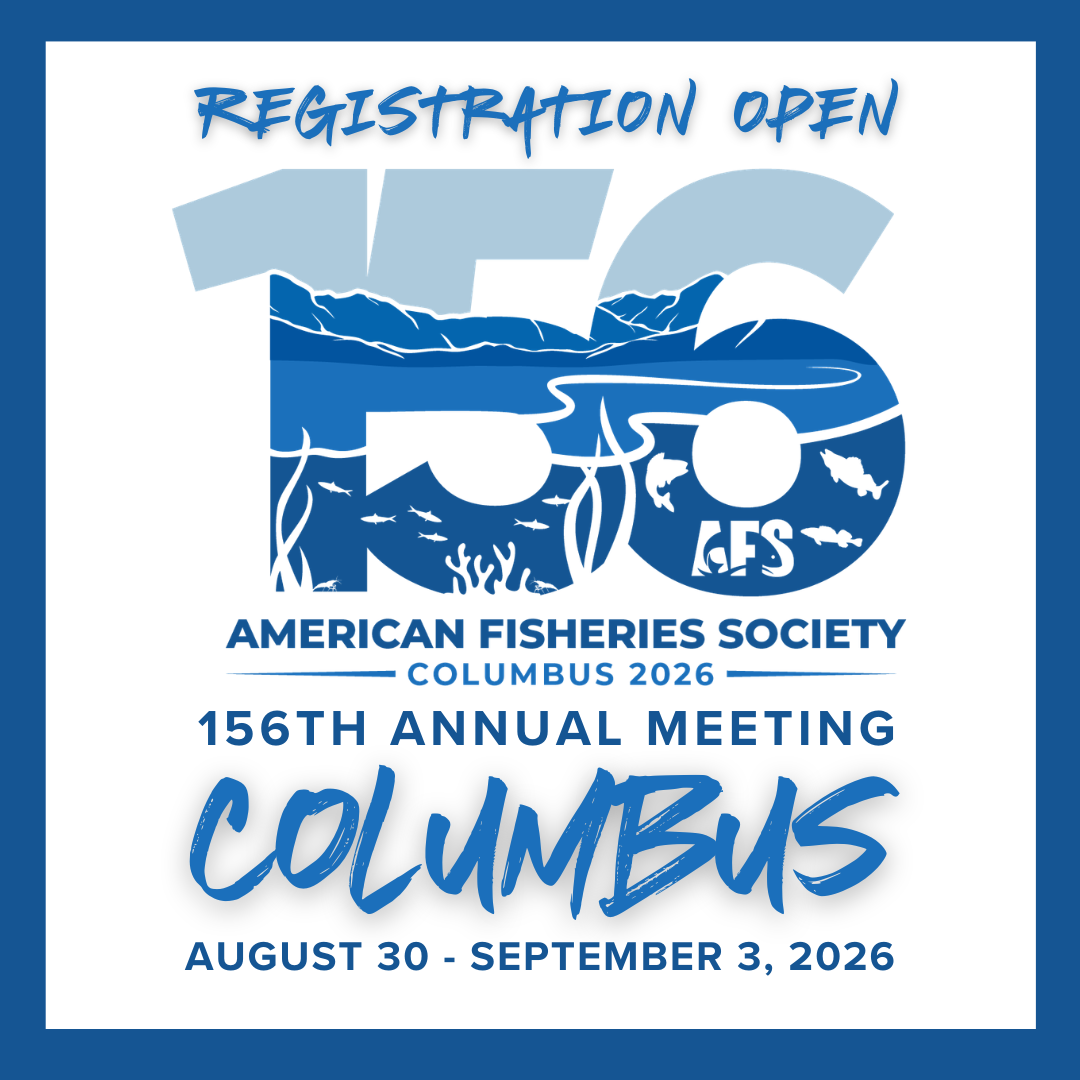
Join us in Columbus in 2026

Divisions, Chapters, Sections

Find an AFS Unit near you or in your area of specialty

Fishbook

Fisheries Collaboration Network

Climate Change and Fisheries

Learn how to communicate the effects of climate change on fisheries

Hutton Junior Fisheries Biology Program

Summer internships for high school students

Community Growth and Connections

Explore our initiatives to build community in the Society and in the fisheries profession

Center for Fisheries Technology and Collaboration

Find fisheries science products and services

Center for Technology and Collaboration

Quick answers to common questions

Other Resources
  • Standard Methods for Sampling North American Freshwater Fish Website

  • Rotenone Stewardship Program Information Site

  • Fishionary: A blog about fish words! 
Latest News
2026 Officer Election Voting Now Open AFS Calls for Continued Protection of Boundary Waters from Mining Proposed Rule Would Undermine Science-based Endangered Species Act Future of Public Trust Resources – Statement of the American Fisheries Society Latest Newsletter
Donate
Login
Logout
$0.00 0 Cart
  • Who We Are

    Who We Are

    Governance

    Learn how AFS is structured

    Divisions, Sections, Chapters

    Find a community in your local
    area or in your expertise

    Committees

    Get engaged and volunteer

    Awards & Recognition

    Nominate your heroes

    Community Growth and Connections

    Learn more about our community-building efforts

    AFS Celebrates 150+ Years

    Explore our history

    AFS Fisheries Partnerships

    Meet our global partners

    Meet the Staff

    Dedicated to serving our members

    Contact Us

    Quick answers to common questions
    Support AFS

    Discover how you can support critical AFS programs

    What Are Fisheries?

    Explore fisheries professions

  • MEMBERSHIP

    Membership

    Learn about membership benefits and member types

    Member Directory

    Find your colleagues

    Types of Membership

    For all stages of your career

    Give the Gift
    of Membership

    Invest in an aspiring fisheries
    professional’s future

    Who Are Our Members

    From students to 50-year Golden Members

    Governance

    Learn about our organization and leadership

    My Account

    Log in to access member benefits or renew

    Join/Renew

    It’s Quick and Easy

    Organizational Membership

    Become a Strategic Partner!

  • POLICY

    POLICY

    Recovering America’s
    Wildlife Act

    Critical funding for state conservation programs

    Climate Change

    Communicate the impacts
    of climate change on fisheries

    Magnuson-Stevens Act

    Ensuring sustainability of marine fisheries

    Waters of the US

    News about Clean Water Act
    jurisdiction

    Water Quality

    Healthy fisheries require healthy waters

    Pebble Mine

    Protecting Bristol Bay salmon fisheries

    National Fish
    Habitat Partnership

    Addressing fish habitat regionally

    Infrastructure

    Funding impacts on fish habitat

    Aquaculture

    Providing food security for the future

    Future of the Nation’s
    Aquatic Resources

    Priorities for US fisheries policies

    Recent Policy Statements

    Official policy statements of AFS

    Policy Letters

    Comments on policy,
    legislation, and regulations

    Sport Fish Restoration Act

    Understanding its importance in funding state agency fisheries management

    Advocacy Guidelines

    For Units and members

    Science Guidelines

    Practicing science appropriately

    Briefings

    Congressional briefings with our partners

    Resolutions

    Member-approved resolutions
    on policy

  • NEWS

    News

    Announcements

    Official AFS news

    Annual Meeting

    News from the meeting

    Members in the News

    Awards and interviews

    Policy News

    Round-up of all policy news

    Beneath the Surface Podcast

    A deep dive into the programs and people at AFS

    Federal Workforce and Budget Cuts

    Resources and Ways to Take Action

    Newsletter

    Bi-weekly newsletter for members and partners

    Press Releases

    News media releases

  • EVENTS

    Events

    Annual Meeting

    Columbus 2026

    Future Annual Meetings

    Where we are heading

    Past Annual Meetings

    Where we’ve been

    World Fisheries Congress 2024

    Seattle, Washington

    Other Past Events

    Past special events

    Fisheries Events Calendar

    Events around the world

    Add Your Event Listing

    Submit your calendar item

  • JOBS

    Jobs

    Career Help from AFS

    Compilation of job listing boards

    Other Career Tips

    Career info for members

    Find a Job

    Listings from all over North America

    Post a Job

    Submit your job opening

  • PUBLICATIONS

    Publications

    AFS Journals Program

    More than 150 years of excellence

    AFS Books Program

    Publish with AFS

    Submit Journal Article

    Reach the right audience for your research

    Fisheries Magazine

    Monthly membership magazine

    Writing Tools

    Guides for authors and other resources

    Fishy Fridays

    Weekly blog highlighting AFS fisheries journal articles

    Bookstore

    Shop more than 180 titles

    Journal Online Access

    Log in to access journal articles

    Gray Literature Database

    Thousands of unpublished agency reports and research

  • Professional Development

    Professional Development

    Continuing Education

    Gain skills and enhance your career

    Professional Certification

    Official recognition of your expertise

    Hutton Junior Fisheries
    Biology Program

    Summer high school
    internship program

    Leadership Opportunities

    Hone your leadership skills, volunteer today!

    Training Opportunities Calendar

    Webinars, online courses, on-site workshops, and field training

    Webinars

    Check out upcoming sessions or browse our library

    More Online Resources

    Practical resources for fisheries professionals

  • Engagement

    Engagement

    Strategic Partners

    See how your organization can partner with AFS

    Support AFS

    Discover how you can support critical AFS programs

    The 1870 Society

    Recognizing generous individual donors who invest in the Society's mission

    2024 Annual Report

    Find out what AFS did for the fisheries community in 2024

    Shop AFS

    Check out the latest AFS merch here

Login
Logout

Sections

Sections are units of the Society defined by professional interests and are intended to advance the Society’s objectives within the various disciplines of fisheries science and practice. Sections share the general mission of the Society but restrict their activities to their specified interest area. A Section may create smaller organizational units within it to serve its purposes, but these units shall not act without Section approval. Sections have no geographic boundaries; AFS members may join as many sections as they wish. It doesn’t cost a lot to join a Section; most are only $5-$10, and for Students and Early Career Professionals, some are free! For a quick list and price sheet, click here.

  • Bioengineering 
  • Canadian Aquatic Resources
  • Cooperative Research with Stakeholders
  • Data and Technology
  • Early Life History
  • Education
    • Student & Early Career Professionals Subsection
  • Equal Opportunity
  • Estuaries
  • Fish Culture
  • Fish Habitat
  • Fish Health
  • Fisheries Administration
  • Fisheries History
  • Fisheries Management
  • Genetics
  • Imperiled Aquatic Species
  • International Fisheries
  • Invasive and Introduced Species
  • Marine Fisheries
  • Native Peoples Fisheries (inactive)
  • Physiology
  • Science Communication
  • Socioeconomics
  • Water Quality

About the Sections

  • The Bioengineering Section develops and maintains an association of persons interested and involved in promoting an understanding of the interrelationship between fisheries scientists and engineers. It encourages the exchange of bioengineering information, criteria, and techniques among fisheries scientists, fish culturists, and engineers. The Section sponsors symposia and publishes a newsletter.
  • The Canadian Aquatic Resources Section promotes the conservation, development, and wise management of aquatic resources in Canada, within the context of sound ecological principles and sustainability.  It gathers and disseminates information pertaining to Canadian fisheries and aquatic resources, and promotes the educational and technical aspects of the fisheries profession in Canada.
  • The Cooperative Research with Stakeholders Section aims to advance the Society’s promotion of scientific research and sustainable management of fisheries resources by encouraging and facilitating research partnerships among scientists, stakeholders, and resource users, especially commercial fishermen/harvesters and recreational anglers.
  • The Data and Technology Section seeks to connect other AFS members with technology and software solutions for fisheries data collection, data storage and management, and analysis.  Originally called the Computer Users Section, this Section now focuses on advancing the technological tools available to fisheries science.  The Section publishes a newsletter featuring new applications of technology to fisheries problems and technology-related course announcements, and supports symposia and sessions at the annual AFS meeting.
  • The Early Life History Section is devoted to interests in the early life history (fish eggs, larvae, juveniles) of freshwater, estuarine and marine fishes.  It encourages and facilitates exchange of knowledge through a highly regarded newsletter, a detailed membership directory, annual Larval Fish Conferences and their published proceedings, related sessions at annual AFS meetings, and special symposia and workshops.
  • The Education Section strives to improve the quality of fisheries education for fisheries scientists, exchanges information, techniques, and materials for progressive teaching, develops programs in continuing education, establishes curriculum guidelines for fisheries programs at colleges and universities, promotes public education and awareness, and assists AFS on matters requiring education expertise.  Other Section activities include administration of the Award of Excellence in Fisheries Education, travel awards for students to attend the annual meeting, and the production of fisheries textbooks.
  • The Student and Early Career Subsection of the Education Section provides a place for all students and early career professionals in the American Fisheries Society (AFS).  Students who join the AFS (not only a Subunit or Chapter) are automatically added to the Student Subsection for free. You will receive innumerable benefits from joining the Subsection and AFS! The Student & Early Career Subsection is technically a subsection under the Education Section, which encompasses many of the fisheries professionals involved in academia, outreach and other educational efforts.
  • The Equal Opportunity Section works to encourage the exchange of information pertinent to the promotion of employment, education, scholarship, participation, professionalism, and recruitment for all individuals in the fisheries profession.  The Section administers the J. Frances Allen Scholarship program and publishes a newsletter.
  • The Estuaries Section provides a Society-wide forum for discussing and resolving the major multidisciplinary, multi-organizational issues concerning United States and Canadian estuaries.  It will assume a leadership/liaison function with other professional societies involved with estuarine issues and will provide a forum for discussion and presentation of major estuarine issues to the membership through seminars and sessions at annual meetings.
  • The Fish Culture Section develops criteria aimed at establishing levels of expertise among fish culturists, maintains a registry of fish culturists who are Section members, continuously upgrades the science of fish culture by organizing national workshops in areas important to fish culture, and publishes a newsletter containing news items and information on meetings and job opportunities.
  • The Fish Habitat Section was established in 2008 to establish a unifying section for freshwater and marine habitat enthusiasts across the AFS membership. Section members have interests across all habitat realms, as shown by their strong support for symposia at AFS annual meetings, In 2015, the Section supported symposia on hydropower, water quality, climate change, the National Fish Habitat Partnership, and euthrophication. The Section has many student members, sponsors annual travel awards for select undergraduate and graduate students each year, presents best paper awards at each annual meeting, and partners with other AFS units on education activities.
  • The Fish Health Section enhances communication among fish health specialists.  Publication of a quarterly newsletter, the Section-established Journal of Aquatic Animal Health, and the “Fish Health Blue Book,” combined with annual meetings, facilitate better communication among professionals concerned with diseases of fish.  The Section offers a comprehensive certification program for fish pathologists and fish health inspectors.
  • The Fisheries Administration Section members are largely administrators from federal, state, and provincial fishery resource management agencies, the people who are responsible for North America’s fishery resources. Official objectives of the Section are to improve the techniques, effectiveness, and efficiency of the administrative functions of fisheries resource management. Unofficially, the Section provides administrators an opportunity to exchange ideas and hopefully solve mutual problems. The intent is to dispense with rigid formality, to communicate rather than just talk, and to learn more about the business of being an administrator.
  • The Fisheries History Section is an association of members who wish to encourage the preservation and collection of fisheries history and to stimulate the interpretation and dissemination of fisheries history for the promotion of fisheries and its heritage. The Section publishes a newsletter which features historical photographs and articles.
  • The Fisheries Management Section members work to develop new management concepts and techniques as well as programs in education and communication to solve fisheries management problems. The Section promotes exchange of fisheries management information and research by sponsoring workshops, symposia, meetings, and special sessions, on such topics as the role of fish culture and fisheries management, urban fishing, trout stream habitat improvement, fisheries computer applications, and fish marking techniques. The Section is also involved in continuing education short courses.
  • The Genetics Section’s overall goal is to promote the conservation of the genetic resources of natural fish populations. It brings together research biologists, resource managers, and agency administrators who are interested in genetic issues and who wish to work together to provide solutions for the fishery management community. The Fish Genetics Section organizes and sponsors symposia and workshops at regional and national levels and publishes a newsletter to communicate new technique developments, progress reports from various research groups, and news items concerning recent occurrences and upcoming events.
  • The Imperiled Aquatic Species Section promotes effective fisheries management by developing and maintaining an association of persons interested in and involved in conservation and management of imperiled freshwater organisms; Promoting the conservation of imperiled freshwater organisms; Encouraging continuing professional growth among Section members and others interested in conservation of imperiled freshwater organisms and growth of the conservation field itself by conducting symposia, workshops, short courses, or other activities that contribute to the conservation and management imperiled freshwater organisms; Collecting, exchanging, and disseminating information relevant to the conservation and management of imperiled freshwater organisms; and Providing a forum for identifying, bringing attention to, and solving issues and problems relating to the conservation of imperiled freshwater organisms.
  • The International Fisheries Section supports and promotes worldwide fishery education, communication, and research efforts. It works to increase North American fishery scientists’ awareness of the interests, needs, and contributions of their colleagues worldwide, and assists in the international exchange of information and technical advice among fishery workers of all nations. The Section participated in the World Fisheries Congress; publishes an International Directory of fisheries-related organizations and individuals, sponsors symposia at the annual AFS meetings and publishes a quarterly newsletter.
  • The Invasive and Introduced Species Section brings together members interested and involved in the use and management of introduced aquatic organisms, i.e., any aquatic organism moved from one place to another as a result of man’s activities. It coordinates and develops programs to advance the knowledge and concerns related to introduced species and to provide a forum for identifying and bringing attention to bear on the beneficial as well as the potentially harmful effects of introduced species. The Section encourages objective communication among scientists, administrators, managers, educators, aquaculturists, and others interested in the species.____ 
  • The Marine Fisheries Section provides a focus for marine biologists and marine issues in the American  Fisheries Society. To ensure that marine issues and techniques are adequately aired, the Section regularly sponsors one or more symposia at the annual AFS meeting. The MFS is especially interested in maintaining a prominent image for marine issues while preserving dialogue with those that are predominantly freshwater scientists. The Section works to ensure that marine and freshwater scientists recognize their common interests so that salinity, a relatively unimportant factor, does not create an unnecessary and weakening schism.
  • The Native Peoples Fisheries Section (currently inactive) evaluates the management of fisheries resources by native peoples with case-history studies and by other means, recommends policy positions on native peoples’ fisheries to the Governing Board, and informs Society members about issues related to native peoples’ fisheries by means of meetings, and publications._____________ 
  • The Physiology Section promotes excellence in the science of fish physiology through improved communication between researchers and other professionals who want current information on physiological processes, tools, and techniques. The Section publishes a newsletter, and will conduct symposia, and workshops to disseminate the results of basic and applied research on fish physiology to the scientific and professional community, resource users, and the general public.
  • The Science Communication Section advances the Society’s promotion of scientific research and sustainable management of fisheries resources by expanding the science communication knowledge and skills of AFS members.
  • The Socioeconomics Section meets the needs of AFS members for information and advice on social and economic aspects of fisheries. The Section provides a professional forum for identifying and bringing attention to economic and social science education in fisheries, to encourage communication among fisheries scientists, administrators, and others interested in economics and the social sciences, and to encourage publication of papers dealing with economics and social sciences as applied to fisheries. The Section organizes symposia for national and Divisional AFS meetings and encourages publication of social science research in fisheries in AFS journals.
  • The Water Quality Section members are concerned with protection of aquatic habitat and the advancement of water pollution control. The Section encourages the development of improved professional and technical standards in the investigation, abatement and regulation of water pollution problems. It conducts workshops and symposia and produces a timely and lively newsletter.
    • Divisions, Chapters and Sections
    • Divisions
      • Past Division Presidents 1948-2015
    • Chapters
    • Student Subunits
    • Sections
      • Past Section Presidents
    • Chapter and Section Price List (PDF)
    • Unit Resource Center
      • AFS Headquarters Office Support and Resources
      • AFS Member Recruitment Toolkit
      • Awards Online System
      • Change of Officer Form
      • Conducting Unit Business
      • Financial Management
      • Fish Tales: For Unit Leaders, By Unit Leaders
      • Frequently Asked Questions
      • Guide to Mentoring
      • Reporting Requirements
      • Social Media Standards and Operating Guidelines
      • Staff Contacts for Unit Help
      • Types of Units and Formation
      • Unit Committees and Volunteers
      • Unit Forms
      • Virtual Meeting Guide
  • Recent News

    • Is Bigger Better for Hatchery Chinook Salmon? May 1, 2026
    • Webinar: A Perpetual Franchise to Cultivate Oysters April 30, 2026
    • Webinar: Skin Cancer Risk and Outdoor Workers: Early Detection and Sun Protection Could Save Your Life April 30, 2026
    • AFS Calls for Robust Funding for NOAA Fisheries April 27, 2026
    • AFS Urges Full Funding for US Fish and Wildlife Service, US Geological Survey, and US Forest Service April 24, 2026
  • About

    The American Fisheries Society is 501c Non-Profit Society


    Donate Now

    Quick Links

    • ABOUT
    • POLICY
    • EVENTS
    • PUBLICATIONS
    • MEMBERSHIP
    • NEWS
    • JOBS
    • Contact Us
    • ABOUT
    • POLICY
    • EVENTS
    • PUBLICATIONS
    • MEMBERSHIP
    • NEWS
    • JOBS
    • Contact Us

    Contact

    • 25 Century Boulevard
      Suite 505
      Nashville, TN 37214
    • (301) 897-8616
    Facebook-f Twitter Instagram Linkedin-in Vimeo-v

    Copyright © 2026 American Fisheries Society | Privacy Policy 

    This website uses cookies to improve your experience. Accept Read More
    Privacy & Cookies Policy

    Privacy Overview

    This website uses cookies to improve your experience while you navigate through the website. Out of these, the cookies that are categorized as necessary are stored on your browser as they are essential for the working of basic functionalities of the website. We also use third-party cookies that help us analyze and understand how you use this website. These cookies will be stored in your browser only with your consent. You also have the option to opt-out of these cookies. But opting out of some of these cookies may affect your browsing experience.
    Necessary
    Always Enabled
    Necessary cookies are absolutely essential for the website to function properly. This category only includes cookies that ensures basic functionalities and security features of the website. These cookies do not store any personal information.
    Non-necessary
    Any cookies that may not be particularly necessary for the website to function and is used specifically to collect user personal data via analytics, ads, other embedded contents are termed as non-necessary cookies. It is mandatory to procure user consent prior to running these cookies on your website.
    SAVE & ACCEPT