
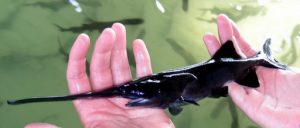
Why Do Paddlefish Restorations Work in Some Reservoirs, But Not Others?
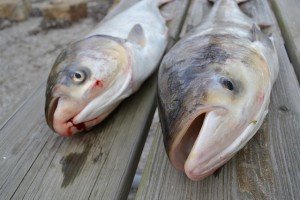
Today’s paper resulted from asking the question, why do Paddlefish restorations work in some reservoirs, but not others? The authors isolated turbidity as a potential difference between systems, and there are documented influences of excessive turbidity impacting foraging in planktivores. Personally, I find this all very interesting because of the increase in Paddlefish work in recent years. The proclivity of breaking world records for Paddlefish certainly has created buzz, especially in Oklahoma and Missouri. That
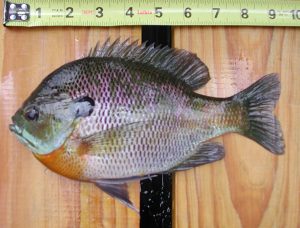
Bluegill Genetics Unaffected by Harvest Pressure
Today’s paper investigates whether fishing pressure and selective harvest can result in fishery-induced evolution. This inside look at bluegill genetics helps us to understand if “sneakers” are gaining an upper hand genetically if larger, parental, nest-guarding males are selectively harvested. The good folks from Kansas, and at Northern Iowa, provide helpful insights into this chicken (bluegill) and egg question. Read and enjoy! https://academic.oup.com/tafs/article/154/1/50/8081668

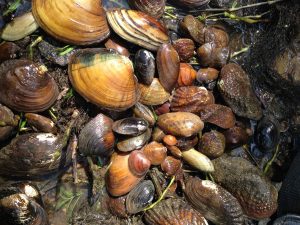
Finding the Pulse of Healthy Native Freshwater Mussels
Today’s paper was recently published online in the Journal of Aquatic Animal Health, and will be coming out in our first Oxford edition of that journal soon. I had not chosen an aquaculture or aquatic animal health paper in too long, and I knew it was time. The article assessed the current condition of freshwater mussel propagation techniques, identified challenges in assessing the health of freshwater mussels, and suggested a variety of future research needs

Fishery-dependent vs. Fishery-independent data
AFS has recently transitioned to Oxford University Publishing (OUP), and all of the AFS current and historic publications are now housed within the OUP system. AFS is currently finalizing the first OUP issues of the majority of our journals, but our open-access Marine and Coastal Fisheries (MCF) journal has already completed an issue from OUP. Today’s article is from MCF, and it I love how it links back to some of my previous work in

Sport Fish Restoration Act: Part 5
Today I am sharing the last two sections of the SFR 50th Anniversary document with you. Section 6 focuses on aquatic resource education, and the excellent work that had been accomplished in that realm from the Wallop-Breaux Amendment in 1984. Section 7 focuses on the future of SFR. I think that is so timely as we contemplate the 75th Anniversary this year. One section is about the role that the Recreational Boating and Fishing Foundation

Sport Fish Restoration Act: Part 4
I have two more sections of the 50th Anniversary document to share with you. Today’s looks at the impact of the act on public access for boating and fishing. This might not be the most attractive part of the document for fish folks, but it is important to understand that a big jump in funding as a result of Wallop-Breaux came from Marine Fuel Taxes. In order for that income to be expended appropriately, improving

Sport Fish Restoration Act: Part 3
I am on a little “rinse and repeat” here with the various pieces from the SFR 50th Anniversary publication. This part talks about how SFR assisted and shaped the maturation of the fisheries profession from adolescence into adulthood (thanks to AFS Past President Steve McMullin for the analogy!). While I always want you to read these, I think this one is very timely. I was on a conference call yesterday with my counterparts from The

Sport Fish Restoration Act 75th Anniversary: Part 2
As I have done for a few weeks now, I am sharing various pieces from the SFR 50th Anniversary publication. I hope this sets the stage for you all to think more about SFR at 75. Many of you who read this are state agency fisheries managers, and I want to use this space to ask you to consider submitting an abstract for the AFS meeting in San Antonio in August. The meeting will feature

Sport Fish Restoration Act 75th Anniversary: Part 1
2025 marks the 75th Anniversary of the passage of the Dingell-Johnson Sport Fish Restoration Act (SFR). This legislation was truly transformative for the fisheries profession. Additionally, the Wallop-Breaux Amendment in 1984 greatly expanded the program, and “fueled” (IYKYK) ability of state agencies, USFWS, and RBFF to do much of the great fisheries work that is being accomplished today. AFS was greatly involved in the initial passage of SFR in 1950, and even more involved in

From Carp to Copi
This week my AFS travels took me to lovely Rock Island, Illinois, and the Illinois Chapter meeting. These folks have a great raffle, and put on a good meeting; I greatly enjoyed their hospitality! Following recent trends, today I will highlight work from Illinois in my Fishy Friday selection. Today’s paper highlights their efforts to grow a commercial market for their burgeoning population of “famous fishes”, as the article states. Copi is the brand name

Walleye Stocking Leads to Recovery
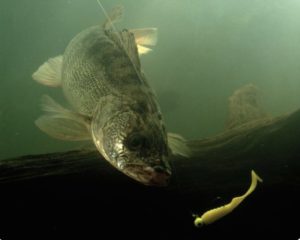
A new week, a new AFS Chapter Meeting attended. I had the pleasure of representing AFS at Minnesota Chapter Meeting this week. As I stated last week, chapter meetings are one of my favorite aspects of AFS, so having the opportunity to visit even more of them now in my position as AFS Executive Director is wonderful. Today’s paper is a shout out to Minnesota DNR fisheries staff, and Minnesota AFS Chapter award winner Dale

Blue Catfish in Kansas Reservoirs
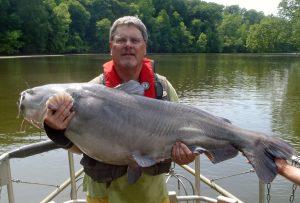
I had the pleasure of attending the Kansas Chapter of the American Fisheries Society’s 50th Annual Meeting this week. Chapter meetings are one of my favorite aspects of AFS, so having the opportunity to visit even more of them now in my position as AFS Executive Director is wonderful. Today’s paper is a recent publication from Kansas Department of Wildlife and Parks (KDWP) fisheries staff, assessing Blue Catfish populations in four Kansas reservoirs. KDWP staff