
Establishing a National Center for Ecologically Sustainable Water Conservation and Management
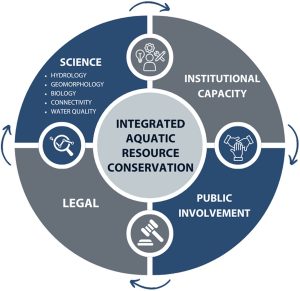
I recall sitting in the audience at the AFS-TWS Joint Meeting in Reno, when Tom Annear was given the Carl R. Sullivan Fishery Conservation Award. I got a brief introduction to his life’s work then, and afterwards invited him to come back home to Iowa to talk at our Iowa AFS meeting. Through a number of conversations, I came to understand much more deeply the importance of his work connecting science, law, policy, people, water and ecosystems to fisheries management.
Sturgeon Surprises
Today’s paper is about lake sturgeon culture methods, but the thing that struck me most about today’s paper is collaboration. The adult lake sturgeon brood stock were collected by USFWS field staff in Michigan, the fish were hatched at the USFWS hatchery at Genoa, Wisconsin, the final part of the project occurred at the Freshwater Restoration Ecology Center in Ontario, and the project was funded by NSERC (Canada). In this time of international relationship challenges, this project highlights the importance of our professional interactions and cooperation.

Sonar for Sturgeons
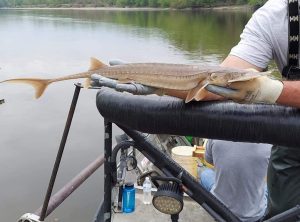
Today’s paper reminded me of some of the sturgeon sampling I assisted with in my former role with the Iowa DNR. We would go out electrofishing (and trammel netting) for Shovelnose Sturgeon during their spring spawning run, and we would tag the captured fish with PIT tags and monel tags. I believe it was more interesting to see a big paddlefish swirl in front of me, than to see an alligator on a video screen….

Blue Catfish Vs. Blue Crabs
This week’s paper comes from Marine & Coastal Fisheries, and was supported by the Virginia Tech Coop Unit, Sport Fish Restoration, and Sea Grant. Such a great example of fisheries collaboration. This study undertook a Management Strategy Evaluation, based on Blue Catfish management in the James River in Virginia….

USGS Vital Fisheries Research at Risk
As I mentioned last week, I was recently in Washington, D.C., representing AFS to a number of Congressional staffers, and meeting with fisheries folks from a variety of federal agencies. I had an outstanding meeting with David Hu and Liann Ball from the USGS Ecosystems Mission Area, and I learned about the important collaborative work they do, providing science services across the federal government. Many of you are probably aware that the Ecosystems Mission Area

Seeing the Forest Service Beyond the Trees
I am working to complete the last of my self-assigned tasks prior to enjoying a holiday tomorrow, and Fishy Friday is about the last item on my list. Last week, I was in Washington, D.C., representing AFS to a number of Congressional staffers, and meeting with fisheries folks from a variety of federal agencies. I had an outstanding meeting with Nat Gillespie from the US Forest Service, and I learned much about the significant partnership

Long-term Data Sets Reveal Shifting Marine Species Distribution
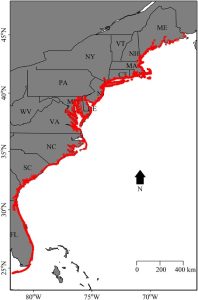
I spent this week in Washington, D.C., undertaking a variety of tasks for AFS. In particular, I had the opportunity to meet with fisheries staffers from a variety of agencies, including NOAA, US Forest Service, and USGS (all of the USFWS folks were out of town). Today’s paper highlights work completed by NOAA fisheries scientists, assessing 40+ years of MRIP (Marine Recreational Information Program) data on recreational angler catches to determine if latitudinal changes in

Developing Offshore Wind Energy
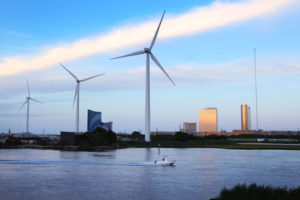
Today’s paper was recently published in Marine & Coastal Fisheries, and is a synthesis article looking at what impacts increasing offshore wind energy development may have on fish and fisheries in the Gulf of Mexico/America. I chose to highlight this article because there is also a symposium at our upcoming AFS Annual Meeting on offshore wind, fish and fisheries. The article provides a great baseline of information on the topic, and identifies priority topic areas

Trends in Striped Bass Growth
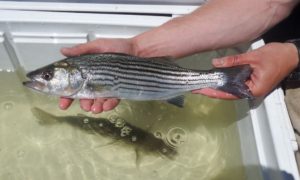
In my “new” role here at AFS, the fisheries stories and issues I been introduced to have grown far beyond my Midwestern roots. A few of the folks I’ve interacted with from the DC area, and elsewhere on the East Coast, have mentioned the issue of Atlantic Striped Bass on numerous occasions. Today’s paper, from the most recent issue of TAFS, touch on this topic and gave me an opportunity to learn more about this

Efficient monitoring of a river restoration project
Today’s paper comes from the April issue of the North American Journal of Fisheries Management, and I found it interesting because it combined remote sensing and field data collection to assess a river restoration project. The authors did a great job of outlining expected responses in measured variables that would then indicate successful restoration activities. In addition, they compared the cost in time and resources of conducting field evaluations of habitat restoration with the costs

When Stream Restoration Works
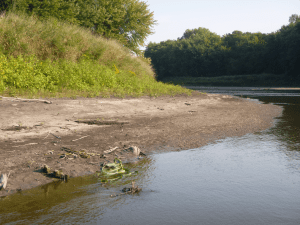
I think about Midwestern rivers and streams often. Most times, it makes me sad. These systems historically had diverse fish communities, stable streambanks and streambeds, and ran clean and clear so you could see the various glacially deposited substrates of gravel and cobble on the stream bottom. Today (as you can see illustrated in the attached photo), those entities are just an imaginary vision, at least in Iowa. But I have hope. I believe that

Making an Impression with Fish Art
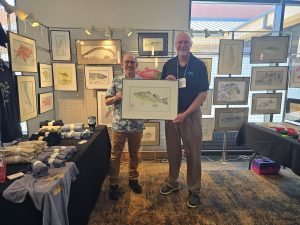
I had a great week at the AFS Western Division meeting, seeing lots of AFS members and talking fish topics with passionate fisheries people. A highlight of the week was stopping in and chatting with longtime AFS supporter and meeting vendor Bruce Koike. Bruce has been conducting Gyotaku courses and offering his prints for sale at AFS meetings for many years. In addition, Bruce has an MS in Fisheries Science from Oregon State, and works