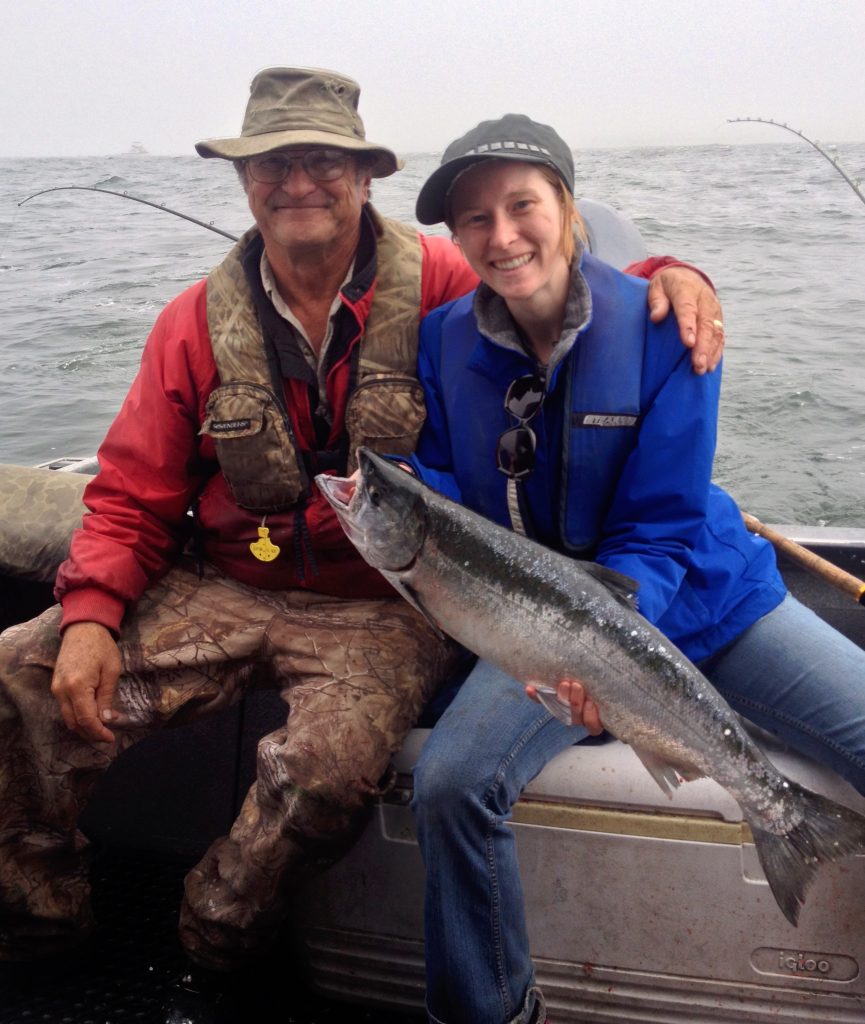
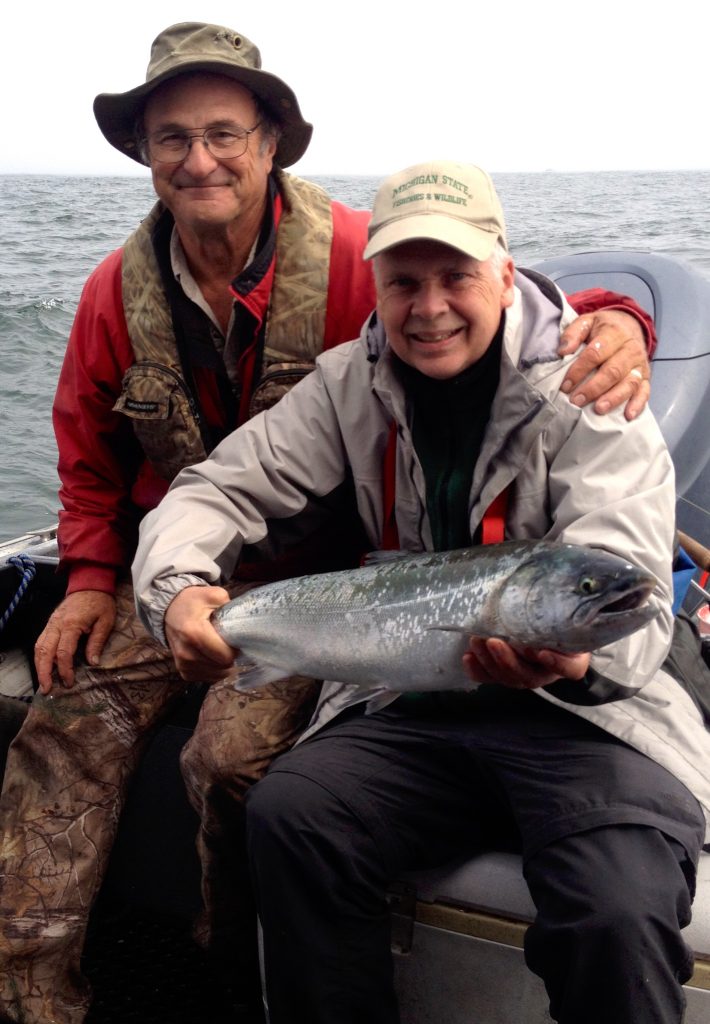
Early one summer morning, I (Betsy Riley) found myself sitting in a boat on the Columbia River with Bill Taylor and Jim Martin, watching the sunrise and waiting for the salmon to bite. It may have been inevitable, in that little boat, that sooner or later we’d start talking politics, so it didn’t surprise me when the topic came up. What surprised me was their advice.
Many fisheries scientists find policy work and advocacy to be frustrating, irrational, and overly political. They believe that if they have good scientific information, then the correct course should be obvious, the way forward should clear, and decisions can be made quickly and without fuss. But the reality is that policy change can be incredibly slow, with many lost battles along the way. Many scientists become disillusioned with the political system and retreat to their research, convinced that their advocacy could never lead to real, substantial change.
So when Jim Martin and Bill Taylor started talking about how important it would be for the next generation of scientists to get involved in the political process, instead of lamenting the foolishness of politicians, I sat up and took note. And in light of the current political transition that is facing our country, the United States, we decided that it was time to have this conversation on a larger scale, to raise the question of what role scientists should play in the future of our country and the development of its fisheries and aquatic resources policies.
Understanding Your Cause
As you consider pursuing advocacy as a means of reaching your goals, the first thing you should do is to write out what you hope to accomplish through pursuing policy avenues for your cause. What would the world look like if you achieved your goal? What might some intermediate steps be that move your cause in the right direction? Not only will this help you to understand your own goals, but it will help you begin to plan for what your advocacy actions might look like and how to best accomplish them. Most importantly, think realistically about how long it may take to reach your goals. Because of the often slow churn of the political process, you may want to add years, or even a decade, to your initial assessment. Keep in mind that for some causes, the final goal may be so lofty that it cannot be achieved in a single lifetime—indeed, these goals are often the most important, because complex issues require complex solutions and are essential to more sustainable fisheries ecosystems.
Once you understand what you want and have a general outline of what you need to get there, you can take a look at the political landscape in which your cause exists. This is where scientists can learn a lot from political campaigns. When candidates decide to run for office, they don’t just simply put their names on the ballot and start giving speeches; they must first understand what their future constituents want, what they like and dislike.
A politician’s constituents are the same people who you will need in order to move your cause forward. Understanding your audience means understanding the policy history of your issue. It’s unlikely that this will be the first time that your issue, or a very similar issue, has received policy attention, and your “constituents” may have already expressed an opinion on the matter—giving you an advantage in better understanding why your campaign hasn’t already happened or, if it has happened, what prevented it from being successful.
Finally, you’ll need to understand the motivations and networks of your naysayers. Don’t confine yourself to simply understanding their stance on issues—dig a little deeper to uncover what sort of influence they have. Understanding their past friendships and conflicts with political actors helps in determining where and with whom you might most effectively engage for success. Making connections with diverse partners is crucial to effectively working with a range of stakeholders and policy makers.
While doing your research to understand your cause, take a few minutes to understand your virtual self—what do people find when they search for you or your team members? Are there places on the Internet where you are quoted? If a policy campaign gets too intense, all of these details will likely surface. It is crucial to understand what sort of information people will find if they attempt to learn more about you and your team’s concerns, beliefs, values, and integrity.
Jim Martin and Bill Taylor
Crafting Your Message To Fit Your Audience
There’s an important reason behind all this research: you will need to effectively frame your message to fit your audience. The term “framing” has received a certain amount of disdain in recent years, having developed a reputation as a tool politicians or corporations use to deceive the unwary. Though framing has certainly been used in this way, it is also one of the most powerful tools in a campaign’s toolbox and can be used very effectively to help people understand the various dimensions of an issue. Remember, your audience is coming to the table with a certain set of values and with their own framing of the issue in mind, even if they know relatively little about your topic. Correctly framing your issue to fit with the expertise level, previous knowledge, and values of your audience can help you to communicate the truth as you understand it, and can cut through the noise of other political framings. Try to learn as much as you can about the demographics you think will support you, and then help them to understand your issue as you know it. Remember that ultimately you are not trying to convince them of your values—you are trying to convince them to become allies with you in reaching what can be a shared policy goal.
Your Role As An Advocate
There is no “one way” to advocate, just like there’s no one way to be a scientist. Individuals have their own unique skill set, and the best advocacy technique is one that fits with an individual’s personality, level of commitment, and professional and personal limitations. Just like a campaigning politician has a good team behind him, all good policy movements have two key components: the leader and the team.
The Leader: The leader in political campaigns is obvious: the candidate. In a policy campaign, it can be less intuitive but still critically important. Though it’s true that one person can’t do it alone, it is nevertheless true that successful campaigns almost always have one person who takes the reins, assuming responsibility for the actions of others and the reputation of the campaign. Like a candidate, this person typically cares passionately about the cause and is willing to go the extra mile to acquire additional information, build networks, raise visibility, improve credibility, secure a vote, raise money, or make an idea reality. The leader also rallies the team, understanding the strengths and weaknesses of the campaign, and how to move goals forward. The leader must juggle the needs of the team in such a way to ensure that the members stay on task, without overworking or under-rewarding them to the point that they leave.
The role of leader is more difficult than being a team member. It involves longer hours, bigger risks, and more emotional investment. But it can also be extremely rewarding when you see the fruits of your labor in the form of more productive and sustainable fisheries systems.
The Team:Sometimes being a leader simply isn’t an option—you may not have the time, expertise, or personal autonomy to take on such an involved role. For those new to advocacy in particular, being on a team, such as through participation in a nongovernmental organization (NGO), may be the best way to become grounded in the campaign. Team members contribute their time and talents to a policy campaign, without taking on the risks and the time commitment involved with being a leader.
Exactly what skills your team will need depends on the objectives of the campaign; below we list a few skills that are mandatory before any campaign can be successful.
Subject-Matter Expert. Policy campaigns build a great deal of their power from being available and ready to answer policy makers’ questions that relate to the objectives of the campaign. This is a role that many scientists feel the most comfortable in, because it involves making use of knowledge that scientists have spent a life time accumulating.
Legal/Policy Expert. Engaging in policy advocacy means encountering laws and regulations, and the more involved your team gets in policy, the more these legal restrictions will come up. Having someone who understands what you can and cannot do within the current legal framework is key to keeping a campaign running. In addition, if your campaign involves working to change laws or regulations, this person can help target the right policies to push for the changes needed for your campaign’s success.
Media Wizard. Whether it’s putting your name in the papers or keeping it out of them, you will need a team member who understands how media relations work. These days, expertise in social media can be invaluable (especially in grassroots campaigns for keeping your membership informed and engaged), in addition to the more traditional forms of newspapers and television. These individuals will also ensure that your programs aren’t buried on the sports page, but rather secure a spot on the front page.
Fundraising Guru. Fundraising is an art, consisting of finding the right donors, hosting the right events, and appealing to the right causes. Just like in the world of science, work doesn’t get done without funding to back it. Though these roles are critical to all campaigns, your specific campaign may have other needs, including a community expert/organizer or NGO members/leaders. Always keep an eye out for new expertise as your campaign changes and grows.
Lastly, remember that teams are stronger when they have members who come from diverse backgrounds—not just in subject-matter expertise, but in terms of life experience, including diversity in age, socioeconomic status, gender, race, and religion. Campaigns live and breathe new membership, and those who have different upbringings will be better positioned to understand which aspects of your campaign will appeal to various decision makers and their publics. Policy campaigns gain strength through numbers, and allies in diverse forms can oftentimes gain you the clout that your campaign will need to succeed.
Where Do You Fit In?
Ultimately, you will need to decide what role you want to play. If you have the passion, the time, and the interpersonal skills to be a leader, then this may be the best role for you. If not, you can still be a valuable member of the team, contributing your skill set according to your abilities. It is important to remember, though, that if no one steps up to be the leader, then the team will remain directionless and with a much lower chance of success.
Walking The Tightrope: Legal Restraints To Advocacy
Before engaging in advocacy work, it is important to fully understand the rules in your workplace regarding political activity. If you work for the federal government, for example, you are no doubt fully aware of the Hatch Act, which prohibits executive branch federal employees (and some state employees) from engaging in certain political activities, including running for office in a partisan election or engaging in political activity while on duty. Other levels of government, NGOs, and private industries may also have restrictions on the political activities of their employees as part of their employment requirements, and every scientific discipline and professional society, such as AFS, has codes of conduct that must be adhered to.
Running A Campaign
Remember that campaigns are long-term commitments and that you may lose many political battles on the path to achieving your goal. There is an energy that comes with a campaign that will ebb and flow over time. A successful campaign must keep this energy moving, even in times of loss. People involved with your campaign should always feel as though they are accomplishing something and moving forward, or the campaign can stagnate. Keep making new alliances. Keep your membership active and involved. Think up new ideas to attract the media and to ignite imagination.
Ending A Campaign
The great irony of policy campaigns is that true, ultimate success means that everything you built will end. Sometimes the dam comes out, fish passage is restored, the campaign’s lights turn off, and your team members return to their homes with their job done. Other times support simply dries up and, dam or no dam, the campaign managers are left with a decision to send everyone home or to build something new in its place. But how do you know when to stop and move on? Campaigns, by their nature, are long-term commitments. Huge campaigns, such as AFS’ goal to advance and disseminate sound science to protect, conserve, and sustain fisheries resources and aquatic ecosystems, may never be over. Ultimately, you have to know what your limits are and the organizations you work with. If you can spend the rest of your life on this—great! If not, learn to recognize the signs that indicate it’s time to end your involvement—even if you’re leaving with less success than you hoped.
Conclusion
Many researchers see active campaign roles as beyond the scope of a scientist’s work. A great deal of literature exists on the role of scientists as “honest brokers,” whose role it is to help decision makers understand the costs and benefits of certain actions, while carefully remaining neutral in the discussion. There is no doubt that this role is powerful, but it is also not for everyone. Oftentimes, fisheries scientists are the only ones who care enough about the ecological systems that sustain fisheries to fight for their protection from competing interests. Whether that fight is through a campaign that you start or your participation in another campaign, such as working with a NGO, your decision to be a scientist does not remove your right, or democratic obligation, to advocate on behalf of your beliefs. Only by being engaged with difficult policy issues in our disciplines, professions, and society will we make a difference and move the needle for the benefit of all!
Members click below for the June 2016 Fisheries magazine’s complete issue. Non-members, join here.
This content is for members only. Please login.
Recent News
This website uses cookies to improve your experience. AcceptRead More
Privacy & Cookies Policy
Privacy Overview
This website uses cookies to improve your experience while you navigate through the website. Out of these, the cookies that are categorized as necessary are stored on your browser as they are essential for the working of basic functionalities of the website. We also use third-party cookies that help us analyze and understand how you use this website. These cookies will be stored in your browser only with your consent. You also have the option to opt-out of these cookies. But opting out of some of these cookies may affect your browsing experience.
Necessary cookies are absolutely essential for the website to function properly. This category only includes cookies that ensures basic functionalities and security features of the website. These cookies do not store any personal information.
Any cookies that may not be particularly necessary for the website to function and is used specifically to collect user personal data via analytics, ads, other embedded contents are termed as non-necessary cookies. It is mandatory to procure user consent prior to running these cookies on your website.