Skip to content

American Fisheries Society Family of Websites:

Fisheries.org

American Fisheries Society
Family of Websites

Journals

Read our five journals and Fisheries magazine

Gray Literature Database

Find thousands of unpublished agency reports and other information

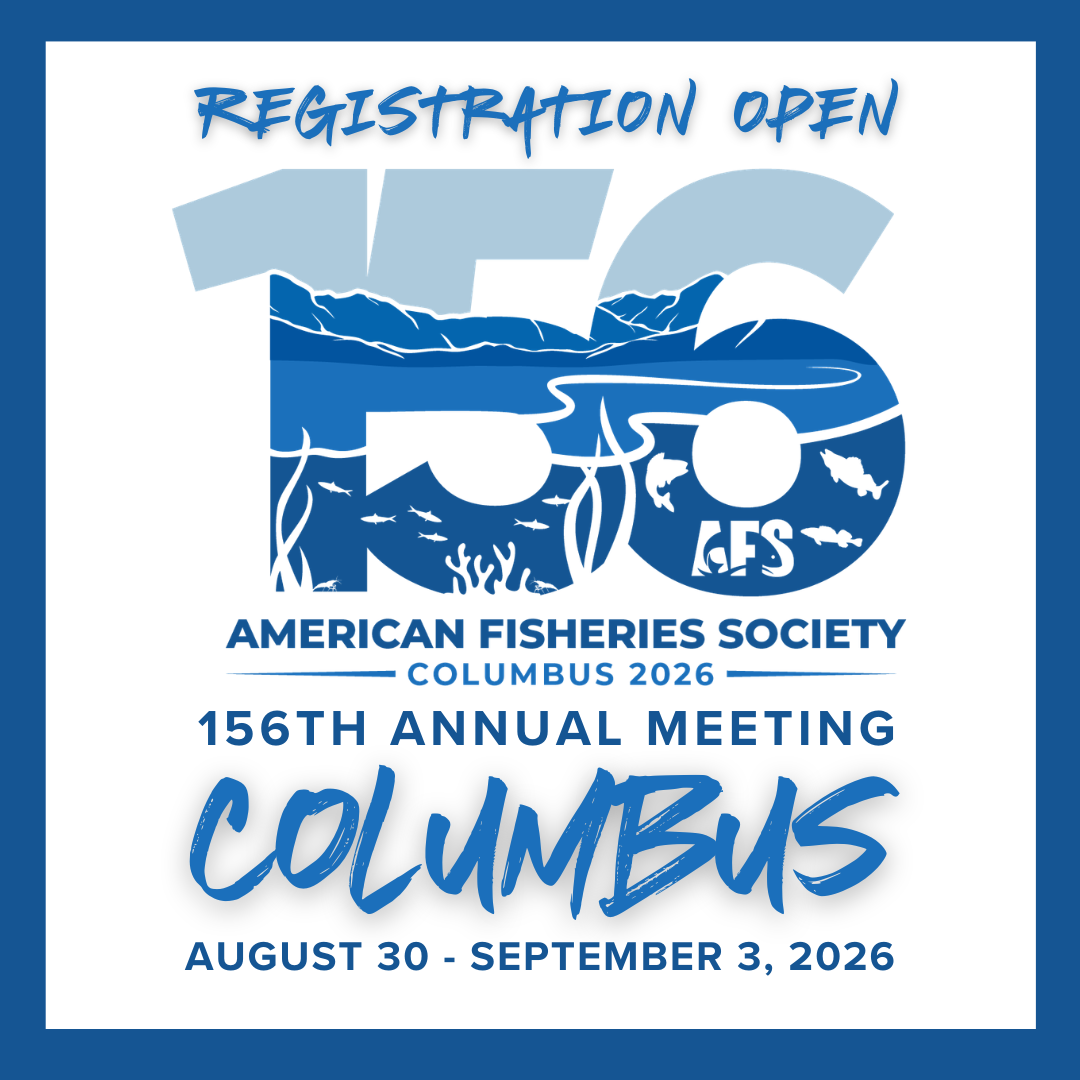
Annual Meeting

Join us in Columbus in 2026

Divisions, Chapters, Sections

Find an AFS Unit near you or in your area of specialty

Fishbook

Fisheries Collaboration Network

Climate Change and Fisheries

Learn how to communicate the effects of climate change on fisheries

Hutton Junior Fisheries Biology Program

Summer internships for high school students

Community Growth and Connections

Explore our initiatives to build community in the Society and in the fisheries profession

Center for Fisheries Technology and Collaboration

Find fisheries science products and services

Center for Technology and Collaboration

Quick answers to common questions

Other Resources
  • Standard Methods for Sampling North American Freshwater Fish Website

  • Rotenone Stewardship Program Information Site

  • Fishionary: A blog about fish words! 
Latest News
2026 Officer Election Voting Now Open AFS Calls for Continued Protection of Boundary Waters from Mining Proposed Rule Would Undermine Science-based Endangered Species Act Future of Public Trust Resources – Statement of the American Fisheries Society Latest Newsletter
Donate
Login
Logout
$0.00 0 Cart
  • Who We Are

    Who We Are

    Governance

    Learn how AFS is structured

    Divisions, Sections, Chapters

    Find a community in your local
    area or in your expertise

    Committees

    Get engaged and volunteer

    Awards & Recognition

    Nominate your heroes

    Community Growth and Connections

    Learn more about our community-building efforts

    AFS Celebrates 150+ Years

    Explore our history

    AFS Fisheries Partnerships

    Meet our global partners

    Meet the Staff

    Dedicated to serving our members

    Contact Us

    Quick answers to common questions

    Support AFS

    Discover how you can support critical AFS programs

    What Are Fisheries?

    Explore fisheries professions

  • MEMBERSHIP

    Membership

    Learn about membership benefits and member types

    Member Directory

    Find your colleagues

    Types of Membership

    For all stages of your career

    Give the Gift
    of Membership

    Invest in an aspiring fisheries
    professional’s future

    Who Are Our Members

    From students to 50-year Golden Members

    Governance

    Learn about our organization and leadership

    My Account

    Log in to access member benefits or renew

    Join/Renew

    It’s Quick and Easy

    Organizational Membership

    Become a Strategic Partner!

  • POLICY

    POLICY

    Recovering America’s
    Wildlife Act

    Critical funding for state conservation programs

    Climate Change

    Communicate the impacts
    of climate change on fisheries

    Magnuson-Stevens Act

    Ensuring sustainability of marine fisheries

    Waters of the US

    News about Clean Water Act
    jurisdiction

    Water Quality

    Healthy fisheries require healthy waters

    Pebble Mine

    Protecting Bristol Bay salmon fisheries

    National Fish
    Habitat Partnership

    Addressing fish habitat regionally

    Infrastructure

    Funding impacts on fish habitat

    Aquaculture

    Providing food security for the future

    Future of the Nation’s
    Aquatic Resources

    Priorities for US fisheries policies

    Recent Policy Statements

    Official policy statements of AFS

    Policy Letters

    Comments on policy,
    legislation, and regulations

    Sport Fish Restoration Act

    Understanding its importance in funding state agency fisheries management

    Advocacy Guidelines

    For Units and members

    Science Guidelines

    Practicing science appropriately

    Briefings

    Congressional briefings with our partners

    Resolutions

    Member-approved resolutions
    on policy

  • NEWS

    News

    Announcements

    Official AFS news

    Annual Meeting

    News from the meeting

    Members in the News

    Awards and interviews

    Policy News

    Round-up of all policy news

    Beneath the Surface Podcast

    A deep dive into the programs and people at AFS

    Federal Workforce and Budget Cuts

    Resources and Ways to Take Action

    Newsletter

    Bi-weekly newsletter for members and partners

    Press Releases

    News media releases

  • EVENTS

    Events

    Annual Meeting

    Columbus 2026

    Future Annual Meetings

    Where we are heading

    Past Annual Meetings

    Where we’ve been

    World Fisheries Congress 2024

    Seattle, Washington

    Other Past Events

    Past special events

    Fisheries Events Calendar

    Events around the world

    Add Your Event Listing

    Submit your calendar item

  • JOBS

    Jobs

    Career Help from AFS

    Compilation of job listing boards

    Other Career Tips

    Career info for members

    Find a Job

    Listings from all over North America

    Post a Job

    Submit your job opening

  • PUBLICATIONS

    Publications

    AFS Journals Program

    More than 150 years of excellence

    AFS Books Program

    Publish with AFS

    Submit Journal Article

    Reach the right audience for your research

    Fisheries Magazine

    Monthly membership magazine

    Writing Tools

    Guides for authors and other resources

    Fishy Fridays

    Weekly blog highlighting AFS fisheries journal articles

    Bookstore

    Shop more than 180 titles

    Journal Online Access

    Log in to access journal articles

    Gray Literature Database

    Thousands of unpublished agency reports and research

  • Professional Development

    Professional Development

    Continuing Education

    Gain skills and enhance your career

    Professional Certification

    Official recognition of your expertise

    Hutton Junior Fisheries
    Biology Program

    Summer high school
    internship program

    Leadership Opportunities

    Hone your leadership skills, volunteer today!

    Training Opportunities Calendar

    Webinars, online courses, on-site workshops, and field training

    Webinars

    Check out upcoming sessions or browse our library

    More Online Resources

    Practical resources for fisheries professionals

  • Engagement

    Engagement

    Strategic Partners

    See how your organization can partner with AFS

    Support AFS

    Discover how you can support critical AFS programs

    The 1870 Society

    Recognizing generous individual donors who invest in the Society's mission

    2024 Annual Report

    Find out what AFS did for the fisheries community in 2024

    Shop AFS

    Check out the latest AFS merch here

Login
Logout

NOAA Fisheries At-Sea Volunteer Opportunities: Hands-On, Hard Work, and a Great Experience

  • July 16, 2015
  • Essays, News
  • Home
  • NOAA Fisheries At-Sea Volunteer Opportunities: Hands-On, Hard Work, and a Great Experience

Shelley Dawicki, Northeast Fisheries Science Center. E-mail: shelley.dawicki@noaa.gov For decades, volunteers have played an important role in National Oceanic and Atmospheric Administration (NOAA) Fisheries at-sea research operations, working side by side with federal researchers during a variety of surveys throughout the year. These include spring and fall bottom trawl surveys; summer surf clam Spisula solidissima, ocean quahog Arctica islandica, and sea scallop Placopecten magellanicus dredge surveys; and fall Atlantic Herring Clupea harengus acoustic surveys. Most of the volunteers have worked with the Ecosystems Surveys Branch, based at the Woods Hole Laboratory of NOAA’s Northeast Fisheries Science Center (NEFSC), which conducts the majority of the NEFSC’s fishery assessment cruises each year. The NEFSC bottom trawl surveys have been conducted since the mid-1960s and represent one of the world’s longest time series of standardized fishery-independent abundance indices for important fishery species. The scallop and clam surveys began in the late 1970s, and the fisheries acoustic surveys began in 1998. “As far as I can determine, volunteers have participated on our surveys since the 1960s,” said Rob Johnston, who is chief of ecosystem survey operations at the NEFSC. “The volunteers are usually students, scientists, or educators with a specific interest in going to sea for a few weeks. It is not a cruise in the way the public thinks of a cruise, as a leisurely recreational activity or vacation. It is often hard, physically demanding work, requiring long hours on watch. The scientists and the volunteers work closely together.” Surveys are conducted to monitor recruitment, biomass and abundance, geographic distribution, and changes in the ecosystem. They also collect biological data used to track maturity stages and feeding habits as well as environmental data useful in a variety of research. Much of this information, added to landings and other data supplied directly by fishermen, is used for fishery stock assessments and helps guide management decisions. “It is important work, critical to our mission to understand, conserve, and utilize in a sustainable way the living marine resources on the Northeast U.S. Continental Shelf,” Johnston said. Volunteers are members of the scientific party and work the same shifts as the scientists. That means a 12-hour stretch on the spring and fall bottom trawl surveys aboard the 209-foot NOAA ship Henry B. Bigelow. The ship conducts multispecies finfish surveys throughout the U.S. Northeast Continental Shelf in four legs: Cape Hatteras/Mid-Atlantic, Southern New England, Georges Bank, and the Gulf of Maine. Each of the legs lasts two to three weeks. The spring 2015 survey began in early March and ran into early May. The fall 2015 bottom trawl survey will take place from early September through mid-November. Given that there are only 15 berths for the science party on the Bigelow and 24-hour operations, every bunk needs to be filled with a qualified person. Working out the logistics is the job of Katherine Sowers, Ecosystems Surveys Branch cruise staffing coordinator since 2006. “Volunteers are full-fledged members of the scientific party, and we place a great value on their participation to help us conduct the surveys and collect data,” said Sowers. “The demands of the schedule and the workload require that every member of the party be able to perform the duties required of a scientist during that leg of the voyage. Our biggest challenge is developing a well-balanced roster for each of the survey legs. Volunteers are important in that regard.” Volunteers learn about the opportunities through the NEFSC website (nefsc.noaa.gov/femad/ecosurvey/mainpage), by word of mouth, or through e-mail alerts. Once they sign up, complete a questionnaire, and meet medical requirements, volunteers are on Sowers’ e-mail list will be notified about upcoming surveys. Staffing calls for the next season’s survey are issued three times a year: the end of January for the spring, the end of March for the summer, and the end of July for the fall surveys. Sowers used to talk with many of the volunteers by phone, sometimes in person, but these days most of the communication is done by e-mail. “I get new candidates all the time, from all over the country and from all ages and backgrounds,” Sowers said. “Most of them have interest in or experience going to sea, are students who want or need the experience for degree requirements, or are educators who want to learn and then share the experience with others when they return, such as participants in the NOAA Teacher at Sea program. This spring, for example, we had volunteers on every leg from such places as the U.S. Coast Guard, Cornell University, and the University of Rhode Island.” Depending on the type of cruise, volunteers handle fish, scallops, and other species caught in nets or a dredge; sort the catch; sample specimens; and record data. In the process, they learn about various fish and shellfish species, how surveys are conducted, and the types of information collected and where it goes. Once processed, data are used in stock assessments, as guidance for resource managers, and for a wide range of research programs. The operations of the research vessel, how the catch is collected, and preparations for handling the catch aboard ship are all part of the learning experience. The at-sea volunteer opportunity can help students decide on career paths and is a positive addition to resumes. Joseph Kunkel and Carol Glor represent the diversity of volunteers. Kunkel, a biologist and professor at the University of New England, has been a volunteer scientist since 1998 during spring and fall bottom trawl surveys aboard the NEFSC’s fisheries survey vessels Albatross IV, Delaware II, and now the Henry B. Bigelow. Glor is a middle school teacher from New York who teaches home and career skills and who was a 2014 NOAA Teacher at Sea. She joined the scallop survey aboard the research vessel Hugh R. Sharp in July 2014 as a first-time volunteer. The type and timing of the surveys makes a difference. There are more volunteer opportunities for students and teachers on the summer clam and scallop surveys, which tend to have shorter legs. The clam surveys, to determine the distribution and abundance of Atlantic surf clams Spisula solidissima and ocean quahogs Arctica islandica, are conducted aboard a chartered commercial vessel in three legs in late July and August, each leg lasting about five days. Since 2012, about one-third of the resource is surveyed annually from the Delmarva Peninsula to Georges Bank. The sea scallop surveys are conducted between May and July aboard the 146-foot research vessel Hugh R. Sharp, operated by the University of Delaware as part of the University– National Oceanographic Laboratory System research fleet. The 2015 integrated benthic/sea scallop survey used an eight-foot dredge and “HabCam,” a towed underwater imaging vehicle, to determine the distribution and abundance of scallops from the Mid-Atlantic Bight to Georges Bank. A number of volunteers, from college students to high school teachers, worked with NEFSC staff aboard each of the three legs, which range from 11 to 14 days each. At the end of their experience at sea, each volunteer completes an evaluation, and Sowers speaks with the watch chiefs to get their input. “The science crew enjoys meeting new people from different backgrounds and interests, and the volunteers come away with an appreciation of life at sea and the work involved in the surveys,” Sowers said. “It isn’t for everyone, as the workload can be tough and dealing with seasickness is not something you want to do. But the experience is usually a positive and memorable one.” Some of the positives of life aboard ship come when volunteers are not on watch. The galley is popular because food is always available there, and the ship’s lounge is a place to relax with a book, watch movies, play cards, or chat with shipmates. Some do handwork they have brought, and with 24-hour Internet, everyone can stay in contact with family and friends ashore via their laptop. Out on deck, volunteers can observe the variety of seabirds, sometimes rare sightings, or catch glimpses of whales, dolphins, and other marine mammals. And then there are the picture postcard sunrises and sunsets at sea—there is nothing like it. One recent fall bottom trawl survey volunteer said of the experience: “I had worries that as volunteers, we will get small, maybe unnecessary jobs, but that was not the case at all. We were actually doing the work. Awesome!” RELATED LINKS

  • NEFSC cruise volunteer information: nefsc.noaa.gov/femad/ecosurvey/mainpage/welcome_aboard.html
  • Other volunteer opportunities at NOAA: volunteer.noaa.gov

  • Recent News

    • AFS Urges Modernization of Sporting Goods Excise Tax that Funds Fisheries Conservation May 13, 2026
    • Is Bigger Better for Hatchery Chinook Salmon? May 1, 2026
    • Webinar: A Perpetual Franchise to Cultivate Oysters April 30, 2026
    • Webinar: Skin Cancer Risk and Outdoor Workers: Early Detection and Sun Protection Could Save Your Life April 30, 2026
    • AFS Calls for Robust Funding for NOAA Fisheries April 27, 2026
  • About

    The American Fisheries Society is 501c Non-Profit Society


    Donate Now

    Quick Links

    • ABOUT
    • POLICY
    • EVENTS
    • PUBLICATIONS
    • MEMBERSHIP
    • NEWS
    • JOBS
    • Contact Us
    • ABOUT
    • POLICY
    • EVENTS
    • PUBLICATIONS
    • MEMBERSHIP
    • NEWS
    • JOBS
    • Contact Us

    Contact

    • 25 Century Boulevard
      Suite 505
      Nashville, TN 37214
    • (301) 897-8616
    Facebook-f Twitter Instagram Linkedin-in Vimeo-v

    Copyright © 2026 American Fisheries Society | Privacy Policy 

    This website uses cookies to improve your experience. Accept Read More
    Privacy & Cookies Policy

    Privacy Overview

    This website uses cookies to improve your experience while you navigate through the website. Out of these, the cookies that are categorized as necessary are stored on your browser as they are essential for the working of basic functionalities of the website. We also use third-party cookies that help us analyze and understand how you use this website. These cookies will be stored in your browser only with your consent. You also have the option to opt-out of these cookies. But opting out of some of these cookies may affect your browsing experience.
    Necessary
    Always Enabled
    Necessary cookies are absolutely essential for the website to function properly. This category only includes cookies that ensures basic functionalities and security features of the website. These cookies do not store any personal information.
    Non-necessary
    Any cookies that may not be particularly necessary for the website to function and is used specifically to collect user personal data via analytics, ads, other embedded contents are termed as non-necessary cookies. It is mandatory to procure user consent prior to running these cookies on your website.
    SAVE & ACCEPT