The Honorable Lee Zeldin Administrator Environmental Protection Agency 1200 Pennsylvania Ave NW Washington, D.C. 20460
The Honorable Adam Telle Assistant Secretary of the Army for Civil Works U.S. Army Corps of Engineers 108 Army Pentagon, Room 3E446 Washington, DC 20310-0108
Via Regulations.gov Re: Updated Definition of ‘‘Waters of the United States, Docket No. EPA-HQ-OW-2025-0322-0001
Dear Mr. Zeldin and Mr. Telle:
The American Fisheries Society (AFS) and Coastal and Estuarine Research Federation (CERF) respectfully submit the following comments in response to the proposed rule, Updated Definition of ‘‘Waters of the United States,’’ Docket No. EPA-HQ-OW-2025-0322-0001 published in the Federal Register on November 20, 2025 (Proposed Rule).
AFS is the world’s oldest and largest professional society of fishery and aquatic scientists and managers. AFS seeks to improve the conservation and sustainability of fishery resources and aquatic ecosystems by advancing fisheries and aquatic science, promoting the development of fisheries professionals, and advocating for the use of the best available science in policy-making. The Coastal and Estuarine Research Federation (CERF) is a multidisciplinary organization whose members study and manage the structure and functions of estuaries and the effects of human activities on these environments. CERF is a not-for-profit and non-partisan organization dedicated to advancing human understanding and appreciation of the Earth’s estuaries and coasts, to the wise use and management of these environments, and to making the results of their research and management actions available to their colleagues and to the public. Collectively, the nearly 10,000 members of AFS and CERF include students, researchers, resource managers, policy makers, and educators representing academic and research institutions, government, industry and consulting, and non-governmental organizations. AFS and CERF have long supported a science-based definition of ‘‘Waters of the United States’’ (WOTUS).
With the passage of the Clean Water Act (CWA) in 1972, Congress aimed “to restore and maintain the chemical, physical, and biological integrity of the nation’s waters” to ensure that our nation’s waters are fishable and swimmable. To achieve this, the CWA regulates pollutant discharges and the dredging and filling of our nation’s waters, including wetlands, to ensure water quality that sustains fisheries and wildlife.
As a result of the 2023 U.S. Supreme Court decision in Sackett v. EPA, approximately two-thirds of the nation’s remaining wetlands and up to 5 million miles of streams are no longer protected by the CWA. The Proposed Rule will further erode those protections by imposing new and confusing standards that restrict protections in a manner not required by Sackett, contradict science, and contravene the purpose of the CWA to “restore and maintain the chemical, physical, and biological integrity of the Nation’s waters.” Under the most restrictive interpretation of WOTUS in the Proposed Rule, the vast majority of wetlands previously covered by the CWA would not be subject to federal permitting for dredging or filling. In addition, as acknowledged by the agencies, it would result in “reducing the number of 404 permits issued and acres of wetland impacts mitigated.” Projections show that 84% of wetlands that previously required a federal permit to dredge or fill would no longer be covered under the CWA (NRDC 2025).
According to the U.S. Geological Survey (USGS), wetlands are among the most productive and economically valuable ecosystems in the world (USGS 2025). Aquatic ecosystems depend on the exchange of chemical components, organisms, sediment, and organic matter between wetlands and abutting water bodies to sustain life in and around their shores. The interconnections between headwater streams, intermittent streams, and freshwater wetlands with underground connections are critical to estuarine waters and wetlands – whatever happens within a watershed has impacts on the associated estuary and coasts. These interconnections and the current definition of wetlands (USACE 2025) are supported by extensive and rigorous scientific literature, including an EPA synthesis report (USEPA 2015). Dredging or filling wetlands and water bodies undermines their ability to filter contaminants and excess nutrients that drive eutrophication and harmful algal blooms, provide habitat and migration pathways for fish and other wildlife, and serve as drainage and storage systems for floodwaters.
If implemented, the Proposed Rule will lead to more uncertainty and confusion in determining jurisdiction and will lead to a cascade of consequences for our nation’s waters, including poorer water quality, increased flooding and pollution, loss of fish and wildlife habitat, reduced drinking water supplies, and impaired blue carbon storage. We strongly recommend that the agencies keep in place the conforming 2023 rule which appropriately modifies the long-standing, Reagan-era definition of “waters of the United States” with the findings of the Supreme Court in Sackett v. EPA. We appreciate the opportunity to comment on the Proposed Rule and submit the following comments for your consideration.
Use of “Wet-Season” Introduces More Uncertainty, Not Less, and Ignores the Science of Waterbody Connectivity
In Sackett v. EPA, the Supreme Court held that only wetlands with a “continuous surface connection” to navigable waters qualify as WOTUS. In the Proposed Rule, the agencies seek to define “continuous surface connection” for the first time to mean “having surface water at least during the wet season and abutting (i.e., touching) a jurisdictional water.” Using a continuous or seasonal surface-water connection to determine whether a stream or wetland qualifies for CWA protection overlooks the complexity of hydrological and meteorological regimes that prevail across the U.S. and the ecological processes that support water quality and functional ecosystems in navigable waters.
The presence of flowing surface water at a given point in time is not a dependable indicator of a wetland’s connectivity to “navigable waters.” Connectivity in wetlands can be sporadic and not strictly seasonal in some geographic areas. A surface connection may be present in some years, but not others. Flooding and groundwater inputs can alter where surface connections persist, and seasonal variability may cause an area to meet the surface connection criteria one year but not the next.
The Proposed Rule does not adequately define exactly what constitutes a “continuous surface connection.” For example, does running or standing water meet the criteria for a “continuous surface connection”? Additionally, the necessary duration of the “continuous connection” is ambiguous. The rule does not specify whether the criteria for a continuous connection of waters during the wet season can be met by saturated conditions when a soil pit is dug or only when standing waters on the surface are present.
For systems without year-round connections among rivers and streams, wetlands, and navigable waters, the Proposed Rule offers the term “wet season” to establish jurisdiction. However, “wet season” is undefined in the rule; does not exist as a formal, consistent, or rigorous scientific term in the literature; and is impossible to generalize in practice. In arid or semi-arid regions of the U.S., rainfall periodicity and intensity can vary on a year-to-year basis due to large-scale meteorological forcings (Lee et al. 2018, Dykstra and Dzwonkowski 2021). Wetland and water body protections require targeted regulation that carefully considers local hydrology and meteorology.
Applying the “wet season” criteria to establish whether a waterbody is a WOTUS will introduce uncertainty for landowners in areas without a year-round connection between upstream water sources, wetlands, and “navigable waters,” or that are lacking in marked seasonal discharges and water flows. Using a short-term, highly variable criterion such as surface water connections during an undefined “wet season” to establish whether a waterbody is a WOTUS introduces more uncertainty for landowners, not less. Further, as climate change intensifies, changes in hydrology will make the “wet season” harder to define, as past-average conditions will likely fail to be representative of the present or future.
Hydric Soils are a Key Measure of Connectivity and a Better Tool than “Wet Season”
The proposed rule seeks to define continuous surface connections using the term “wet season,” which is ambiguous both legally and scientifically, rather than using an established and verified scientific definition and proven process for defining and determining hydrologic connectivity. Connections between water bodies and wetlands are documented in the settled science of wetland development and function, which underpins the U.S. Army Corps of Engineers Wetlands Delineation Manual (USACE) 1987 manual. The manual has been fine-tuned to reflect regional variation in vegetation and local soil types and has been used since 1987 to determine whether an area qualifies as a wetland. Importantly, the manual defines “hydric soils” as those “inundated or saturated soil conditions resulting from permanent or periodic inundation by ground water or surface water.” Because soils take time to change, they are a key, long-term indicator of water’s presence. These hydric soils demonstrate that an area maintains a hydrologic connection, not just for a single wet season, but for multiple, successive wet seasons (Richardson et al. 2016). Hydric soils hold and filter our waters, two critical elements in the biological and chemical integrity of our nation’s waters. For example, the soils under isolated prairie potholes record the years of inundation and, despite often drying out seasonally, retain the hydric characteristics that are evidence of their function as water storage and filtration systems (Chizen and Bedard-Haughn 2025). Similarly, hydrophytic (wetland-adapted) vegetation takes many years to become established and therefore provides substantial, persistent evidence of the presence of water, even if it is NOT present on the day when a site is inspected. If the goal is to have durable, easily confirmed indicators of hydrologic connectivity, the 1987 Manual has established soil and vegetation indicators that are far more robust than a surface water connection during an undefined “wet season”.
The process of delineating a wetland relies on three factors: 1) specific types of vegetation, 2) hydric soils, and 3) hydrology, or water presence. Soils reflect the chemistry of water and its effects, hydrology reflects physical connectivity, and perennial vegetation demonstrates the presence of biological factors supported by long-term, seasonal inundation. The USACE’s 1987 manual and the regional supplements require all three criteria to designate an area as a wetland (USACE 2025). Although surface hydrology is part of the criteria, it is noted to be seasonally variable and the manual includes several visible indicators that can be used in the absence of surface water to confirm connections to hydrology. The 1987 manual draws from all three disciplines included in the purpose of the CWA in selecting the criteria: the chemical, physical, and biological, and should continue to be used.
Proposed Rule Compromises Vital Streams for Fisheries
The proposed rule goes beyond the Sackett decision and seeks to limit CWA jurisdiction to only perennial waters (those that flow year-round) or that occur during “wet months.” The term “wet months” assumes consistent seasonality and discharge, which is not the case for all tributaries that support downstream water quality and function across the country. This change would eliminate CWA protections for an estimated 8 million miles of streams (NRDC 2025).
This legal construct in the Proposed Rule conflicts with water connectivity science. More than half a century of scientific research demonstrates that the integrity of “traditionally navigable” waters fundamentally depends on tributaries – including headwater ephemeral, intermittent, and perennial streams – as well as many associated lakes, wetlands, and off-channel habitats. In fact, the USEPA (2015) noted in “Connectivity of streams and wetlands to downstream waters: A review and synthesis of the scientific evidence”:
The scientific literature unequivocally demonstrates that streams, individually or cumulatively, exert a strong influence on the integrity of downstream waters. All tributary streams, including perennial, intermittent, and ephemeral streams, are physically, chemically, and biologically connected to downstream rivers via channels and associated alluvial deposits where water and other materials are concentrated, mixed, transformed, and transported…. Wetlands and open waters in non-floodplain landscape settings (hereafter called “non-floodplain wetlands”) provide numerous functions that benefit downstream water integrity. This diverse group of wetlands (e.g., many prairie potholes, vernal pools, playa lakes) can be connected to downstream waters through surface-water, shallow subsurface-water, and ground-water flows and through biological and chemical connections.
Under the proposed regulation, protections for ephemeral streams and most intermittent streams would be eliminated, including those necessary for safeguarding vitally important headwater streams. Headwaters, broadly defined as those portions of a river basin that contribute to the development and maintenance of downstream navigable waters, including rivers, lakes, and oceans, are at particular risk of losing protections under the Proposed Rule. Headwaters include wetlands outside of floodplains, small stream tributaries with permanent flow, tributaries with intermittent flow (e.g., periodic or seasonal flows supported by groundwater or precipitation), and tributaries or areas of the landscape with ephemeral flows (e.g., short-term flows that occur as a direct result of a rainfall event).
Headwaters process and retain excess nutrients (e.g., nitrogen), protecting the chemical integrity of downstream navigable waters (Alexander et al. 2007). Headwater streams comprise roughly 53% of U.S. streams and 79% of total stream length (Colvin et al. 2018, Nadeau and Rains 2007). Crucially, 60% of U.S. streams flow only seasonally or after precipitation events, and these provide over half the volume of downstream waters (USEPA 2019, Brinkerhoff et al. 2024). Ephemeral streams alone contribute an average of 55% of flow to downstream jurisdictional waters and can reach up to 97% of the flow in some river basins (Brinkerhoff et al. 2024).
These small streams, springs, and out-of-channel wetlands occur across a wide range of climatic, geologic, riparian, and biogeographic settings (Meyer et al. 2007, Colvin et al. 2019). They expose aquatic flora and fauna to diverse thermal, hydrologic, and chemical regimes (Meyer et al. 2007). Despite covering less than 1% of Earth’s surface, freshwater habitats house over half of all known fish species (Fricke et al. 2025). In the U.S., at least 731 native freshwater species exist and 59% of them have habitat preferences for springs, creeks, or headwaters for all or part of their life cycle (Page et al. 2013, Frimpong and Angermeier 2009). As an example, juvenile Coho Salmon (Oncorhynchus kisutch) rely on intermittent streams for overwintering, even growing larger in intermittent streams compared to Coho in perennial streams (Wigington et al. 2006).
Headwater streams are the capillaries of a watershed’s circulatory system and are critical to the health of the entire stream network. Harm to headwater streams echoes throughout the entire stream network. When headwater habitats are polluted or destroyed, fish, fisheries, and ecosystem services are compromised in both upstream and downstream waters. Threatened and endangered species will be harder to recover, and more species will be at risk of becoming imperiled. Loss of protections for headwaters will have grave consequences for fish and fisheries and would have far-reaching implications for fish, wildlife, and their habitats, as well as economies dependent on those systems.
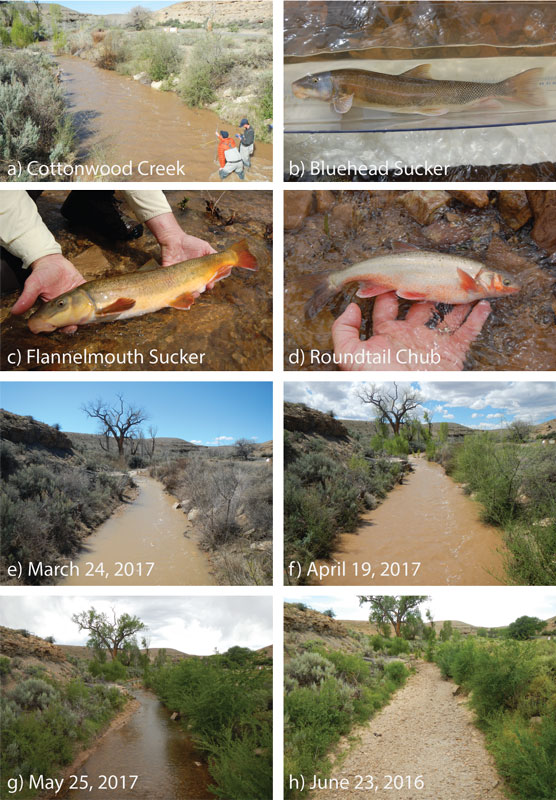
Intermittent streams only flow for a few weeks in most years (Albers 2018). The following example illustrates the peril to endangered species from the loss of protections for intermittent streams. Cottonwood Creek (a) is an intermittent tributary of the Gunnison River in the Colorado River basin, which is dry for most of the year. During the spring, when the tributary runs, it hosts large numbers of (b) Bluehead Sucker, (c) Flannelmouth Sucker, and (d) Roundtail Chub (Figure 1, Hooley-Underwood et al. 2019). These species spawn in the tributary, and their offspring move to downstream areas before the spawning habitat dries. Intermittent tributaries like these are critical for sustaining populations of these three species, which are the subject of rangewide conservation efforts to prevent listing under the Endangered Species Act (Colvin et al. 2019, Hooley-Underwood et al. 2019). Should intermittent headwater streams lose protection under the Proposed Rule, these fish could decline to levels warranting protection under the Endangered Species Act.
Figure 1. (A) Cottonwood Creek is an intermittent tributary of the Gunnison River (Colorado River basin) in western Colorado that hosts large numbers of (B) Bluehead Sucker Catostomus discobolus, (C) Flannelmouth Sucker C. latipinnis, and (D) Roundtail Chub Gila robusta during spring spawning. Stream discharge varies widely based on snowfall, but these three imperiled species show considerable behavioral plasticity in timing their entry from the main river to this headwater tributary to take advantage of the seasonally available spawning habitat it provides. Fish enter the stream as soon as water depths permit, often in consecutive years. Spawning suckers of both species displayed tributary residency of more than 25 days in years when March or early April flows were adequate (E and F), and more than 10,000 individuals used the stream annually (Hooley-Underwood et al., 2019). Adults and just-hatched larvae subsequently moved out of the stream (G), and by mid-June (H), flow ceased and the streambed dried completely. Intermittent tributaries like these are critical for sustaining populations of these three species, which are the subject of rangewide conservation efforts to prevent listing under the Endangered Species Act (Colvin et al. 2019).
Perennial streams in the arid West are predicted to experience increased drying, shifting from year-round flow to intermittent flow due to higher temperatures, prolonged droughts, earlier snowmelt, and altered precipitation, leading to reduced water availability, habitat loss, fragmented aquatic networks, and significant impacts on riparian ecosystems and native species. Climate change will only exacerbate those losses. Aquatic resources in many states, particularly in the central and western U.S., are already stressed by overuse of water and extreme weather patterns. The decline in groundwater has significantly altered flow regimes, causing many streams to shift from perennial to intermittent or even ephemeral (Colvin et al. 2019).
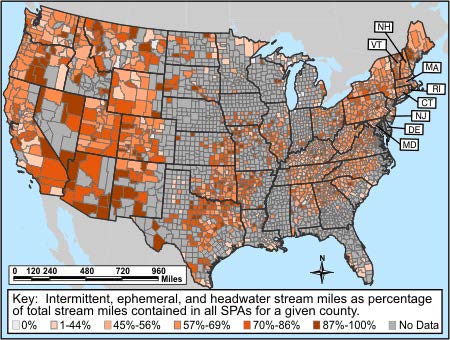
In addition to threatening fish and fisheries, the Proposed Rule threatens drinking water supplies and increases the cost of providing clean drinking water to communities. In the continental United States, about 117 million people, over one-third of the total U.S. population, get some or all of their drinking water from public drinking water systems that rely at least in part on intermittent, ephemeral, or headwater streams (USEPA 2006). Reducing the regulation of pollutants in these waters will increase costs for water treatment across the U.S. Allowing water withdrawals or increased fill of these waterways will reduce water availability to many communities. Figure 2 demonstrates the disproportionate risk to western states due to the region’s dependence on higher elevation, headwater streams that store snowpack and are often intermittent or ephemeral.
Figure 2. Map of regional patterns of dependence on intermittent, ephemeral, and headwater streams for surface drinking water by county (USEPA 2006).
Effects on Tribal Lands
Reductions in federal water protection will have a disproportionate effect on Tribal lands. Ephemeral and intermittent streams can make up large portions of watersheds on reservations, like at Fort Apache Reservation in Arizona, where ephemeral streams represent an estimated 88.6% of total stream length. Tribes rely on a variety of waterways and wetlands for traditional use, including the gathering of fish and aquatic vegetation for food, ceremony, and medicine. The plant camas (Camassia spp.) grows in non-permanent, wet prairie habitats and is used as a traditional food, medicine, and cultural plant. The proposed rule would put the waters where the plant grows at even greater risk. The U.S. government has a trust responsibility to protect these resources on reservations, and it can only do so by incorporating the needs of Tribal communities and aligning policy with science (Sulliván et al. 2024).
Value of Wetlands and Proposed Changes to Wetland Mosaics/Complexes
The Proposed Rule seeks to further reduce CWA protections for wetlands by shifting how wetland complexes or mosaics are treated. Wetland complexes include non-floodplain wetland types like prairie potholes, Carolina Bays, playas, and vernal pools, which provide ecosystem services such as flood mitigation and groundwater recharge, as well as habitat for many threatened and endangered species. Lands that include these wetland complexes would require individual delineation rather than being treated as a connected ecosystem. Wetland complexes often contain dry landscape elements such as ridges and hummocks. While not technically considered wetlands, these structures are essential to the wetland functioning and are critical to biodiversity, water and carbon storage, and nutrient cycling (Diamond et al. 2020). Individual delineation would increase the risk of destruction and fragmentation for a variety of wetland complexes. Further, the requirement to map individual wetlands and the landscape features within those wetland complexes will add undue difficulty, complexity, and costs to the process of wetland delineation. Shifting delineation of wetlands in a mosaic will reduce important off-channel water storage vital to reducing flooding and the ability of wetlands to filter pollutants (Acreman and Holden 2013, Creed et al. 2017).
According to the National Oceanic and Atmospheric Administration (NOAA), flash floods are the second leading cause of weather-related deaths in the U.S. (Dolce 2025). Eighty-eight percent of most major U.S. cities have experienced an increase in rainfall intensity since the 1970s (Climate Central 2025). Mitigating the impact of flash floods requires maintaining or restoring connection between floodplains, bottomland forests, former wetlands, and wet prairies to increase water infiltration (Shannon et al. 2019). Individual delineation of wetland complexes would be a monumental task that risks the loss of protections afforded by these ecosystems against flash flooding.
Exclusion of Ditches
Under the Proposed Rule, ditches that are constructed entirely on dry land would not be within the CWA’s jurisdiction, even if they have relatively permanent flow and connect to jurisdictional waters. This change claims to bring clarity and reduce confusion. However, simplification of policy for landowners and developers does not equate to cleaner water. This change ignores the significant presence and impact that constructed ditches can have within watersheds, whether they be roadside or agricultural. For example, one study in a central New York watershed found that 94% of ditches were hydrologically connected to natural streams (Buchanan et al. 2012). The fact that a ditch was constructed in an upland area as opposed to within a wetland does not negate that ditch’s ability to function as a tributary, transport pollutants and sediments downstream, and negatively affect watershed health overall. Plus, determining which ditches have been excavated in dry land compared to wetlands is likely to increase costs for environmental consultants that must make a determination of what constitutes a ditch excavated in dry land versus a natural stream or within a wetland–the latter of which is not categorically excluded from the proposed rule.
State Laws Do Not Fill the Jurisdictional Gap in Coverage Left By This Rule
The notion that states will fill the gap to safeguard clean water is spurious. The argument by the agencies (USACE, USEPA) that states can better regulate waters not covered by the proposed ruling is not consistent with state legislation in practice. In fact, twenty-four states lack independent state protections to evaluate, mitigate, or protect critical waterbodies from the impacts of pollution, dredging, or filling (McElfish 2022, Sullivan et al. 2025). Seven states explicitly ban more stringent clean water protections than federal jurisdiction and nineteen have significant barriers to stricter regulations. Post-Sackett, there will certainly be a significant gap in clean water protections in the U.S. Further reductions would result from the Proposed Rule, leaving fish and fisheries, as well as the multiple ecosystem services that streams and wetlands provide, in significant peril. Given the existing regulatory gaps at the state and territory levels, the Proposed Rule does not adequately address how the agencies achieve the objective of the CWA “to restore and maintain the chemical, physical, and biological integrity of the nation’s waters.”
Conclusion
Over the last 50 years, with the safeguards of a science-based law, our nation has enjoyed improvements in water quality and ecosystem function that have allowed fishable and swimmable waters. The Proposed Rule undermines these gains and threatens the health of streams and wetlands while increasing risks of flooding and increasing costs for municipal and industrial treatment of water polluted from upstream sources. Thank you for considering our science-based recommendations.
Sincerely,
Jeff Kopaska Executive Director American Fisheries Society
Susan Park Executive Director Coastal and Estuarine Research Federation
References
Acreman, M. and Holden, J. 2013. How wetlands affect floods. Wetlands. 33 (5): 773 – 786. https://link.springer.com/article/10.1007/s13157-013-0473-2
Albers, J. L., Wildhaber, M. L., and Green, N. S. 2018. Population viability analyses for three Macrhybopsis spp. of the Lower Missouri River. Journal of Applied Ichthyology. 34: 1285–1292. https://doi.org/10.1111/jai.13791
Alexander, R. B., Boyer, E. W., Smith, R. A., Schwarz, G. E., and Moore, R. B. 2007. The role of headwater streams in downstream water quality. Journal of the American Water Resources Association. 43: 41-59.
Brinkerhoff, C. B., Gleason, C. J., Kotchen, M. J., Kysar, D. A., and Raymond, P. A. 2024. Ephemeral stream water contributions to United States drainage networks. Science. 384: 1476–1482. https://doi.org/10.1126/science.adg9430
Buchanan, B. P., Falbo, K., Schneider, R. L., Easton, Z. M., and Walter, M. T. 2012. Hydrological impact of roadside ditches in an agricultural watershed in Central New York: implications for non-point source pollutant transport. Hydrological Processes. 27(17): 2422-2437. https://doi.org/10.1002/hyp.9305
Chizen, C. J., Bedard-Haughn, A. K. 2025. Drivers of Soil Carbon Variability in North America’s Prairie Pothole Wetlands: A Review. Wetlands. 45: 18. https://doi.org/10.1007/s13157-025-01898-9
Climate Central. 2025. “Heavier Rainfall Rates in U.S. Cities.” Updated March 26, 2025. https://www.climatecentral.org/climate-matters/heavier-rainfall-rates-in-us-cities
Colvin, S. A. R., Sulliván, S. M. P., Shirey, P. D., Colvin, R. W., Winemiller, K. O., Hughes, R. M., Fausch, K. D., Infante, D. M., Olden, J. D., Bestgen, K. R., Danehy, R. J., and Eby, L. 2019. Headwater streams and wetlands are critical for sustaining fish, fisheries, and ecosystem services. Fisheries. 44: 73-91. https://doi.org/10.1002/fsh.10229
Creed, I. F., Lane, C. R., Serran, J. N., Alexander, L. C, Basu, N. B., Calhoun, A. J. K., Christensen, J. R., Cohen, M. J., Craft, C., D’Amico, E., and Rains, M. C. 2017. Enhancing Protection for Vulnerable Waters. Nature Geoscience. 10: 809–815. https://www.nature.com/articles/ngeo3041
Diamond, J. S., Epstein, J. M., Cohen, M. J., McLaughlin, D. L., Hsueh, Y., Keim, R. F., and Duberstein, J. A. 2020. A little relief: Ecological functions and autogenesis of wetland microtopography. WIREs Water. 8: e1493. https://doi.org/10.1002/wat2.1493
Dolce, C. 2025. 20 US Flood Deaths In 4 Days A Reminder America’s Second-Biggest Weather Killer Is Not What You Think. The Weather Channel. Published June 17, 2025. https://weather.com/safety/floods/news/2025-06-16-americas-second-deadliest-weather-type-flooding
Dykstra, S. L. and Dzwonkowski, B. 2021. The Role of Intensifying Precipitation on Coastal River Flooding and Compound River-Storm Surge Events, Northeast Gulf of Mexico. Water Resources Research. 57(11): e2020WR029363. https://doi.org/10.1029/2020WR029363
Frimpong, E. A., and Angermeier, P. L. 2009. Fish traits: A database of ecological and life-history traits of freshwater fishes of the United States. Fisheries. 34: 487–493.
Hooley-Underwood, Z. E., S. B. Stevens, N. R. Salinas, and K. G. Thompson. 2019. An Intermittent Stream Supports Extensive Spawning of Large-River Native Fishes. Transactions of the American Fisheries Society. 148: 426-441. https://doi.org/10.1002/tafs.10141
Kiro, Y. 2025. Coastal aquifers key contributors to ocean chemistry through solute fluxes. Nature Communications. 16: 7082. https://doi.org/10.1038/s41467-025-62411-8
Lee, S. K., Lopez, H., Chung, E. S., DiNezio, P., Yeh, S. W., and Wittenberg, A. T. 2018. On the Fragile Relationship Between El Niño and California Rainfall. Geophysical Research Letters. 45(2): 907-915. https://doi.org/10.1002/2017GL076197
Leibowitz, S. G., Wigington, P. J., Schofield, K. A., Alexander, L. C., Vanderhoof, M. K. and Golden, H. E. 2018. Connectivity of Streams and Wetlands to Downstream Waters: An Integrated Systems Framework. Journal of the American Water Resources Association. 2018(2): 298-322. https://onlinelibrary.wiley.com/doi/10.1111/1752-1688.12631
Li, Z. and Quiring, S. M. 2021. Identifying the Dominant Drivers of Hydrological Change in the Contiguous United States. Water Resources Research. 57(5). https://doi.org/10.1029/2021WR029738
Fricke, R., Eschmeyer, W. N., and Van der Laan, R. editors. 2025. Eschmeyer’s catalog of fishes: genera, species, references. California Academy of Sciences, San Francisco, California. Accessed December 11, 2025. http://researcharchive.calacademy.org/research/ichthyology/catalog/fishcatmain.asp
McElfish, J. 2022. State protection of nonfederal waters: turbidity continues. Environmental Law Reporter. 52: 10679-10692. Meyer, J. L., Strayer, D. L., Wallace, J. B., Eggert, S. L., Helfman, and Leonard, N. E. 2007. The contributions of headwater streams to biodiversity in river networks. Journal of the American Water Resources Association. 43: 86-103. https://doi.org/10.1111/j.1752-1688.2007.00008.x
Mitsch, W., and Gosselink, J. 2000. Wetlands. 3rd ed. John Wiley and Sons. Natural Resources Defense Council (NRDC). 2025. Mapping Destruction: Using GIS modeling to show the disastrous impacts of Sackett v. EPA on America’s Wetlands. Published March 24, 2025. https://www.nrdc.org/resources/mapping-destruction
Nadeau, T. L., and Rains, M. C. 2007. Hydrological connectivity between headwater streams and downstream waters: how science can inform policy. Journal of the American Water Resources Association. 43: 118–133. https://doi.org/10.1111/j.1752-1688.2007.00010.x
Page, L. M., Espinosa-Pérez, H., Findley, L. T., Gilbert, C. R., Lea, R. N., Mandrak, N. E., Mayden, R. L., and Nelson, J. S. 2013. Common and scientific names of fishes from the United States, Canada, and Mexico. 7th ed. American Fisheries Society, Spec. Publ. 34. Bethesda, MD. 243 pp.
Richardson, J. L., M. J. Vepraskas, and Christopher, B.C, editors. 2016. Wetland Soils: Genesis, Hydrology, Landscapes, and Classification. 2nd ed. CRC Press, Taylor and Francis Group.
Shannon, P. D., Swanston, C. W., Janowiak, M. K., Handler, S. D., Schmitt, K. M., Brandt, L. A., Butler-Leopold, P. R., and Ontl, T. 2019. Adaptation strategies and approaches for forested watersheds. Climate Services. 13: 51–64. https://doi.org/10.1016/j.cliser.2019.01.005
Simpson, S. D. 2024. Top Agricultural Producing Countries. Updated November 14, 2024. Investopedia. https://www.investopedia.com/financial-edge/0712/top-agricultural-producing-countries.aspx
Sulliván, S. M. P., Hughes, R. M., Vadas, R. L., Davies, G. T., Shirey, P. D., Colvin, S. A. R., Infante, D. M., Danehy, R. J., Sanchez, N. K., and Keast, R. B. 2025. Waterbody connectivity: Linking science and policy for improved waterbody protection. BioScience. 75: 68–91. https://doi.org/10.1093/biosci/biae117
Sulliván, S. M. P., Hedden-Nicely, D., Bulltail, G. 2024. Enhancing water protection on Tribal lands. Frontiers in Ecology and the Environment. 22(6): e2751. https://doi.org/10.1002/fee.2751
U.S. Army Corps of Engineers (USACE). 1987. Corps of Engineers Wetlands Delineation Manual. Environmental Laboratory U.S. Army Corps of Engineers, Waterways Experiment Station, Wetlands Research Program Technical Report Y-87-1. Vicksburg, MS. https://www.sac.usace.army.mil/portals/43/docs/regulatory/1987_wetland_delineation_manual_reg.pdf
U.S. Army Corps of Engineers (USACE). 2025. Regional Supplements to Corps Delineation Manual. https://www.usace.army.mil/Missions/Civil-Works/Regulatory-Program-and-Permits/reg_supp/
U.S. Environmental Protection Agency (USEPA). 2006. Geographic Information Systems Analysis of the Surface Drinking Water Provided by Intermittent, Ephemeral, and Headwater Streams in the U.S. US. Environmental Protection Agency. Washington, D.C. Last updated December 2, 2025. https://www.epa.gov/cwa-404/geographic-information-systems-analysis-surface-drinking-water-provided-intermittent
U.S. Environmental Protection Agency (USEPA). 2015. Connectivity of streams and wetlands to downstream waters: A review and synthesis of the scientific evidence. EPA/600/R-14/475F. Office of Research and Development. U.S. Environmental Protection Agency. Washington, D.C. nepis.epa.gov/Exe/ZyPDF.cgi/P100LOJZ.PDF?Dockey=P100LOJZ.PDF
U.S. Geological Survey (USGS). 2025. Wetlands and Estuaries. Accessed January 5, 2025. https://www.usgs.gov/science/science-explorer/coasts/wetlands-and-estuaries
Wigington Jr., P. J., Ebersole, J. L., Colvin, M. E., Leibowitz, S. G., Miller, B., Hansen, B., Lavigne, H. R., White, D., Baker, J. P., Church, M. R., Brooks, J. R., Cairns, M. A., and Compton, J. E. 2006. Coho salmon dependence on intermittent streams. Frontiers in Ecology and the Environment. 4: 513–518. https://doi.org/10.1890/1540-9295(2006)4[513:CSDOIS]2.0.CO;2
Xin, P., Wilson, A., Shen, C., Ge, Z., Moffett, K. B., Santos, I. R., Chen, X., Xu, X., Yau, Y. Y. Y., Moore, W., Li, L., and Barry, D. A. 2022. Surface Water and Groundwater Interactions in Salt Marshes and Their Impact on Plant Ecology and Coastal Biogeochemistry. Reviews of Geophysics. 60(1): e2021RG000740. https://doi.org/10.1029/2021RG000740
Xu, Y. 2022. Clean water doesn’t come cheap: Nebraska towns are shelling out millions to treat nitrate-laced drinking water. Flatwater Free Press. Published December 14, 2022. https://nebraskapublicmedia.org/en/news/news-articles/clean-water-doesnt-come-cheap-nebraska-towns-are-shelling-out-millions-to-treat-nitrate-laced-drinking-water/
Recent News
This website uses cookies to improve your experience. AcceptRead More
Privacy & Cookies Policy
Privacy Overview
This website uses cookies to improve your experience while you navigate through the website. Out of these, the cookies that are categorized as necessary are stored on your browser as they are essential for the working of basic functionalities of the website. We also use third-party cookies that help us analyze and understand how you use this website. These cookies will be stored in your browser only with your consent. You also have the option to opt-out of these cookies. But opting out of some of these cookies may affect your browsing experience.
Necessary cookies are absolutely essential for the website to function properly. This category only includes cookies that ensures basic functionalities and security features of the website. These cookies do not store any personal information.
Any cookies that may not be particularly necessary for the website to function and is used specifically to collect user personal data via analytics, ads, other embedded contents are termed as non-necessary cookies. It is mandatory to procure user consent prior to running these cookies on your website.