Skip to content

American Fisheries Society Family of Websites:

Fisheries.org

American Fisheries Society
Family of Websites

Journals

Read our five journals and Fisheries magazine

Gray Literature Database

Find thousands of unpublished agency reports and other information

Annual Meeting

Join us in Columbus in 2026

Divisions, Chapters, Sections

Find an AFS Unit near you or in your area of specialty

Fishbook

Fisheries Collaboration Network

Climate Change and Fisheries

Learn how to communicate the effects of climate change on fisheries

Hutton Junior Fisheries Biology Program

Summer internships for high school students

Community Growth and Connections

Explore our initiatives to build community in the Society and in the fisheries profession

Center for Fisheries Technology and Collaboration

Find fisheries science products and services

Center for Technology and Collaboration

Quick answers to common questions

Other Resources
  • Standard Methods for Sampling North American Freshwater Fish Website

  • Rotenone Stewardship Program Information Site

  • Fishionary: A blog about fish words! 
Latest News
2026 Officer Election Voting Now Open AFS Calls for Continued Protection of Boundary Waters from Mining Proposed Rule Would Undermine Science-based Endangered Species Act Future of Public Trust Resources – Statement of the American Fisheries Society Latest Newsletter
Donate
Login
Logout
$0.00 0 Cart
  • Who We Are

    Who We Are

    Governance

    Learn how AFS is structured

    Divisions, Sections, Chapters

    Find a community in your local
    area or in your expertise

    Committees

    Get engaged and volunteer

    Awards & Recognition

    Nominate your heroes

    Community Growth and Connections

    Learn more about our community-building efforts

    AFS Celebrates 150+ Years

    Explore our history

    AFS Fisheries Partnerships

    Meet our global partners

    Meet the Staff

    Dedicated to serving our members

    Contact Us

    Quick answers to common questions

    Support AFS

    Discover how you can support critical AFS programs

    What Are Fisheries?

    Explore fisheries professions

  • MEMBERSHIP

    Membership

    Learn about membership benefits and member types

    Member Directory

    Find your colleagues

    Types of Membership

    For all stages of your career

    Give the Gift
    of Membership

    Invest in an aspiring fisheries
    professional’s future

    Who Are Our Members

    From students to 50-year Golden Members

    Governance

    Learn about our organization and leadership

    My Account

    Log in to access member benefits or renew

    Join/Renew

    It’s Quick and Easy

    Organizational Membership

    Become a Strategic Partner!

  • POLICY

    POLICY

    Recovering America’s
    Wildlife Act

    Critical funding for state conservation programs

    Climate Change

    Communicate the impacts
    of climate change on fisheries

    Magnuson-Stevens Act

    Ensuring sustainability of marine fisheries

    Waters of the US

    News about Clean Water Act
    jurisdiction

    Water Quality

    Healthy fisheries require healthy waters

    Pebble Mine

    Protecting Bristol Bay salmon fisheries

    National Fish
    Habitat Partnership

    Addressing fish habitat regionally

    Infrastructure

    Funding impacts on fish habitat

    Aquaculture

    Providing food security for the future

    Future of the Nation’s
    Aquatic Resources

    Priorities for US fisheries policies

    Recent Policy Statements

    Official policy statements of AFS

    Policy Letters

    Comments on policy,
    legislation, and regulations

    Sport Fish Restoration Act

    Understanding its importance in funding state agency fisheries management

    Advocacy Guidelines

    For Units and members

    Science Guidelines

    Practicing science appropriately

    Briefings

    Congressional briefings with our partners

    Resolutions

    Member-approved resolutions
    on policy

  • NEWS

    News

    Announcements

    Official AFS news

    Annual Meeting

    News from the meeting

    Members in the News

    Awards and interviews

    Policy News

    Round-up of all policy news

    Beneath the Surface Podcast

    A deep dive into the programs and people at AFS

    Federal Workforce and Budget Cuts

    Resources and Ways to Take Action

    Newsletter

    Bi-weekly newsletter for members and partners

    Press Releases

    News media releases

  • EVENTS

    Events

    Annual Meeting

    Columbus 2026

    Future Annual Meetings

    Where we are heading

    Past Annual Meetings

    Where we’ve been

    World Fisheries Congress 2024

    Seattle, Washington

    Other Past Events

    Past special events

    Fisheries Events Calendar

    Events around the world

    Add Your Event Listing

    Submit your calendar item

  • JOBS

    Jobs

    Career Help from AFS

    Compilation of job listing boards

    Other Career Tips

    Career info for members

    Find a Job

    Listings from all over North America

    Post a Job

    Submit your job opening

  • PUBLICATIONS

    Publications

    AFS Journals Program

    More than 150 years of excellence

    AFS Books Program

    Publish with AFS

    Submit Journal Article

    Reach the right audience for your research

    Fisheries Magazine

    Monthly membership magazine

    Writing Tools

    Guides for authors and other resources

    Fishy Fridays

    Weekly blog highlighting AFS fisheries journal articles

    Bookstore

    Shop more than 180 titles

    Journal Online Access

    Log in to access journal articles

    Gray Literature Database

    Thousands of unpublished agency reports and research

  • Professional Development

    Professional Development

    Continuing Education

    Gain skills and enhance your career

    Professional Certification

    Official recognition of your expertise

    Hutton Junior Fisheries
    Biology Program

    Summer high school
    internship program

    Leadership Opportunities

    Hone your leadership skills, volunteer today!

    Training Opportunities Calendar

    Webinars, online courses, on-site workshops, and field training

    Webinars

    Check out upcoming sessions or browse our library

    More Online Resources

    Practical resources for fisheries professionals

  • Engagement

    Engagement

    Strategic Partners

    See how your organization can partner with AFS

    Support AFS

    Discover how you can support critical AFS programs

    The 1870 Society

    Recognizing generous individual donors who invest in the Society's mission

    2024 Annual Report

    Find out what AFS did for the fisheries community in 2024

    Shop AFS

    Check out the latest AFS merch here

Login
Logout

Step Aboard One of America’s Most Advanced Ocean Research Vessels

  • November 18, 2023
  • News
  • Home
  • Step Aboard One of America’s Most Advanced Ocean Research Vessels

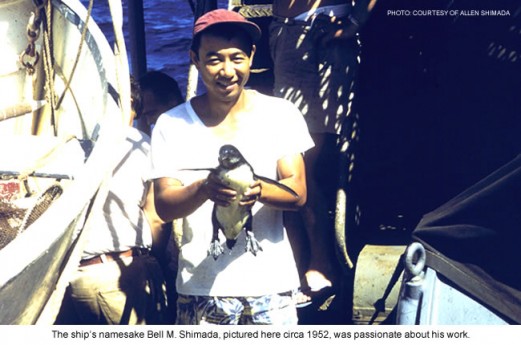
Wired Magazine is cool.  NOAA’s newest research vessel, the Bell Shimada is even cooler.  And Allen Shimada, the son of the man for whom the vessel was named – Bell – is an active member of AFS and is on the governing board ofAIFRB.  Thus, we thought it was high time we introduced those few who didn’t know, about the connection!
allen-shimada-bell-521x345

Bell M. Shimada – the father of Allen Shimada – had a distinguished fisheries biologist career, making a lasting contribution in the early study of Pacific tuna stocks – so distinguished, in fact, that the National Oceanic and Atmospheric Administration (NOAA) paid tribute to Shimada by commissioning their latest research vessel in his name a couple of years ago. The Bell M. Shimada is a 208-feet, state-of-the-art research vessel studies  a wide range of marine life and ocean conditions along the West Coast. The ship operates primarily in U.S. waters from Washington state to Southern California.

allen-shimada1-429x345

Shimada died in a 1958 plane crash at the age of 36 during a research trip prior to taking a new job as the director of a new Bureau of Fisheries’ Eastern Pacific Tuna Investigations. He left behind his wife Rae and young children Julie and Allen, a current NOAA fisheries biologist. A native of Seattle, Shimada entered the University of Washington’s School of Fisheries in 1939, During World War II, he served in the Military Intelligence Service in Guam and at the U.S. Army headquarters in Tokyo. After the War, he received his bachelor’s, master’s and doctorate degrees from the University of Washington. In 1956 when Shimada began work for the Bureau of Fisheries to the Inter-American Tropical Tuna Commission, which was co-housed with the Scripps Institute of Oceanography, he earned a reputation as an expert on the habits of Pacific tuna.

According to Allen Shimada, the ship’s commissioning was a high honor not only for Shimada, but Rae, who was a secretary with the U.S. Bureau of Commercial Fisheries, the predecessor agency to National Marine Fisheries Service. “However, I think [his] story is only one of the many young Nisei who volunteered out of the camps for the military or government service and who rightly belong to ‘The Greatest Generation’,” said Allen Shimada, a Chicago and Washington, D.C. JACL member. The ship was named by a team of students from Marina High School in Monterey, Calif. that won a regional NOAA contest to name the vessel.

Step Aboard One of America’s Most Advanced Ocean Research Vessels
By Joe Hanson / Wired Magazine

Right now, off the west coast of the United States, the world’s quietest non-military ship is cutting through the waves and deploying advanced underwater sensors, high-tech trawling equipment and sensitive sonar arrays. All in search of a few good sardines.

Photo 1:

bell1-517x345

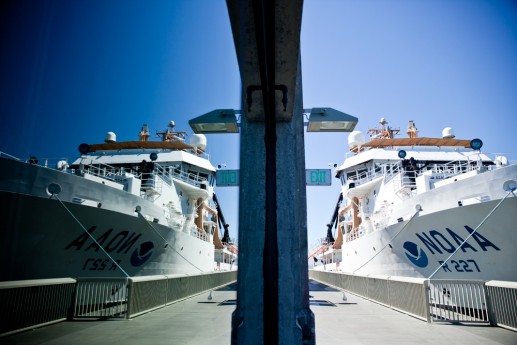
The National Oceanic and Atmospheric Administration manages a fleet of aircraft and ships charged with collecting data on the nation’s oceans, atmosphere and everything in between. Recently, NOAA’s ship the Bell M. Shimada docked at San Francisco’s Exploratorium (above), midway through a survey mission between San Diego and Vancouver Island, Canada. WIRED got a chance to look inside one of the most advanced marine research vessels on Earth.

The Bell M. Shimada, launched in 2010, measures 209 feet in length, and to the untrained eye looks a lot like a commercial fishing vessel. But instead of fish-processing conveyer belts, it’s full of advanced scientific instruments. The newest NOAA ship in its class, its crew is charged with monitoring west coast fisheries from Vancouver to Baja. With a range of 12,000 nautical miles, NOAA can conduct field studies stretching up to 40 days a time. Their current mission found them surveying schools of sardines and hake along the Pacific coast, both important food sources for larger fish and mammals.

Photo 2:

bell2-517x345

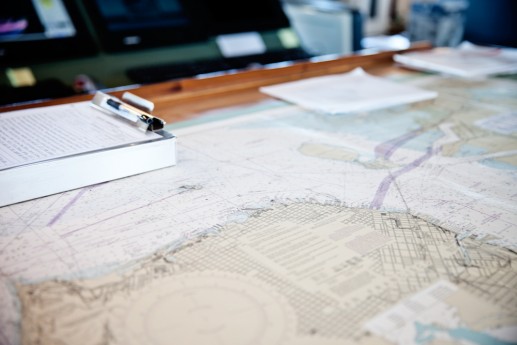
Even the most advanced fisheries research vessel in the world, its bridge armed with multi-band radar, terrain-sensing sonar and forward-looking infrared sensors, still needs paper maps. Just in case.

Photo 3:

bell3-517x345

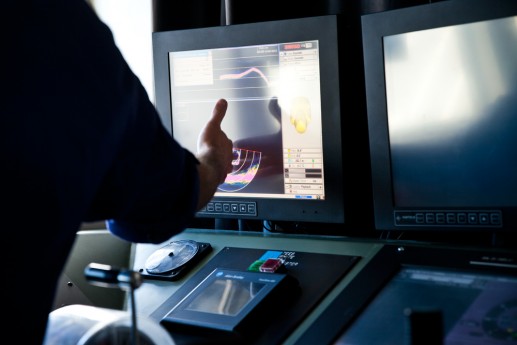
From the bridge, the NOAA crew can not only pilot the ship, but also command the ship’s advanced sonar and fishing equipment. According to Commander Scott Sirois, they operate much like those on a commercial fishing vessel would, scanning the sea below them for the characteristic blip of a fish school and then trawling large nets behind them to reel in their study subjects.

Photo 4:

bell4-517x345

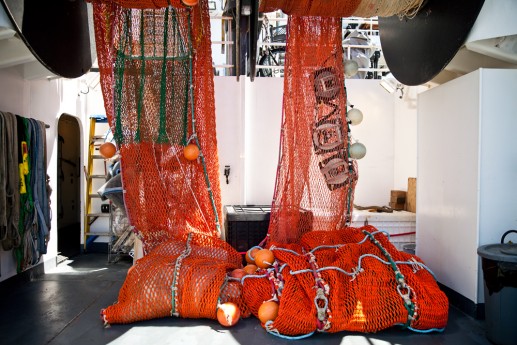
The equipment used by the crew of the Bell M. Shimada to net their catch has some key differences from that used by commercial fishermen. Instead of thousands of fish, the NOAA scientists only want to catch a few dozen at a time. Visible on the above right, their fishing net is armed with an array of GoPro cameras. This allows them to tally their haul one fish at a time, making every effort not to disrupt the populations they are studying. On the left, a net has a large metal gate with bars. This device is wide enough to allow fish inside the net, but prevents marine mammals like dolphins and seals from getting tangled up in the gear by diverting them to the side. This science is dolphin-safe.

Photo 5:

bell5-545x307

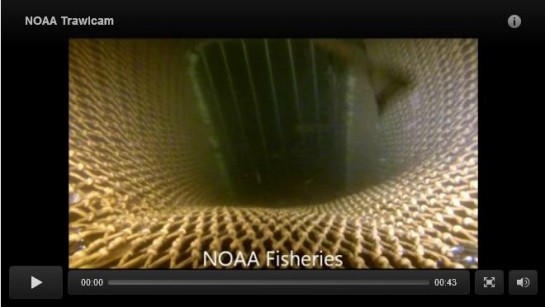
The crew of the Bell M. Shimada aren’t the only ones in the ocean looking to grab a few fish. In the video above, captured by one of the onboard net cameras, an uninvited visitor tries to snatch a snack but is thwarted by the exclusion gate. Click on here to see the NOAA Trawl Cam!)

Credit: NOAA

Photo 6:

bel6-517x345

Phil White (above) is the chief survey technician on board the Bell M. Shimada. Much of the work on this fisheries research vessel doesn’t involve the fish themselves, but rather the ocean they live in. Arrays of automated collection bottles called rosettes are lowered over the side to return water samples from various depths.

Inside the chemistry lab, White and fellow technicians analyze those water samples for characteristics like conductivity and density. These data are then uploaded to NOAA computers on shore to give scientists from Ghana to Galveston an up-to-date picture of ocean conditions.

The array of tubes and boxes on the wall behind him measures the seawater’s carbon dioxide content by spraying a droplet of seawater through a laser beam. Increased CO2 concentrations in the ocean caused by climate change can affect the health of plankton as well as the fish that depend on them for food.

Photo: Ariel Zambelich/Wired

Photo 7:

bell7-517x345

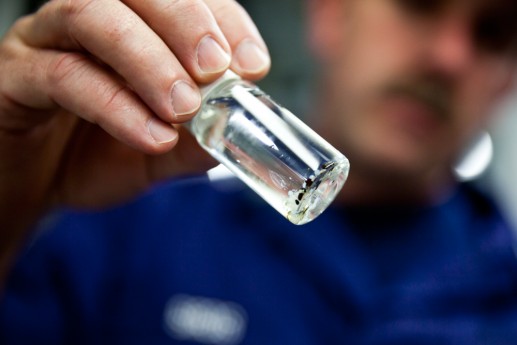
Every hour while at sea, a pump aboard the Bell M. Shimada delivers a sample of seawater, and all the microscopic life it holds, to the ship’s chemistry lab. There, plankton content is measured and any fish or squid eggs are counted and marked for species before storing them away in their freezer. Blood and tissue samples from the research catch are also analyzed here on this floating data collection platform. Depending on the mission, the scientists on board will collect data like sex, size, feeding behavior, age, and reproductive condition of the fish.

Above, Commander Scott Sirois holds a vial of squid eggs collected outside of San Francisco Bay.
Photo: Ariel Zambelich/Wired

Photo 8:

bell8-517x345

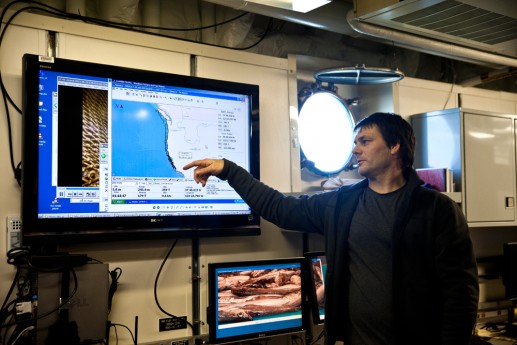
The heart of the Bell M. Shimada’s cutting-edge science capability lies within the acoustics lab. Randy Cutter (above), a NOAA scientist, spends his days “listening” to the ocean. On the array of monitors before him, he can access all the data collected in the ship’s wake, including sonar surveys and images of the fish collected up in the processing lab.

Photo: Ariel Zambelich/Wired

Photo 9:

bell9-517x345

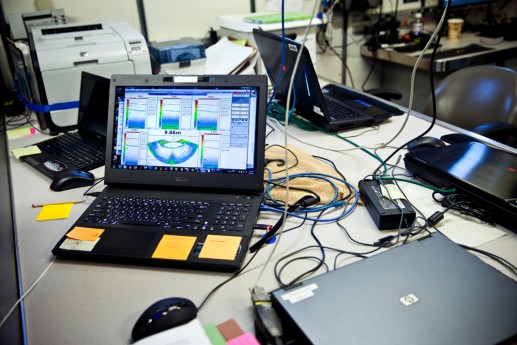
A sonar array mounted to the bottom of the ship is used to echolocate fish and map shallow terrain. Unlike military sonar, which has been linked to whale deaths, the high frequencies used by the scientists are not thought to interfere with marine life. Computers onboard the ship stitch these sound slices into 3-D reconstructions of the world below them, able to create models of fish schools and detailed landscapes.

Photo: Ariel Zambelich/Wired

Photo 10:

bell10-517x345

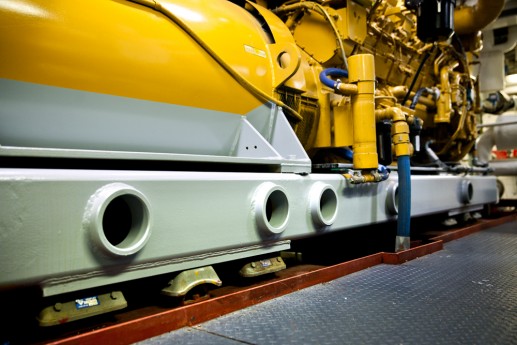
The real marvel of a ship like the Bell M. Shimada is its acoustic signature. Or, more accurately, the lack thereof. Every moving part on the ship, from the enormous diesel-electric engines to small ventilation fans and oil pumps, is mounted on specially-designed shock absorbers. Everything from the paint to the prop has been carefully engineered to minimize noise, which would otherwise contaminate the low-impact research. By decreasing vibrations within the hull, the ship is able to travel through the seas with the quietest sound signature of any non-military ship in the world.

Above, one of the 1,360 kW diesel generators is shown mounted on shock-absorbing dampeners.

Photo: Ariel Zambelich/Wired

Story by Wired.  Intro compiled by AIFRB and Pacific Citizen.

AFS wants to thank AIFRB for allowing us to reprint this on Fisheries.org.

  • Recent News

    • AFS Urges Modernization of Sporting Goods Excise Tax that Funds Fisheries Conservation May 13, 2026
    • Is Bigger Better for Hatchery Chinook Salmon? May 1, 2026
    • Webinar: A Perpetual Franchise to Cultivate Oysters April 30, 2026
    • Webinar: Skin Cancer Risk and Outdoor Workers: Early Detection and Sun Protection Could Save Your Life April 30, 2026
    • AFS Calls for Robust Funding for NOAA Fisheries April 27, 2026
  • About

    The American Fisheries Society is 501c Non-Profit Society


    Donate Now

    Quick Links

    • ABOUT
    • POLICY
    • EVENTS
    • PUBLICATIONS
    • MEMBERSHIP
    • NEWS
    • JOBS
    • Contact Us
    • ABOUT
    • POLICY
    • EVENTS
    • PUBLICATIONS
    • MEMBERSHIP
    • NEWS
    • JOBS
    • Contact Us

    Contact

    • 25 Century Boulevard
      Suite 505
      Nashville, TN 37214
    • (301) 897-8616
    Facebook-f Twitter Instagram Linkedin-in Vimeo-v

    Copyright © 2026 American Fisheries Society | Privacy Policy 

    This website uses cookies to improve your experience. Accept Read More
    Privacy & Cookies Policy

    Privacy Overview

    This website uses cookies to improve your experience while you navigate through the website. Out of these, the cookies that are categorized as necessary are stored on your browser as they are essential for the working of basic functionalities of the website. We also use third-party cookies that help us analyze and understand how you use this website. These cookies will be stored in your browser only with your consent. You also have the option to opt-out of these cookies. But opting out of some of these cookies may affect your browsing experience.
    Necessary
    Always Enabled
    Necessary cookies are absolutely essential for the website to function properly. This category only includes cookies that ensures basic functionalities and security features of the website. These cookies do not store any personal information.
    Non-necessary
    Any cookies that may not be particularly necessary for the website to function and is used specifically to collect user personal data via analytics, ads, other embedded contents are termed as non-necessary cookies. It is mandatory to procure user consent prior to running these cookies on your website.
    SAVE & ACCEPT