Brendan Runde | PhD Student at the Center for Marine Sciences and Technology, Department of Applied Ecology, North Carolina State University. E-mail: bjrunde@ncsu.edu
“Fisheries management” might be more aptly called “human management.” While not a groundbreaking revelation to the readers of Fisheries magazine, this concept can be easily forgotten by those of us who do not regularly engage with the public. Our field is a carousel of complex issues, each with diverse stakeholder groups and their associated competing needs. As a PhD student studying marine reef fisheries, one of my professional “Holy Grails” is to resolve some (one? two? any would be nice) of these problems. As I describe below, the way to achieve this goal is by convincing stakeholders that not only does science work, but that it can work for them. I recently had an opportunity to present an important aspect of my dissertation research to a surprisingly agreeable audience of individuals from every sector of the fishery, in what I hope is the first of many successful forays into human management in my career.
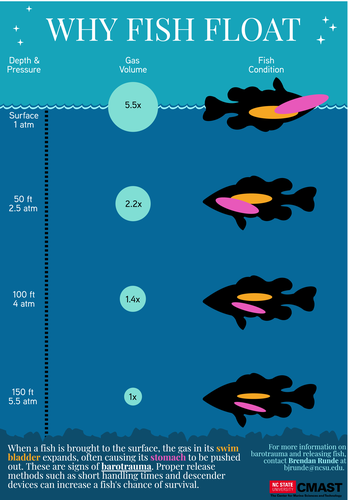
Millions of years of evolution led to the success of predatory marine bottom fishes, like snappers and groupers. Unfortunately for them, many of their evolved traits also predispose them to heavy targeting by the commercial and recreational fishing sectors alike; they are large, delicious, aggressive animals prone to capture. High levels of effort have led to overfishing of many species, which in turn has led to strict management such as lengthy seasonal closures. The problem is, a closed season does not prevent fish from being accidentally caught and summarily released; out‐of‐season species are commonly encountered by anglers targeting in‐season fish. When snappers and groupers (and other fishes with physoclistous swim bladders) are brought to the surface from the seafloor, they are exposed to a rapid decrease in barometric pressure which leads to a variety of physiological effects collectively called barotrauma (Davis 2002). In many cases, expanded gases from the swim bladder render a fish so buoyant that it is unable to re‐submerge (Figure 1). Devoid of oxygenated water and exposed to predation from above and below, floating fish are destined for mortality (Burns and Restrepo 2002). The management implications of this phenomenon are very significant since traditional measures, like closing a fishery or instituting minimum length limits, are ineffective if a large percentage of the released fish die anyway. In my corner of the world (coastal North Carolina), the tension surrounding management of species like Red Snapper Lutjanus campechanus is immense. Fishing mortality from dead discards alone is enough to keep the fishery closed for this species in some years (e.g., SAFMC 2010).
Figure 1 The first of two posters displayed at the stakeholder outreach event shows the main cause of barotrauma: differential pressure between the surface and the seafloor.
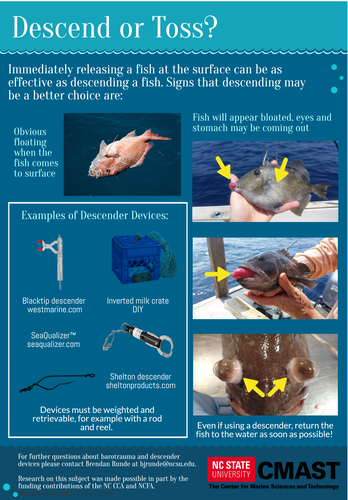
The solution may be descender devices—tools specifically designed to address the problem of floating, barotraumatized fish (Figure 2). A simple idea: return the barotraumatized fish to a depth where internal gases and organs can recompress, and maybe it will recover and live! Research at my university and other institutions have shown that this is plausible (Hannah and Matteson 2007; Curtis et al. 2015; Runde and Buckel 2018). I have collected data and video demonstrating that species like Snowy Grouper Hyporthodus niveatus, a fish notoriously susceptible to barotrauma, can live post‐release if we help them submerge. The excitement of this eureka moment was tempered by the societal can of worms it opened: changing angler behavior is historically challenging and using a descender device is more burdensome than throwing a fish back at the surface. While the South Atlantic Fishery Management Council is considering requiring descender devices on any vessel targeting bottom fish, convincing people to actually use the devices is another issue entirely. From my graduate research and the work of others, we had evidence that descender devices work, but what could I do to get people to believe in this solution?
Recent work has shown that awareness of descender devices and their usage is low in Florida (Crandall et al. 2018). Speaking with my friends and contacts in the recreational and commercial fishing communities of coastal NC indicated that our area was no different. Everyone seemed in favor of keeping floating fish alive, but were unsure of the best way to do so. I saw this as an opportunity. There is so little that unites these sectorial groups—usually at odds over fisheries management—that any common ground must be recognized as fertile. My discussions with local fishermen and contacts within fishing‐related organizations confirmed that there was interest in closing the knowledge gap. To take advantage of this, I organized an outreach event during which I demonstrated the use of a descender device called the SeaQualizer (SeaQualizer, Davie, Florida). Data and video were provided, showing our success in descending groupers, and, crucially, 25 SeaQualizer devices (US$60 each, retail) were passed out free of charge. Approximately 70 community members and stakeholders attended, including prominent commercial fishermen, charter captains, and many recreational anglers. I gave away all 25 devices to individuals expressing commitment to use them; their excitement was aroused after seeing the footage I showed of once‐floating fish swimming back to the seafloor as well as posters providing information about descender devices and barotrauma (Figures 1 and 2).
Figure 2 The second poster displayed at the stakeholder outreach event identifies signs of severe barotrauma and provides suggestions for descender devices that might reverse these potentially lethal injuries.
Several factors contributed to the success of this event. First, hosting the event in an informal setting (a local craft brewery) encouraged attendance and participation. Second, garnering the support of two influential associations was crucial. The North Carolina Chapter of the Coastal Conservation Association and the North Carolina Fisheries Association, which are respectively aligned with recreational and commercial interests, came together to provide 50/50 sponsorship of the free descender devices. This “bipartisanship” was critical—not only did they make my giveaway possible financially, but these groups also encouraged their members to attend. Third, I am fortunate to have members of the fishing community involved in my research (portions of my study involve the collaboration of two commercial fishermen and a charter boat captain). This “street cred” likely helped bridge the gap between my results and the people who can benefit from them. Everyone I spoke to during or after the event had extremely positive comments and reactions to the idea of using descender devices. I came away from the evening feeling encouraged about the chances of successfully implementing descender device use. It now seems possible—dare I say probable—that with similar and widespread outreach efforts, a pervasive problem in the management of marine coastal fisheries could be solved by stakeholder compliance with a simple solution.
This experience illuminated a shortcoming in my 8 years of studying fisheries science, one that I fear may be commonplace among my peers. We spend long hours toiling away entering data and running code, trying to understand the science of fisheries, yet many students are not engaging in a regular dialogue with the most important species in fisheries management: humans. As one of these stakeholder‐meeting rookies, I was nervous to host the event described above. Most of my experience in public speaking has been in a conference room in front of 20 or so AFS attendees who positively breathe fisheries science. This was different—methodological jargon was off the table, and I feared I would be met with naysaying stakeholders attempting to hold me accountable for any and all perceived shortcomings in the North Carolina fishing regulations. Fortunately, my worries were unfounded. While decidedly different than presenting to other students or scientists, speaking directly to stakeholders was exciting and rewarding. I was heartened by the turnout of people who have made a livelihood or pastime of catching the fish that we both love and wanting to participate in a management solution.
I would encourage any fellow student who is working on management issues to identify a way to engage stakeholders in your science. A great way to start is by going to docks, fish cleaning stations, or tackle shops (all hotspots for stakeholder diversity). There you will have the chance to “shoot the breeze” in an informal setting with people who know the fisheries and know the issues you are working on. Find common ground between as many groups as you can, and invite everyone to have a conversation. If you take me up on this, I think that you will emerge from the experience feeling energized to apply your fresh, well‐rounded perspective to your research and to continue the dialogue between scientists and stakeholders.
ACKNOWLEDGMENTS
Brendan Runde studies varying approaches to manage deepwater reef fishes and is advised on this topic and myriad others by Jeffrey Buckel. He gratefully acknowledges the Steven Berkeley Marine Conservation Fellowship and the Joseph E. and Robin C. Hightower Graduate Student Award in Fisheries and Wildlife Sciences for supporting his work. His research is funded by NOAA’s Cooperative Research Program and Saltonstall‐Kennedy Program. SeaQualizer, LLC provided a researcher discount on descender devices, Coastal Conservation Association and North Carolina Fisheries Association provided funding for the event, and Crystal Coast Brewing Company donated the space. This column was greatly improved by discussions with Linnea Andersen. Thanks to Kelsey Dick and the South Atlantic Fisheries Management Council who supported the idea to bring people together over a cold beer to talk about fish.
Recent News
This website uses cookies to improve your experience. AcceptRead More
Privacy & Cookies Policy
Privacy Overview
This website uses cookies to improve your experience while you navigate through the website. Out of these, the cookies that are categorized as necessary are stored on your browser as they are essential for the working of basic functionalities of the website. We also use third-party cookies that help us analyze and understand how you use this website. These cookies will be stored in your browser only with your consent. You also have the option to opt-out of these cookies. But opting out of some of these cookies may affect your browsing experience.
Necessary cookies are absolutely essential for the website to function properly. This category only includes cookies that ensures basic functionalities and security features of the website. These cookies do not store any personal information.
Any cookies that may not be particularly necessary for the website to function and is used specifically to collect user personal data via analytics, ads, other embedded contents are termed as non-necessary cookies. It is mandatory to procure user consent prior to running these cookies on your website.