Skip to content

American Fisheries Society Family of Websites:

Fisheries.org

American Fisheries Society
Family of Websites

Journals

Read our five journals and Fisheries magazine

Gray Literature Database

Find thousands of unpublished agency reports and other information

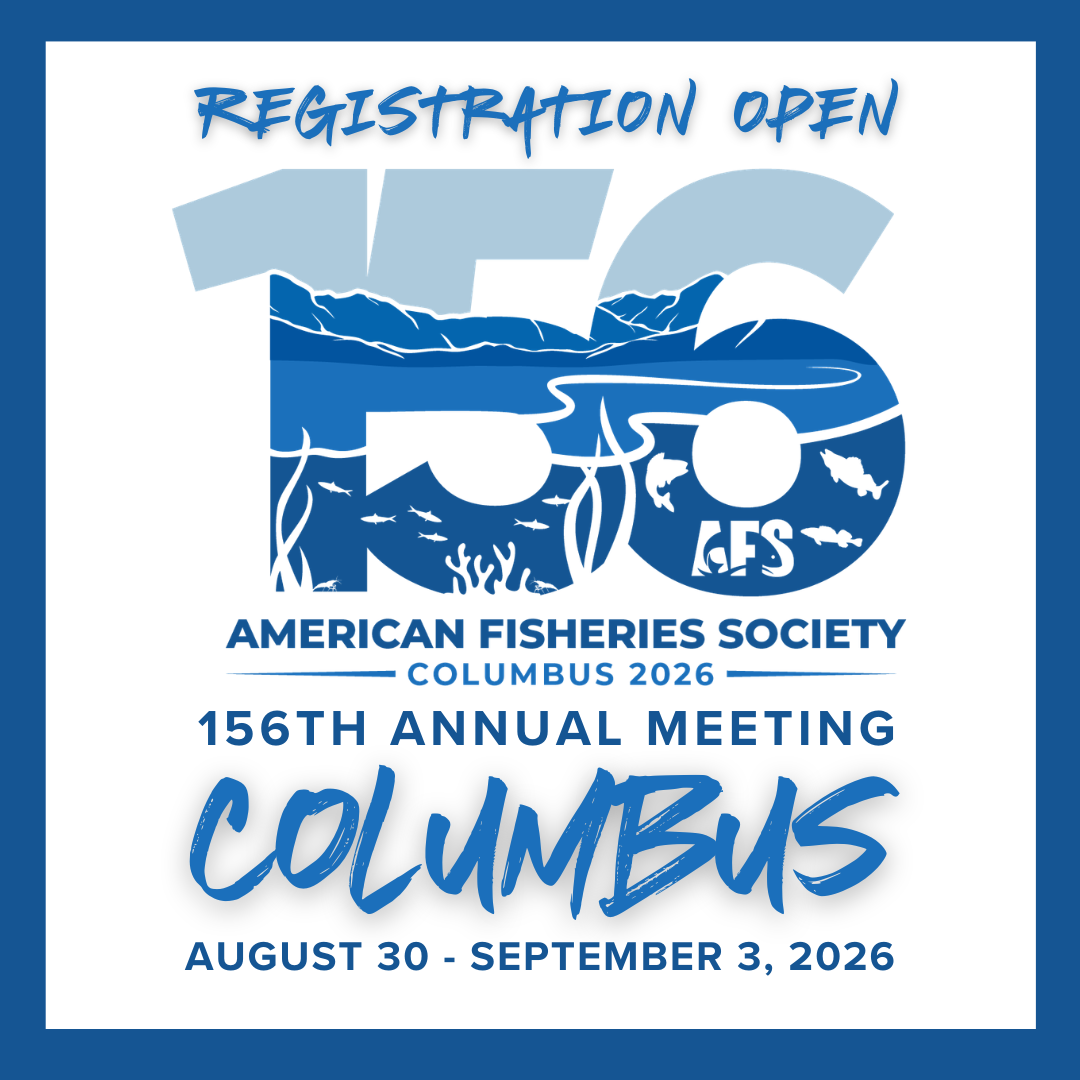
Annual Meeting

Join us in Columbus in 2026

Divisions, Chapters, Sections

Find an AFS Unit near you or in your area of specialty

Fishbook

Fisheries Collaboration Network

Climate Change and Fisheries

Learn how to communicate the effects of climate change on fisheries

Hutton Junior Fisheries Biology Program

Summer internships for high school students

Community Growth and Connections

Explore our initiatives to build community in the Society and in the fisheries profession

Center for Fisheries Technology and Collaboration

Find fisheries science products and services

Center for Technology and Collaboration

Quick answers to common questions

Other Resources
  • Standard Methods for Sampling North American Freshwater Fish Website

  • Rotenone Stewardship Program Information Site

  • Fishionary: A blog about fish words! 
Latest News
2026 Officer Election Voting Now Open AFS Calls for Continued Protection of Boundary Waters from Mining Proposed Rule Would Undermine Science-based Endangered Species Act Future of Public Trust Resources – Statement of the American Fisheries Society Latest Newsletter
Donate
Login
Logout
$0.00 0 Cart
  • Who We Are

    Who We Are

    Governance

    Learn how AFS is structured

    Divisions, Sections, Chapters

    Find a community in your local
    area or in your expertise

    Committees

    Get engaged and volunteer

    Awards & Recognition

    Nominate your heroes

    Community Growth and Connections

    Learn more about our community-building efforts

    AFS Celebrates 150+ Years

    Explore our history

    AFS Fisheries Partnerships

    Meet our global partners

    Meet the Staff

    Dedicated to serving our members

    Contact Us

    Quick answers to common questions

    Support AFS

    Discover how you can support critical AFS programs

    What Are Fisheries?

    Explore fisheries professions

  • MEMBERSHIP

    Membership

    Learn about membership benefits and member types

    Member Directory

    Find your colleagues

    Types of Membership

    For all stages of your career

    Give the Gift
    of Membership

    Invest in an aspiring fisheries
    professional’s future

    Who Are Our Members

    From students to 50-year Golden Members

    Governance

    Learn about our organization and leadership

    My Account

    Log in to access member benefits or renew

    Join/Renew

    It’s Quick and Easy

    Organizational Membership

    Become a Strategic Partner!

  • POLICY

    POLICY

    Recovering America’s
    Wildlife Act

    Critical funding for state conservation programs

    Climate Change

    Communicate the impacts
    of climate change on fisheries

    Magnuson-Stevens Act

    Ensuring sustainability of marine fisheries

    Waters of the US

    News about Clean Water Act
    jurisdiction

    Water Quality

    Healthy fisheries require healthy waters

    Pebble Mine

    Protecting Bristol Bay salmon fisheries

    National Fish
    Habitat Partnership

    Addressing fish habitat regionally

    Infrastructure

    Funding impacts on fish habitat

    Aquaculture

    Providing food security for the future

    Future of the Nation’s
    Aquatic Resources

    Priorities for US fisheries policies

    Recent Policy Statements

    Official policy statements of AFS

    Policy Letters

    Comments on policy,
    legislation, and regulations

    Sport Fish Restoration Act

    Understanding its importance in funding state agency fisheries management

    Advocacy Guidelines

    For Units and members

    Science Guidelines

    Practicing science appropriately

    Briefings

    Congressional briefings with our partners

    Resolutions

    Member-approved resolutions
    on policy

  • NEWS

    News

    Announcements

    Official AFS news

    Annual Meeting

    News from the meeting

    Members in the News

    Awards and interviews

    Policy News

    Round-up of all policy news

    Beneath the Surface Podcast

    A deep dive into the programs and people at AFS

    Federal Workforce and Budget Cuts

    Resources and Ways to Take Action

    Newsletter

    Bi-weekly newsletter for members and partners

    Press Releases

    News media releases

  • EVENTS

    Events

    Annual Meeting

    Columbus 2026

    Future Annual Meetings

    Where we are heading

    Past Annual Meetings

    Where we’ve been

    World Fisheries Congress 2024

    Seattle, Washington

    Other Past Events

    Past special events

    Fisheries Events Calendar

    Events around the world

    Add Your Event Listing

    Submit your calendar item

  • JOBS

    Jobs

    Career Help from AFS

    Compilation of job listing boards

    Other Career Tips

    Career info for members

    Find a Job

    Listings from all over North America

    Post a Job

    Submit your job opening

  • PUBLICATIONS

    Publications

    AFS Journals Program

    More than 150 years of excellence

    AFS Books Program

    Publish with AFS

    Submit Journal Article

    Reach the right audience for your research

    Fisheries Magazine

    Monthly membership magazine

    Writing Tools

    Guides for authors and other resources

    Fishy Fridays

    Weekly blog highlighting AFS fisheries journal articles

    Bookstore

    Shop more than 180 titles

    Journal Online Access

    Log in to access journal articles

    Gray Literature Database

    Thousands of unpublished agency reports and research

  • Professional Development

    Professional Development

    Continuing Education

    Gain skills and enhance your career

    Professional Certification

    Official recognition of your expertise

    Hutton Junior Fisheries
    Biology Program

    Summer high school
    internship program

    Leadership Opportunities

    Hone your leadership skills, volunteer today!

    Training Opportunities Calendar

    Webinars, online courses, on-site workshops, and field training

    Webinars

    Check out upcoming sessions or browse our library

    More Online Resources

    Practical resources for fisheries professionals

  • Engagement

    Engagement

    Strategic Partners

    See how your organization can partner with AFS

    Support AFS

    Discover how you can support critical AFS programs

    The 1870 Society

    Recognizing generous individual donors who invest in the Society's mission

    2024 Annual Report

    Find out what AFS did for the fisheries community in 2024

    Shop AFS

    Check out the latest AFS merch here

Login
Logout

Pricing the Priceless

  • June 10, 2019
  • News
  • Home
  • Pricing the Priceless

Jesse T. Trushenski | AFS President

The English language is full of idiosyncrasies. For every so‐called rule of spelling or grammar, there is a word or circumstance that breaks it. The word “priceless” is one example. Those unfamiliar with the word might understandably mistake its meaning for “without a price” or without value. Of course, we know it is meant to suggest the opposite: we say something is priceless when it is so valuable that its true worth is beyond calculation. These mirrored meanings—without a price and priceless—spring to mind when I consider the existence value of fish. As fisheries professionals, we talk about the importance of biodiversity and the ecological roles different organisms play. But what is the intrinsic value of a species? We are usually forced to think of conservation in dollars and cents, so we ask economists to price the priceless. They ask constituents about their “willingness to pay” for restoration activities, tally up the money spent by anglers, and grapple with the uncertain statistics of ecosystem services. However well intentioned and comprehensive the analysis, the results still seem somehow inadequate. When it comes to grasping the significance of an imperiled species simply continuing to be, I suspect we are no better accountants of their last days than we are of our own. Anyone who’s gone through the actuarial exercise of determining their life’s worth would probably argue we’re not very good at that either. When it comes to intrinsic or non‐use value, we often lack the means to articulate the true meaning of priceless, and so are left with the default assumptions of little or no value.

An estimated 99.9% of all the species that have ever lived on Earth are now extinct. The roughly 8.7 million species that remain are the fortunate 0.1% whose ancestors survived a series of mass extinction events, each having wiped the slate of life nearly clean. The first fish came into being some 530 million years ago, jawless children of the Cambrian explosion. They survived the Ordovician–Silurian Extinction (439 million years ago) that killed off 86% of life on Earth. They survived the Late Devonian Extinction (364 million years ago) that took out 75% of all living species. They were among the 4% of species surviving the Permian–Triassic Extinction (251 million years ago), the biggest of the “big five” mass extinction events. They also bore witness to the Triassic–Jurassic Extinction (199‐214 million years ago), as well as the Cretaceous–Paleogene Extinction (65 million years ago), which felled the dinosaurs and 76% of their contemporaries. Most species do not last more than 1–10 million years, but some fish species are remarkably resilient. For example, the Queensland Lungfish Neoceratodus fosterihas existed for more than 100 million years and may be the oldest of all extant vertebrate species. Fish that we recognize today as bichirs, gars, arowana and arapaima, hagfish, sturgeons and paddlefishes, mudskippers, various sharks, the infamous coelacanth, and others have existed—in more or less their current form—for hundreds of millions of years. These living fossils and the rest of the 30,000+ extant species of fish are the result of both happenstance and the patient, unyielding forces of natural selection. Some say it is better to be lucky than good; over the course of their evolutionary history, fish have been both. Where so many other species have winked out of existence, they have persisted and thrived, each a bewildering, beguiling wonder of life.

Many fishes will survive the current Anthropocene Extinction, but not all. A great number have already been lost, including more than 50 North American freshwater taxa in the last century alone (Burkhead 2012). There is a vague melancholy that comes with the realization that future generations shall only know Las Vegas Dace Rhinichthys deacon, Stumptooth Minnow Stypodon signifer, Pahrump Ranch Poolfish Empetrichthys latos pahrump, and so many other evocatively named fish from ichthyological specimens (Miller et al. 1989). The tragic fate of the Snake River Sucker Chasmistes muriei—known only from a single specimen, both the first and the last of its kind—elicits a sharper regret. These feelings of loss are not readily articulated, much less translated into monetary terms.

Not all species will survive the Holocene (present era). Some will go extinct because of human activity, some will survive despite us. We must be pragmatic and practical, and not let our desire to save all species spread efforts so thin as to save none. However, we must also leave a little room for idealism and allow ourselves to be occasionally awed by these uncanny creatures. The battle to save imperiled fishes is worth fighting, but not just because of the economic value we assign them. We can try to price the priceless, but should also remember that victory belongs not to mercenaries who fight for a price, but to warriors who fight for a cause.

References

  • Burkhead, N. M. 2012. Extinction rates in North American freshwater fishes, 1900–2010. BioScience62: 798– 808.
    Crossref | Web of Science® | Google Scholar
  • Miller, R. R., Williams, J. D., and Williams, J. E.. 1989. Extinctions of North American fishes during the past century. Fisheries 14( 6): 22– 38.

    Wiley Online Library | Web of Science® | Google Scholar
  • Recent News

    • AFS Urges Modernization of Sporting Goods Excise Tax that Funds Fisheries Conservation May 13, 2026
    • Is Bigger Better for Hatchery Chinook Salmon? May 1, 2026
    • Webinar: A Perpetual Franchise to Cultivate Oysters April 30, 2026
    • Webinar: Skin Cancer Risk and Outdoor Workers: Early Detection and Sun Protection Could Save Your Life April 30, 2026
    • AFS Calls for Robust Funding for NOAA Fisheries April 27, 2026
  • About

    The American Fisheries Society is 501c Non-Profit Society


    Donate Now

    Quick Links

    • ABOUT
    • POLICY
    • EVENTS
    • PUBLICATIONS
    • MEMBERSHIP
    • NEWS
    • JOBS
    • Contact Us
    • ABOUT
    • POLICY
    • EVENTS
    • PUBLICATIONS
    • MEMBERSHIP
    • NEWS
    • JOBS
    • Contact Us

    Contact

    • 25 Century Boulevard
      Suite 505
      Nashville, TN 37214
    • (301) 897-8616
    Facebook-f Twitter Instagram Linkedin-in Vimeo-v

    Copyright © 2026 American Fisheries Society | Privacy Policy 

    This website uses cookies to improve your experience. Accept Read More
    Privacy & Cookies Policy

    Privacy Overview

    This website uses cookies to improve your experience while you navigate through the website. Out of these, the cookies that are categorized as necessary are stored on your browser as they are essential for the working of basic functionalities of the website. We also use third-party cookies that help us analyze and understand how you use this website. These cookies will be stored in your browser only with your consent. You also have the option to opt-out of these cookies. But opting out of some of these cookies may affect your browsing experience.
    Necessary
    Always Enabled
    Necessary cookies are absolutely essential for the website to function properly. This category only includes cookies that ensures basic functionalities and security features of the website. These cookies do not store any personal information.
    Non-necessary
    Any cookies that may not be particularly necessary for the website to function and is used specifically to collect user personal data via analytics, ads, other embedded contents are termed as non-necessary cookies. It is mandatory to procure user consent prior to running these cookies on your website.
    SAVE & ACCEPT