Skip to content

American Fisheries Society Family of Websites:

Fisheries.org

American Fisheries Society
Family of Websites

Journals

Read our five journals and Fisheries magazine

Gray Literature Database

Find thousands of unpublished agency reports and other information

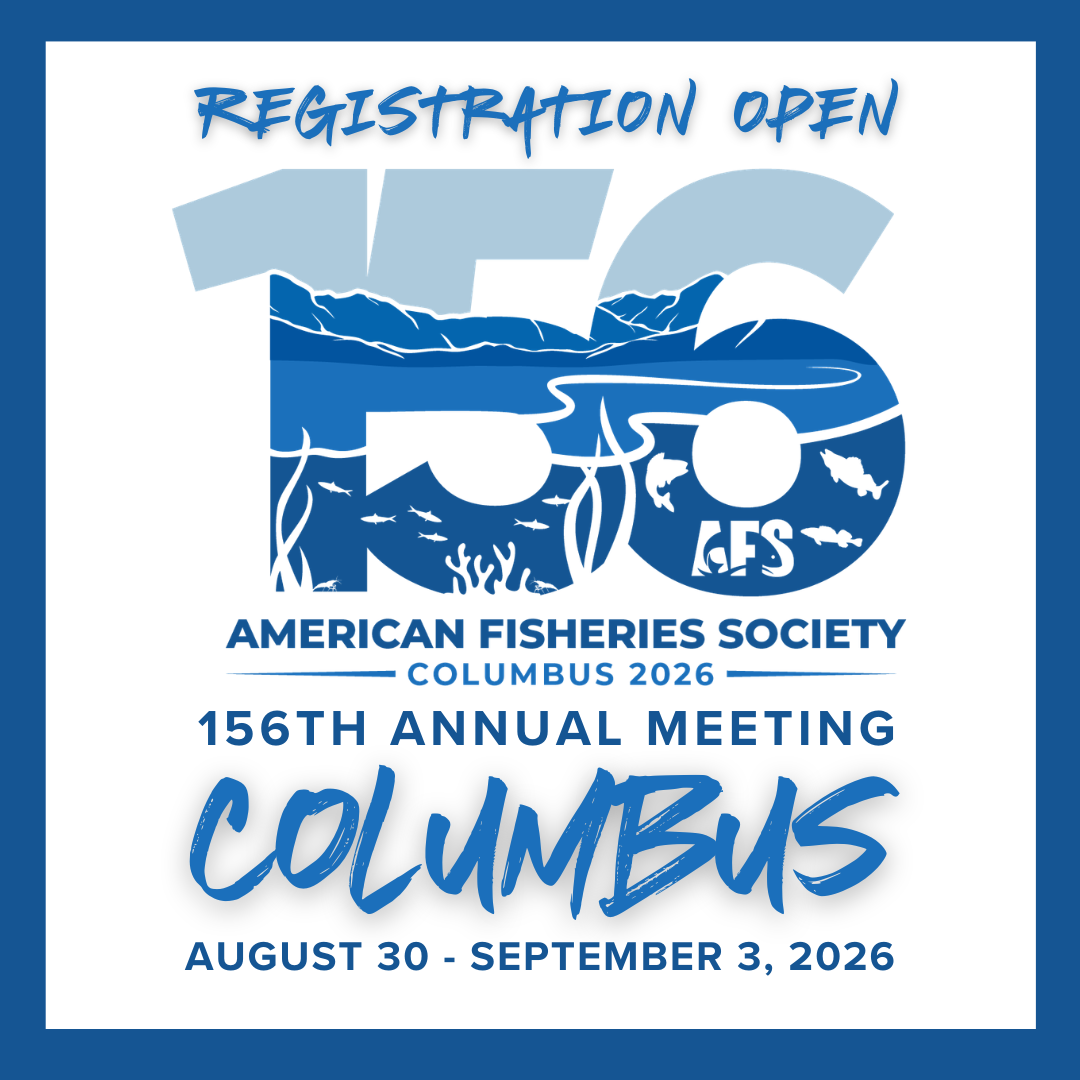
Annual Meeting

Join us in Columbus in 2026

Divisions, Chapters, Sections

Find an AFS Unit near you or in your area of specialty

Fishbook

Fisheries Collaboration Network

Climate Change and Fisheries

Learn how to communicate the effects of climate change on fisheries

Hutton Junior Fisheries Biology Program

Summer internships for high school students

Community Growth and Connections

Explore our initiatives to build community in the Society and in the fisheries profession

Center for Fisheries Technology and Collaboration

Find fisheries science products and services

Center for Technology and Collaboration

Quick answers to common questions

Other Resources
  • Standard Methods for Sampling North American Freshwater Fish Website

  • Rotenone Stewardship Program Information Site

  • Fishionary: A blog about fish words! 
Latest News
2026 Officer Election Voting Now Open AFS Calls for Continued Protection of Boundary Waters from Mining Proposed Rule Would Undermine Science-based Endangered Species Act Future of Public Trust Resources – Statement of the American Fisheries Society Latest Newsletter
Donate
Login
Logout
$0.00 0 Cart
  • Who We Are

    Who We Are

    Governance

    Learn how AFS is structured

    Divisions, Sections, Chapters

    Find a community in your local
    area or in your expertise

    Committees

    Get engaged and volunteer

    Awards & Recognition

    Nominate your heroes

    Community Growth and Connections

    Learn more about our community-building efforts

    AFS Celebrates 150+ Years

    Explore our history

    AFS Fisheries Partnerships

    Meet our global partners

    Meet the Staff

    Dedicated to serving our members

    Contact Us

    Quick answers to common questions

    Support AFS

    Discover how you can support critical AFS programs

    What Are Fisheries?

    Explore fisheries professions

  • MEMBERSHIP

    Membership

    Learn about membership benefits and member types

    Member Directory

    Find your colleagues

    Types of Membership

    For all stages of your career

    Give the Gift
    of Membership

    Invest in an aspiring fisheries
    professional’s future

    Who Are Our Members

    From students to 50-year Golden Members

    Governance

    Learn about our organization and leadership

    My Account

    Log in to access member benefits or renew

    Join/Renew

    It’s Quick and Easy

    Organizational Membership

    Become a Strategic Partner!

  • POLICY

    POLICY

    Recovering America’s
    Wildlife Act

    Critical funding for state conservation programs

    Climate Change

    Communicate the impacts
    of climate change on fisheries

    Magnuson-Stevens Act

    Ensuring sustainability of marine fisheries

    Waters of the US

    News about Clean Water Act
    jurisdiction

    Water Quality

    Healthy fisheries require healthy waters

    Pebble Mine

    Protecting Bristol Bay salmon fisheries

    National Fish
    Habitat Partnership

    Addressing fish habitat regionally

    Infrastructure

    Funding impacts on fish habitat

    Aquaculture

    Providing food security for the future

    Future of the Nation’s
    Aquatic Resources

    Priorities for US fisheries policies

    Recent Policy Statements

    Official policy statements of AFS

    Policy Letters

    Comments on policy,
    legislation, and regulations

    Sport Fish Restoration Act

    Understanding its importance in funding state agency fisheries management

    Advocacy Guidelines

    For Units and members

    Science Guidelines

    Practicing science appropriately

    Briefings

    Congressional briefings with our partners

    Resolutions

    Member-approved resolutions
    on policy

  • NEWS

    News

    Announcements

    Official AFS news

    Annual Meeting

    News from the meeting

    Members in the News

    Awards and interviews

    Policy News

    Round-up of all policy news

    Beneath the Surface Podcast

    A deep dive into the programs and people at AFS

    Federal Workforce and Budget Cuts

    Resources and Ways to Take Action

    Newsletter

    Bi-weekly newsletter for members and partners

    Press Releases

    News media releases

  • EVENTS

    Events

    Annual Meeting

    Columbus 2026

    Future Annual Meetings

    Where we are heading

    Past Annual Meetings

    Where we’ve been

    World Fisheries Congress 2024

    Seattle, Washington

    Other Past Events

    Past special events

    Fisheries Events Calendar

    Events around the world

    Add Your Event Listing

    Submit your calendar item

  • JOBS

    Jobs

    Career Help from AFS

    Compilation of job listing boards

    Other Career Tips

    Career info for members

    Find a Job

    Listings from all over North America

    Post a Job

    Submit your job opening

  • PUBLICATIONS

    Publications

    AFS Journals Program

    More than 150 years of excellence

    AFS Books Program

    Publish with AFS

    Submit Journal Article

    Reach the right audience for your research

    Fisheries Magazine

    Monthly membership magazine

    Writing Tools

    Guides for authors and other resources

    Fishy Fridays

    Weekly blog highlighting AFS fisheries journal articles

    Bookstore

    Shop more than 180 titles

    Journal Online Access

    Log in to access journal articles

    Gray Literature Database

    Thousands of unpublished agency reports and research

  • Professional Development

    Professional Development

    Continuing Education

    Gain skills and enhance your career

    Professional Certification

    Official recognition of your expertise

    Hutton Junior Fisheries
    Biology Program

    Summer high school
    internship program

    Leadership Opportunities

    Hone your leadership skills, volunteer today!

    Training Opportunities Calendar

    Webinars, online courses, on-site workshops, and field training

    Webinars

    Check out upcoming sessions or browse our library

    More Online Resources

    Practical resources for fisheries professionals

  • Engagement

    Engagement

    Strategic Partners

    See how your organization can partner with AFS

    Support AFS

    Discover how you can support critical AFS programs

    The 1870 Society

    Recognizing generous individual donors who invest in the Society's mission

    2024 Annual Report

    Find out what AFS did for the fisheries community in 2024

    Shop AFS

    Check out the latest AFS merch here

Login
Logout

Washington Takes on Climate Change? Rhetoric vs. Reality

  • May 23, 2019
  • News
  • Home
  • Washington Takes on Climate Change? Rhetoric vs. Reality

Policy Column

Drue Banta Winters | AFS Policy Director

In its first month, the 116th Congress was embroiled in a debate over funding for a border wall between Mexico and the United States, the primary roadblock in finalizing the federal fiscal year 2019 budget. The stalemate resulted in the longest government shutdown on record. Natural resource agencies were shuttered for over a month leaving a cadre of federal fish and wildlife professionals unable to conduct research, collaborate on cooperative projects with state agencies, operate critical research facilities, or make grants to academic and other nongovernmental organizations.

The border wall has become a defining battle in America’s latest culture war, but the specter of climate change looms large over the debate even if the words were barely mentioned in the mainstream press. A wall threatens to fragment migratory corridors and destroy important habitat for endangered plants and animals, both increasingly problematic in the face of climate change. On the opposite side, mass migration of refugees seeking respite from extreme weather events, rising temperatures, and drought is likely as the effects of climate change become more severe, creating additional challenges for the USA.

At the end of January, the warring factions agreed to a temporary stopgap funding measure that allowed the government to re‐open and climate got some long overdue time in the spotlight. After all, there is a presidential election on the horizon and the issue promises to be important in 2020.

February ushered in the most action on climate in nearly a decade with a flurry of press events, no fewer than seven congressional hearings, and the creation of the House Select Committee on the Climate Crisis. Not since the 2009 Waxman–Markey cap and trade bill was introduced has climate been given so much airtime.

Notably, climate champion Sen. Ed Markey (D‐Mass.) joined freshman and self‐defined socialist Rep. Alexandria Ocasio‐Cortez (D‐N.Y.) in announcing a framework for a “Green New Deal,” a non‐binding resolution that seeks to achieve net‐zero greenhouse gas emissions in the United States by 2030, create jobs, and invest in sustainable infrastructure. A key goal of the framework is to transition 100 percent of the country’s power demand to renewable energy sources. The International Panel on Climate Change report called for drastic reductions in greenhouse gas emissions in the same time frame—11 short years. The Green New Deal does not yet lay out how to accomplish the lofty environmental goals or how to accomplish some of the social and economic concepts called for in the plan. The devil is always in the details.

Sweeping legislation will still require the support of the Republican controlled Senate and White House. Even with some Republicans acknowledging the settled science behind climate change for the first time in recent hearings, it is unlikely that economic conservatives and energy hawks will buy into the concepts proposed in the Green New Deal. Republicans pushed back against the concepts proposed as part of the deal at a House Energy and Commerce hearing with Greg Walden (R‐Ore.) citing the $5.7 trillion price tag that would be passed on to consumers and taxpayers to make the deal a reality. Rather, he suggested the right will be focused on adaptation, innovation and conservation. Democrats themselves are divided on a solution with leadership favoring an approach that would charge carbon dioxide emitters a price for the right to release it into the atmosphere.

A change of this magnitude would require a sweeping overhaul of our daily lives and our economy. Ten years is not likely to be a realistic timeframe for such a far‐reaching transition in our transportation systems, including airplanes and cars, electricity generation, agriculture, and industry to allow for such a drastic reduction in emissions. Further, without a firm commitment from other countries to reduce emissions, especially those big emitters like China and India, the United States is unlikely to take action that would disadvantage domestic business interests.

In her compelling testimony to the House Natural Resources Committee’s Water, Oceans, and Wildlife subcommittee, Deborah Bronk, President and CEO of Bigelow Laboratory for Ocean Science and former director for the National Science Foundation’s Division of Ocean Science stated, “Our challenge as a nation moving forward is to reduce the risks of climate change while capitalizing on its benefits, and I believe there will be plenty of both. The nation who will own the future will be the one that invests in the science of climate change so that decisions are based on sound data, that educates its citizen on ways to mitigate its effects, and that adapts to the new reality we all face. There has been much talk about reducing greenhouse gas emissions and as a nation we need to make this a priority…Supporting programs to advance the science and reduce the cost of green technology is critical to our country’s future. I believe it is too late, however, to rely solely on this approach to mitigate severe climate disruption. The carbon ship has left the dock and humanity has shown little commitment to taking it back into port.” It is hard to argue with these realities. The risks that climate change pose to fish and wildlife and our way of life makes it imperative that we continue to find solutions that will reduce greenhouse gas emissions, but it promises to be an uphill battle and we don’t have time to wait. As an initial matter, the fiscal year 2020 budget may provide some opportunities to make inroads. Investing in research, infrastructure, and forests could be options on the table.

AFS is working to define a proper role for the society in this dialogue and I anticipate many spirited debates on this topic. We will be forming a special working group on climate to update the science. Keep an eye out for programming in Reno this fall on the great work of the joint AFS/TWS Ecosystem Transformation working group and other exciting climate related topics. As always, consider ways that you can contribute your time and talents to this important issue whether within the society or at‐large.

  • Recent News

    • AFS Urges Modernization of Sporting Goods Excise Tax that Funds Fisheries Conservation May 13, 2026
    • Is Bigger Better for Hatchery Chinook Salmon? May 1, 2026
    • Webinar: A Perpetual Franchise to Cultivate Oysters April 30, 2026
    • Webinar: Skin Cancer Risk and Outdoor Workers: Early Detection and Sun Protection Could Save Your Life April 30, 2026
    • AFS Calls for Robust Funding for NOAA Fisheries April 27, 2026
  • About

    The American Fisheries Society is 501c Non-Profit Society


    Donate Now

    Quick Links

    • ABOUT
    • POLICY
    • EVENTS
    • PUBLICATIONS
    • MEMBERSHIP
    • NEWS
    • JOBS
    • Contact Us
    • ABOUT
    • POLICY
    • EVENTS
    • PUBLICATIONS
    • MEMBERSHIP
    • NEWS
    • JOBS
    • Contact Us

    Contact

    • 25 Century Boulevard
      Suite 505
      Nashville, TN 37214
    • (301) 897-8616
    Facebook-f Twitter Instagram Linkedin-in Vimeo-v

    Copyright © 2026 American Fisheries Society | Privacy Policy 

    This website uses cookies to improve your experience. Accept Read More
    Privacy & Cookies Policy

    Privacy Overview

    This website uses cookies to improve your experience while you navigate through the website. Out of these, the cookies that are categorized as necessary are stored on your browser as they are essential for the working of basic functionalities of the website. We also use third-party cookies that help us analyze and understand how you use this website. These cookies will be stored in your browser only with your consent. You also have the option to opt-out of these cookies. But opting out of some of these cookies may affect your browsing experience.
    Necessary
    Always Enabled
    Necessary cookies are absolutely essential for the website to function properly. This category only includes cookies that ensures basic functionalities and security features of the website. These cookies do not store any personal information.
    Non-necessary
    Any cookies that may not be particularly necessary for the website to function and is used specifically to collect user personal data via analytics, ads, other embedded contents are termed as non-necessary cookies. It is mandatory to procure user consent prior to running these cookies on your website.
    SAVE & ACCEPT