Retail Baitfish in Michigan Harbor Serious Fish Viral Pathogens
Traimat Boonthai, Thomas P. Loch, Qingli Zhang, Michelle Gunn Van Deuren, Mohamed Faisal, Gary E. Whelan, and Seth J. Herbst
Journal of Aquatic Animal Health
Indigenous small cyprinid fish species play an important role in Great Lakes ecosystems and also comprise the backbone of a multimillion‐dollar baitfish industry. Due to their widespread use in sport fisheries of the Laurentian Great Lakes, there are increasing concerns that baitfish may introduce or disseminate fish pathogens. In this study, we evaluated whether baitfish purchased from 78 randomly selected retail bait dealers in Michigan harbored fish viruses. Between September 2015 and June 2016, 5,400 baitfish divided into 90 lots of 60 fish were purchased. Fish were tested for the presence of viral hemorrhagic septicemia virus (VHSV), spring viremia of carp virus (SVCV), golden shiner reovirus (GSRV), fathead minnow nidovirus (FHMNV), fathead minnow picornavirus (FHMPV), and white sucker bunyavirus (WSBV). Using the epithelioma papulosum cyprini cell line and molecular confirmation, we demonstrated the presence of viruses in 18 of the 90 fish lots (20.0%) analyzed. The most prevalent virus was FHMNV, being detected in 6 of 30 lots of Fathead Minnow Pimephales promelas and 3 of 42 lots of Emerald Shiners Notropis atherinoides. We also confirmed GSRV in two fish species: the Golden Shiner Notemigonus crysoleucas (5 of 11 lots) and Fathead Minnow (3 of 30 lots). Two VHSV (genotype IVb) isolates were recovered from a single lot of Emerald Shiners. No SVCV, FHMPV, or WSBV was detected in any of the fish examined. Some of the infected fish exhibited clinical signs and histopathological alterations. This study demonstrates that live baitfish are a potential vector for the spread of viral pathogens and underscores the importance of fish health certifications for the Great Lakes baitfish industry.
https://doi.org/10.1002/aah.10034
Assessment of Carbon Dioxide Piscicide Treatments
Aaron R. Cupp, Justin R. Smerud, John A. Tix, Jose M. Rivera, Stacie A. Kageyama, Christopher M. Merkes, Richard A. Erickson, Jon J. Amberg, and Mark P. Gaikowski
North American Journal of Fisheries Management
- Carbon dioxide is being developed as a new aquatic piscicide to control invasive and nuisance fishes.
- Dry ice is a simple carbon dioxide delivery method to administer piscicide treatments.
- Overwinter survival of invasive Silver Carp Hypophthalmichthys molitrix and Bighead Carp H. nobilis was significantly reduced in ponds treated with carbon dioxide as dry ice.
- eDNA concentrations in pond water correlated with fish mortality during carbon dioxide piscicide treatments.
https://doi.org/10.1002/nafm.10227
Novel Feed from Invasive Species is Beneficial to Walleye Aquaculture
Sahar Mejri, Réjean Tremblay, Grant Vandenberg, and Céline Audet
North American Journal of Aquaculture
 Carnivorous fishes, such as the Walleye Sander vitreus, are nutritionally demanding for fish meal. A promising alternative to marine‐origin fish meal, the supply of which has been stagnant in recent decades, is fish meal derived from undesirable freshwater species, such as the White Sucker Catostomus commersonii. To evaluate the relative value of such ingredients, we examined the growth performance of Walleye juveniles. Two dietary treatments were tested: an experimental (EXP) diet that was manufactured using White Sucker as fish meal in comparison with a commercial (COM) diet, EWOS Micro (EWOS Canada, Ltd.). Dietary lipid content was 15.1% and 16.8% for EXP and COM diets, respectively. The protein content was 50.4% and 57.6% for EXP and COM diets, respectively. The energy content was 5,098.76 ± 9.23 cal/g (mean ± SD) for the EXP diet and 5,134.47 ± 10.95 cal/g for the COM diet. Starting at 27 d posthatch, Walleye juveniles (initial weight [mean ± SD] = 0.030 ± 0.008 g; initial length = 15.7 ± 1.5 mm) were reared for 6 weeks in three replicate tanks for each treatment. Condition factor (0.83), final weight (1.12 ± 0.30 g), and weight gain (1.09 ± 0.06 g) were higher in fish that were fed the EXP diet. Similarly, the energetic lipid content of fish in the EXP treatment group (mean ± SD = 5.01 ± 0.45 g/kg) was also higher than that of fish fed the COM diet (3.30 ± 0.53 g/kg). Although the polar lipid content (membrane lipids) was similar in fish from the two treatments, the nutritional ratio for COM juveniles was over 1.5 for arachidonic acid and docosahexaenoic acid, indicating selective incorporation by juveniles and suggesting a potential dietary imbalance of these fatty acids. Furthermore, the higher observed selective incorporation of oleic acid in juveniles fed the EXP diet suggested that a higher value of this fatty acid in the EXP feed could have increased Walleye growth performance. Threonine was the main essential amino acid (AA; >18.5% of total AAs), while serine and glycine contributed the highest percentages of the nonessential AAs (>31.0% and 8.5% of total AAs, respectively). All three AAs, often considered limiting ingredients, are important to support growth and are involved in metabolic processes in some fish species. Our results demonstrate that feed pellets made with White Sucker fish meal improved growth in Walleye juveniles and can serve as a suitable and probably lower‐cost regional alternative to marine fish meal in feeds for carnivorous fishes. [Image credit: Jean‐luc Lacroix]
https://doi.org/10.1002/naaq.10063




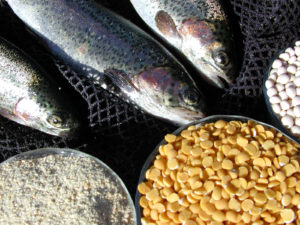 Reliance on marine resources is an ongoing constraint in aquaculture nutrition, and progress in identifying alternative ingredients is becoming increasingly marginal.
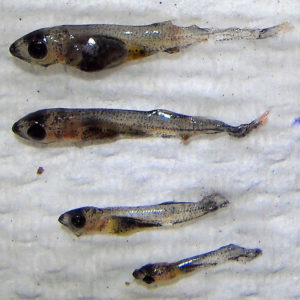 Carnivorous fishes, such as the Walleye Sander vitreus, are nutritionally demanding for fish meal. A promising alternative to marine‐origin fish meal, the supply of which has been stagnant in recent decades, is fish meal derived from undesirable freshwater species, such as the White Sucker Catostomus commersonii. To evaluate the relative value of such ingredients, we examined the growth performance of Walleye juveniles. Two dietary treatments were tested: an experimental (EXP) diet that was manufactured using White Sucker as fish meal in comparison with a commercial (COM) diet, EWOS Micro (EWOS Canada, Ltd.). Dietary lipid content was 15.1% and 16.8% for EXP and COM diets, respectively. The protein content was 50.4% and 57.6% for EXP and COM diets, respectively. The energy content was 5,098.76 ± 9.23 cal/g (mean ± SD) for the EXP diet and 5,134.47 ± 10.95 cal/g for the COM diet. Starting at 27 d posthatch, Walleye juveniles (initial weight [mean ± SD] = 0.030 ± 0.008 g; initial length = 15.7 ± 1.5 mm) were reared for 6 weeks in three replicate tanks for each treatment. Condition factor (0.83), final weight (1.12 ± 0.30 g), and weight gain (1.09 ± 0.06 g) were higher in fish that were fed the EXP diet. Similarly, the energetic lipid content of fish in the EXP treatment group (mean ± SD = 5.01 ± 0.45 g/kg) was also higher than that of fish fed the COM diet (3.30 ± 0.53 g/kg). Although the polar lipid content (membrane lipids) was similar in fish from the two treatments, the nutritional ratio for COM juveniles was over 1.5 for arachidonic acid and docosahexaenoic acid, indicating selective incorporation by juveniles and suggesting a potential dietary imbalance of these fatty acids. Furthermore, the higher observed selective incorporation of oleic acid in juveniles fed the EXP diet suggested that a higher value of this fatty acid in the EXP feed could have increased Walleye growth performance. Threonine was the main essential amino acid (AA; >18.5% of total AAs), while serine and glycine contributed the highest percentages of the nonessential AAs (>31.0% and 8.5% of total AAs, respectively). All three AAs, often considered limiting ingredients, are important to support growth and are involved in metabolic processes in some fish species. Our results demonstrate that feed pellets made with White Sucker fish meal improved growth in Walleye juveniles and can serve as a suitable and probably lower‐cost regional alternative to marine fish meal in feeds for carnivorous fishes. [Image credit: Jean‐luc Lacroix]