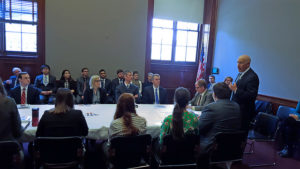
 On April 12, AFS and U.S. Geological Survey (USGS) hosted a roundtable discussion with congressional staff on impacts on inland fish from extreme weather events like hurricanes, flood, drought, and forest fires. USGS scientists cautioned that as these extreme events increase in frequency and severity they will have significant ecological consequences for inland fisheries and social implications for communities that rely on recreational fishing as an important economic driver.
AFS Executive Director Doug Austen touted USGS programs like the Cooperative Fish and Wildlife Research Units, the Climate Adaptation Science Centers, and the Great Lakes Science Center for the actionable science they produce to meet management needs of state and federal fisheries managers. Austen said, ”This science will become increasingly important as state and federal agencies must respond to imperiled aquatic species that are less resilient in the face of these extreme events. USGS scientists provide technical assistance in applying new information to meet management needs and develops the next generation of fisheries professionals who will be on the front lines of responding to these issues.”
Doug Beard, acting director for the USGS Land Resources Mission Area, discussed how the important fisheries research conducted across the country equips natural resource professionals with the information and tools to manage fisheries in the face of changing ecosystems.
 USGS scientists are evaluating and developing methods for controlling aquatic invasive species through chemical, biological, and physical means, including barriers in the Great Lakes. Bo Bunnell, a USGS research fisheries biologist with the Great Lakes Science Center, provided a concrete example of the types of fisheries impacts that could result from an extreme event: flooding in the Midwest. He explained how extreme flooding in the Illinois River watershed could make Lake Michigan much more vulnerable to the invasion of Asian carp, where they could devastate native fish populations. However, recent investments have been made (through the Great Lakes Restoration Initiative) to greatly reduce this probability. Fishing in the region is valued at $1 billion.
AFS Policy Director Drue Winters shared a letter from AFS to House and Senate Appropriators requesting robust funding to the Cooperative Fish and Wildlife Research Units in the Fiscal Year 2019 federal budget and challenged attendees to consider how disaster mitigation funding could be applied to also help fish populations become more resilient in the face of these extreme events.
AFS is proud to support the great work that USGS is doing across the country to provide credible, applied science that produces information to solve both very specific short-term issues and long-term research that helps to inform critical conservation work.
Why inland fisheries are important (“The social, economic, and environmental importance of inland fish and fisheries,” Lynch et al. 2016)
- Inland capture fisheries and aquaculture contribute over 40% to the world’s reported finfish production from less than 0.01% of the total volume of water on earth.
- Globally over 90% of inland capture fisheries production is used for human consumption
- Sustainable aquaculture has a more efficient food conversion ratio of less than 2kg of dry feed over 1 kg of gain
- The annual net value of recreational fishing in the Laurentian Great Lakes is estimated as high as $1.47 billion
- Provides individual (food security, economic security, empowerment) societal (cultural, human health and well-being, recreational) and environmental (“green food,” ecosystem function and biodiversity, and aquatic “canaries”) benefits.
Co-op unit importance and value
- Meeting the actionable science needs of our cooperators, providing them technical guidance and assistance in interpreting and applying new advances in science, and developing the future workforce through graduate education and mentoring
- The 40 Cooperative Fish & Wildlife Research Units (CRUs) across 38 states are embedded in major research universities and bridge the gap between science and natural resource decisions
- They conduct research on renewable natural resources, participate in the education of graduate students to help develop the future workforce, provide technical assistance and consultation on natural resource issues and provide continuing education for natural resource professionals
- Each unit consists of 2-5 federal scientists and 1-2 administrative specialists
- There are currently more than 1,000 research projects underway and they generate 250-300 scientific publications annually (published 398 in the year 2016 alone)
- They focus on addressing the conservation challenges
- Unit scientists develop programs and applications to be used by state and federal managers to conduct analysis to inform decision making
- The Arizona Unit developed a simple, web-based tool to compare freshwater fish data collected using American Fisheries Society standard methods
- The President’s budget has a $17 million decrease in Cooperative Research Units
Important research they have conducted:
- Assessing distribution of catfish in the Rio Yaqui drainage
- Tracking Coho Salmon using eDNA
- Evaluating methodologies for estimating age and growth of Lake Sturgeon
- Reproductive indices of hatchery-origin White Sturgeon in the lower Columbia River
- Spawing in site contribution and movements of Lake Whitefish in northwestern Michigan
Types of projects:
- Culvert replacement to assist with fish passage and flood resilience. In floods, these structures blow out and need to be replaced when they are the wrong size. Incentivize replacement with properly sized structures. Makes them resilient to blow out in future storms and allows for effective fish passage
- Dam removal and installation of nature based features/natural landscape features tat allow for hydrologic changes such as flooding and droughts
- Projects to make lakes drought resistant like Lake Whicita in Texas
- Increasing flows in rivers in dry years for adaptively manage conditions for fish like salmon
- Fish passage in watersheds
- Reconnect rivers with floodplains
- USGS stream gauge data helps with flows




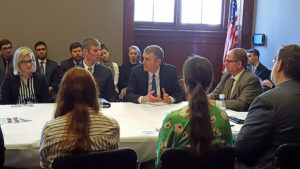 USGS scientists are evaluating and developing methods for controlling aquatic invasive species through chemical, biological, and physical means, including barriers in the Great Lakes. Bo Bunnell, a USGS research fisheries biologist with the Great Lakes Science Center, provided a concrete example of the types of fisheries impacts that could result from an extreme event: flooding in the Midwest. He explained how extreme flooding in the Illinois River watershed could make Lake Michigan much more vulnerable to the invasion of Asian carp, where they could devastate native fish populations. However, recent investments have been made (through the Great Lakes Restoration Initiative) to greatly reduce this probability. Fishing in the region is valued at $1 billion.
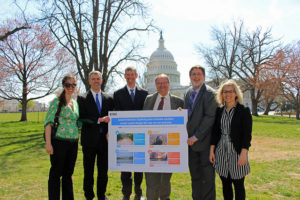 AFS Policy Director Drue Winters shared a letter from AFS to House and Senate Appropriators requesting robust funding to the Cooperative Fish and Wildlife Research Units in the Fiscal Year 2019 federal budget and challenged attendees to consider how disaster mitigation funding could be applied to also help fish populations become more resilient in the face of these extreme events.