Skip to content

American Fisheries Society Family of Websites:

Fisheries.org

American Fisheries Society
Family of Websites

Journals

Read our five journals and Fisheries magazine

Gray Literature Database

Find thousands of unpublished agency reports and other information

Annual Meeting

Join us in Columbus in 2026

Divisions, Chapters, Sections

Find an AFS Unit near you or in your area of specialty

Fishbook

Fisheries Collaboration Network

Climate Change and Fisheries

Learn how to communicate the effects of climate change on fisheries

Hutton Junior Fisheries Biology Program

Summer internships for high school students

Community Growth and Connections

Explore our initiatives to build community in the Society and in the fisheries profession

Center for Fisheries Technology and Collaboration

Find fisheries science products and services

Center for Technology and Collaboration

Quick answers to common questions

Other Resources
  • Standard Methods for Sampling North American Freshwater Fish Website

  • Rotenone Stewardship Program Information Site

  • Fishionary: A blog about fish words! 
Latest News
2026 Officer Election Voting Now Open AFS Calls for Continued Protection of Boundary Waters from Mining Proposed Rule Would Undermine Science-based Endangered Species Act Future of Public Trust Resources – Statement of the American Fisheries Society Latest Newsletter
Donate
Login
Logout
$0.00 0 Cart
  • Who We Are

    Who We Are

    Governance

    Learn how AFS is structured

    Divisions, Sections, Chapters

    Find a community in your local
    area or in your expertise

    Committees

    Get engaged and volunteer

    Awards & Recognition

    Nominate your heroes

    Community Growth and Connections

    Learn more about our community-building efforts

    AFS Celebrates 150+ Years

    Explore our history

    AFS Fisheries Partnerships

    Meet our global partners

    Meet the Staff

    Dedicated to serving our members

    Contact Us

    Quick answers to common questions

    Support AFS

    Discover how you can support critical AFS programs

    What Are Fisheries?

    Explore fisheries professions

  • MEMBERSHIP

    Membership

    Learn about membership benefits and member types

    Member Directory

    Find your colleagues

    Types of Membership

    For all stages of your career

    Give the Gift
    of Membership

    Invest in an aspiring fisheries
    professional’s future

    Who Are Our Members

    From students to 50-year Golden Members

    Governance

    Learn about our organization and leadership

    My Account

    Log in to access member benefits or renew

    Join/Renew

    It’s Quick and Easy

    Organizational Membership

    Become a Strategic Partner!

  • POLICY

    POLICY

    Recovering America’s
    Wildlife Act

    Critical funding for state conservation programs

    Climate Change

    Communicate the impacts
    of climate change on fisheries

    Magnuson-Stevens Act

    Ensuring sustainability of marine fisheries

    Waters of the US

    News about Clean Water Act
    jurisdiction

    Water Quality

    Healthy fisheries require healthy waters

    Pebble Mine

    Protecting Bristol Bay salmon fisheries

    National Fish
    Habitat Partnership

    Addressing fish habitat regionally

    Infrastructure

    Funding impacts on fish habitat

    Aquaculture

    Providing food security for the future

    Future of the Nation’s
    Aquatic Resources

    Priorities for US fisheries policies

    Recent Policy Statements

    Official policy statements of AFS

    Policy Letters

    Comments on policy,
    legislation, and regulations

    Sport Fish Restoration Act

    Understanding its importance in funding state agency fisheries management

    Advocacy Guidelines

    For Units and members

    Science Guidelines

    Practicing science appropriately

    Briefings

    Congressional briefings with our partners

    Resolutions

    Member-approved resolutions
    on policy

  • NEWS

    News

    Announcements

    Official AFS news

    Annual Meeting

    News from the meeting

    Members in the News

    Awards and interviews

    Policy News

    Round-up of all policy news

    Beneath the Surface Podcast

    A deep dive into the programs and people at AFS

    Federal Workforce and Budget Cuts

    Resources and Ways to Take Action

    Newsletter

    Bi-weekly newsletter for members and partners

    Press Releases

    News media releases

  • EVENTS

    Events

    Annual Meeting

    Columbus 2026

    Future Annual Meetings

    Where we are heading

    Past Annual Meetings

    Where we’ve been

    World Fisheries Congress 2024

    Seattle, Washington

    Other Past Events

    Past special events

    Fisheries Events Calendar

    Events around the world

    Add Your Event Listing

    Submit your calendar item

  • JOBS

    Jobs

    Career Help from AFS

    Compilation of job listing boards

    Other Career Tips

    Career info for members

    Find a Job

    Listings from all over North America

    Post a Job

    Submit your job opening

  • PUBLICATIONS

    Publications

    AFS Journals Program

    More than 150 years of excellence

    AFS Books Program

    Publish with AFS

    Submit Journal Article

    Reach the right audience for your research

    Fisheries Magazine

    Monthly membership magazine

    Writing Tools

    Guides for authors and other resources

    Fishy Fridays

    Weekly blog highlighting AFS fisheries journal articles

    Bookstore

    Shop more than 180 titles

    Journal Online Access

    Log in to access journal articles

    Gray Literature Database

    Thousands of unpublished agency reports and research

  • Professional Development

    Professional Development

    Continuing Education

    Gain skills and enhance your career

    Professional Certification

    Official recognition of your expertise

    Hutton Junior Fisheries
    Biology Program

    Summer high school
    internship program

    Leadership Opportunities

    Hone your leadership skills, volunteer today!

    Training Opportunities Calendar

    Webinars, online courses, on-site workshops, and field training

    Webinars

    Check out upcoming sessions or browse our library

    More Online Resources

    Practical resources for fisheries professionals

  • Engagement

    Engagement

    Strategic Partners

    See how your organization can partner with AFS

    Support AFS

    Discover how you can support critical AFS programs

    The 1870 Society

    Recognizing generous individual donors who invest in the Society's mission

    2024 Annual Report

    Find out what AFS did for the fisheries community in 2024

    Shop AFS

    Check out the latest AFS merch here

Login
Logout

Landscape: Headwater Heaven

  • May 6, 2016
  • Fisheries Magazine, News
  • Home
  • Landscape: Headwater Heaven

By Mike Lunde

Headwater Heaven 5-2

A river is an aquatic interstate, interconnected by multiple boulevards of gin-clear, crystalline water. The river’s birthplace is centered around groundwater located underground in the permafrost in between snow-capped mountains that cascade below low altitude cumulus clouds. Other rivers emerge in headwater lakes characterized by jade-blue glacial water. Around the shoreline, snow-capped mountains tower into
the heavens above, where anadromous spirits overlook their predecessors’ journey. The wind diverts the lake’s flow towards the outlet. At higher altitudes, the wind picks up fresh snow and sends it into the air. Downstream from the outlet, the current flows at multiple speeds, uninterrupted from those environmental structures of destruction called dams. Through its winding journey downstream past evergreens the size of small skyscrapers, there are no noise disturbances, almost complete silence. The only sound is the current. Mile by mile, the channel widens giving forth to new physical features. Sporadic clusters of ferns and grass-lined banks transcend to craggy ledges of shale. The inside shoreline contains limestone of endless shapes and sizes, some light grey and others dark charcoal. Small regions of sand border the limestone. A remaining brown bear print is reflected in the sand. Around table-sized boulders, the groundwater below spirals bubbles into a tornado-like funnel until it strikes the surface, producing the headwater rapid. Upon current initiating contact, a louder noise, nature’s rocket engine is produced. The true reflection of a headwater system is represented by the seasons.

The main channel diverts into two separate highways. One flows in a semi-straight direction with an occasional meandering downstream through a meadow of moss and sub-Arctic tundra. A periodic change in depth subsides on the tailout section of low gradient riffles. The other channel contains multiple bends. As it weaves through a dense forest of Sitka spruce and cottonwood, the channel twists and braids back upon themselves in the watery labyrinths of life. The bottom transitions from coarse substrate to bedrock. The current suddenly intensifies. A series of highly turbulent waterfalls are encountered. Above the falls, it seems like barren sadness as if a woman in all her beauty is hollow and incapable of love. Clouds of vapor rise into the air. A plunge pool is formed below the falls entrapped with foam. Eventually, the two channels converge, forming a deep, clear confluence pool. It is deeper than other pool types. At 15 feet in depth, it concentrates all forms of aquatic life. Other young- of-the-year salmon speciesPinks Oncorhynchus gorbuscha, Chums O. keta, Sockeye O. nerka, and the occasional steelhead O. mykiss—gather in mutual coexistence to forage on suspended communities of zooplankton and phytoplankton.

DSCN0169

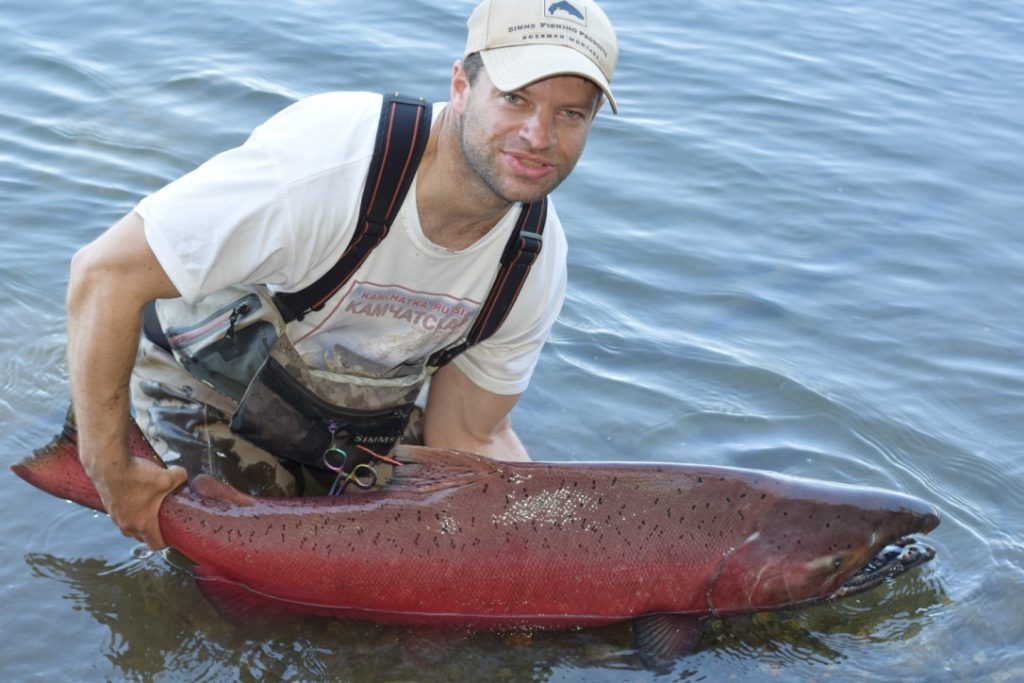
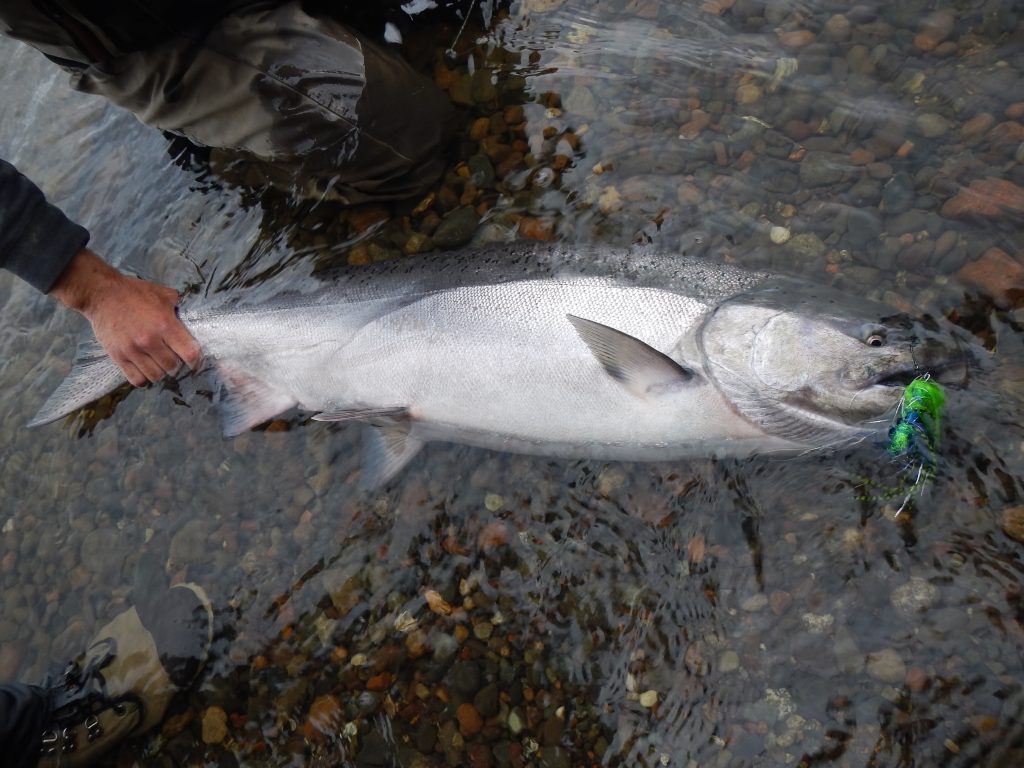
Summer in the headwaters is a story about nature rewritten through a chronological series of biological events. As high altitude showers conclude, the cumulus clouds fade away. The sun peaks through, erasing any remains of surface darkness. Where the light touches, new life is portrayed. On the outside bend downstream of old black spruce tree trunks wedged into the bottom, a large bowling-ball like splash eclipses the surface. A large female Chinook Salmon O. tshawytscha, or King Salmon, surges forward like a red fire engine determined to hurdle the next obstacle. Her body remains in the same position as she slithers in a zigzag-like motion to remain stationary against the current. Her metabolism seems infinite. A close distance nearby, a small waterfall appears. Her long awaited journey is abruptly interrupted. She is not fazed. A running start is engaged. Using her fins like a sail against the wind, she contracts her pectoral fins in unison and leaps. Airborne for a brief moment in time, she lands. She rests momentarily in a miniature pool scoured by decades of mountain runoff water rushing under half-hollow Sitka spruce. At last, the arrival to her golden throne composed of coffee table-sized boulders and an underlayer of granite rock is established. Her mouth contracts. Perhaps this is a message, her sense of biological communication to the outside world. “I’m coming home, I’m coming hometell the world I’m coming home.”

Her tail excavates the bottom, acting like an oversized windshield wiper. The repeated movements send coarse substrate upwards into the current until swept downstream never to be seen again. She waits patiently for her king. Among the thousands, only one, an individual who once terrorized the pelagic forage for four years is merely within feet of completing his reproductive quest. His counterparts attempt to swim in parallel formation beside him. He is not amused. A sudden abandonment of his position ensues. Two smaller males are located a foot from his adipose fin. The blood pressure inside his body skyrockets, fueling his inner aggression even more. He darts with fire. Bang!  At contact, the dominant male’s hooked-shape kype crashed into the side of the smaller male. That male vanished. Other males nearby retreat in the blink of an eye downstream for protection. Alongside his queen, their reproductive quest is finalized. Eggs are riffled spasmodically into the gravel redd coupled with a cloud of milt. Some fall into the miniaturized crevasses of granite. A large majority swept suspended in the current towards hungry Rainbow Trout. Some lay covered in layers of sand never to be exposed. The ones that emerge in the coming months are a spiritual rebirth for the world of anadromy. Their parents, tired from a thousand-mile upstream journey prepare for their permanent retirement in the headwater nursery. A task so rare is complete.

We are often reminded that death is not the final end. Although she has retired her riverine throne, her final seconds of fame are not a distant memory, yet a passing of the anadramous torch. She spins helplessly in the current. A few operculum contractions and that is it. Once when she roamed the haunts of the open ocean, the accumulation of marine-derived nutrients in the forms of nitrogen and phosphorous embedded in her flesh are geared for a new phase. Isotopes in the chemical forms of N13 and C15 act as nature’s terrestrial fertilizer, transported alongside the streambanks and deeper into forests where new forms of life evolve. Newly eclipsed ferns under white spruce, fireweed alongside expired logs, and young-of-the-year tamaracks are created from these marine nutrients transported from wildlife that consumed the anadromous warriors of yesteryear. After the spawned-out remains are consumed, the terrestrial wildlife act as key ecosystem engineers, spreading the nutrients around like a seed exiting the outer petals of a wild flower. In similar fashion, each hair that sheds the outer epidermis enters the air at the mercy of the wind and blown on a path to god knows where. Somehow, someway, the natural world works its mysterious wonders, in which new life emerges. The soil darkens and the air smells different. After a late-afternoon summer shower, the remaining water vapor gives off a new wintergreen scent.

Autumn in the headwaters is reminiscent of a nature painting. Shades of green leaves morph into a mixed composition of red, orange, and yellow. Temperatures drop, causing hues of brown to appear. As daytime temperatures decline, the amber light dims to satin gray. The original insignificant blob of transparent orange plasma rises from the underwater palace of cobble and marble substrate. The creature looks oddly shaped and absurd. For the first time, its eyes perceive the underwater world. With its yolk-sac still attached to its body, it attempts to explore outside the realms of its restricted home. He swims two feet at most. He feels frightened. He gravitates away from the fast current, escaping to the gravel with his underbelly pinned against the gravel. When ready, he awaits another opportunity. Days later, overcast gives way to blue-bird skies. In the streaming sunlight, may fly nymphs and adult caddisflies emerge in the burbling riffle. The outsized September caddisflies with their reddish-orange bodies dance on the surface of the bowl-shaped mid-channel pool. At three-inches long, he is a warrior amongst his smoltmates. The sudden surface disturbances triggers curiosity. His beady, little eyes focus upward. He swims upwards inches at a time, then pauses, and repeats again. His next episodic burst of propulsion is immediate and targeted at the water-air interface. Plop! Plop! A complete disappearing act and the other caddisflies contract their wings into overdrive to escape the foraging grounds. At last, our once reddmate that inherited his majesties’ senses used them wisely. To avoid being someone else’s dinner, he seeks shelter in a moss-covered log jam adjacent to large boulders.

While the Chinook Salmon smolts seek preparation for the cold temperatures of late autumn into the transition of winter, others were unfortunate. Dive-bombing king fishers dart through the white spruce branches overhanging above the riparian vegetation. Their enriched blue-colored eyes stare at the surface like a laser beam. Left to right, then right to left, they scan for young-of-the-year salmon hovering just below the surface. Other avian predatorsravens, seagulls, and merganserspartake in the clean up crew. Remaining salmon carcasses drift downstream into white spruce branches suspended below through the surface. Pieces of tan colored flesh, a physiological blueprint, hang from the branches like glittering ornamental tinsel from streamside alder and tamarack. It dries under direct sunlight. Terrestrial insects slowly inch their way down the bark towards the flesh. The first group appears followed by hundreds and then thousands. The salmon carcasses provide much needed malnourishment to the localized epifauna.

Winter is another wonderland in headwater heaven. Like the clouds above, the ground is a white canvas. All coloration erased with the sounds of an autumn breeze. At first glance, the river appears lifeless. The water is clear. The surface acts like a crystal-clear glass mirror that reflects images back to the naked eye. Deep lateral scour and debris-dammed pools are frozen with a hard layer of black ice. Multiple branches are embedded half-way through the ice. Located on the bottom in between the spaces of granite rocks below, another world exists. Stoneflies emerge from the porous space. They use their claws to attach to moss on the underside of rocks while others lay hidden in the periphyton. Their antennae wiggle back-and-forth to sense new habitat and immediate danger. Jointed legs equipped with sparse hairs and an underbelly with evenly-spaced gills form their bodies. Through the eye of a microscope, they resemble alien life forms. A three-segmented antenna, beady little eyes, and six legs arranged in two rows of three form its body designed for bottom exploration. Each step is delicate and careful, or else the river’s power is unleashed. Underneath the darkness, the stronger and improved mini-kings abandon their deep debris-dammed pool searching for stoneflies embedded in the periphyton. His nose bumps the periphyton. A school of black stoneflies rise. They attempt to escape. Their small size serves a disadvantage. He opens his mouth and contracts quick, satisfaction achieved. As winter continues, he will continue foraging in this habitat while he continues building muscle and fat reserves.

Spring is the biological rebirth of life. Daylight lengthens. Temperatures warm triggering surface runoff to cascade towards the shorelines. Fresh leaves bud from their branches. The marine-derived nutrients embedded in the soil give rise to new populations of Douglas aster, lupine, and bunchberry wild flowers. The first bees of spring hover onto the owers. Their proboscis is inserted into the petal. They extract the nectar and return to their spiral-shaped hives. As a long winter subsides and spring approaches, our mini-king is about four inches in length. His original silvery body changes to a subset of pink- colored parallel parr marks. Their location begins just behind the operculum gill ap and runs along the top of the lateral line until it borders the narrow region of its caudal peduncle. The chemical composition inside his body slowly changes. Nitrogen and potassium reverse their physiological roles. He is preparing himself for the great downstream outmigration to the marine environment. Other mini-kings congregate to join our singled- out individual. They have made it this far. Other challenges awaitRainbow Trout, king fishers, ravens, seals, bear cubs, and waterfallsthat reduce their survivorship. Any small cascading creek serves as temporary shelter and foraging habitat. A plethora of adult stoneflies and mayflies with an established full- grown set of wings dance in the lower reaches of these cascade creeks. The mainstem channel soon widens more. As the river exits headwater heaven, we reach the middle river. Here, a new migratory journey begins.

Members click below for the May 2016 Fisheries magazine’s complete issue. Non-members, join here.

This content is for members only. Please login.
  • Recent News

    • AFS Urges Modernization of Sporting Goods Excise Tax that Funds Fisheries Conservation May 13, 2026
    • Is Bigger Better for Hatchery Chinook Salmon? May 1, 2026
    • Webinar: A Perpetual Franchise to Cultivate Oysters April 30, 2026
    • Webinar: Skin Cancer Risk and Outdoor Workers: Early Detection and Sun Protection Could Save Your Life April 30, 2026
    • AFS Calls for Robust Funding for NOAA Fisheries April 27, 2026
  • About

    The American Fisheries Society is 501c Non-Profit Society


    Donate Now

    Quick Links

    • ABOUT
    • POLICY
    • EVENTS
    • PUBLICATIONS
    • MEMBERSHIP
    • NEWS
    • JOBS
    • Contact Us
    • ABOUT
    • POLICY
    • EVENTS
    • PUBLICATIONS
    • MEMBERSHIP
    • NEWS
    • JOBS
    • Contact Us

    Contact

    • 25 Century Boulevard
      Suite 505
      Nashville, TN 37214
    • (301) 897-8616
    Facebook-f Twitter Instagram Linkedin-in Vimeo-v

    Copyright © 2026 American Fisheries Society | Privacy Policy 

    This website uses cookies to improve your experience. Accept Read More
    Privacy & Cookies Policy

    Privacy Overview

    This website uses cookies to improve your experience while you navigate through the website. Out of these, the cookies that are categorized as necessary are stored on your browser as they are essential for the working of basic functionalities of the website. We also use third-party cookies that help us analyze and understand how you use this website. These cookies will be stored in your browser only with your consent. You also have the option to opt-out of these cookies. But opting out of some of these cookies may affect your browsing experience.
    Necessary
    Always Enabled
    Necessary cookies are absolutely essential for the website to function properly. This category only includes cookies that ensures basic functionalities and security features of the website. These cookies do not store any personal information.
    Non-necessary
    Any cookies that may not be particularly necessary for the website to function and is used specifically to collect user personal data via analytics, ads, other embedded contents are termed as non-necessary cookies. It is mandatory to procure user consent prior to running these cookies on your website.
    SAVE & ACCEPT