Skip to content

American Fisheries Society Family of Websites:

Fisheries.org

American Fisheries Society
Family of Websites

Journals

Read our five journals and Fisheries magazine

Gray Literature Database

Find thousands of unpublished agency reports and other information

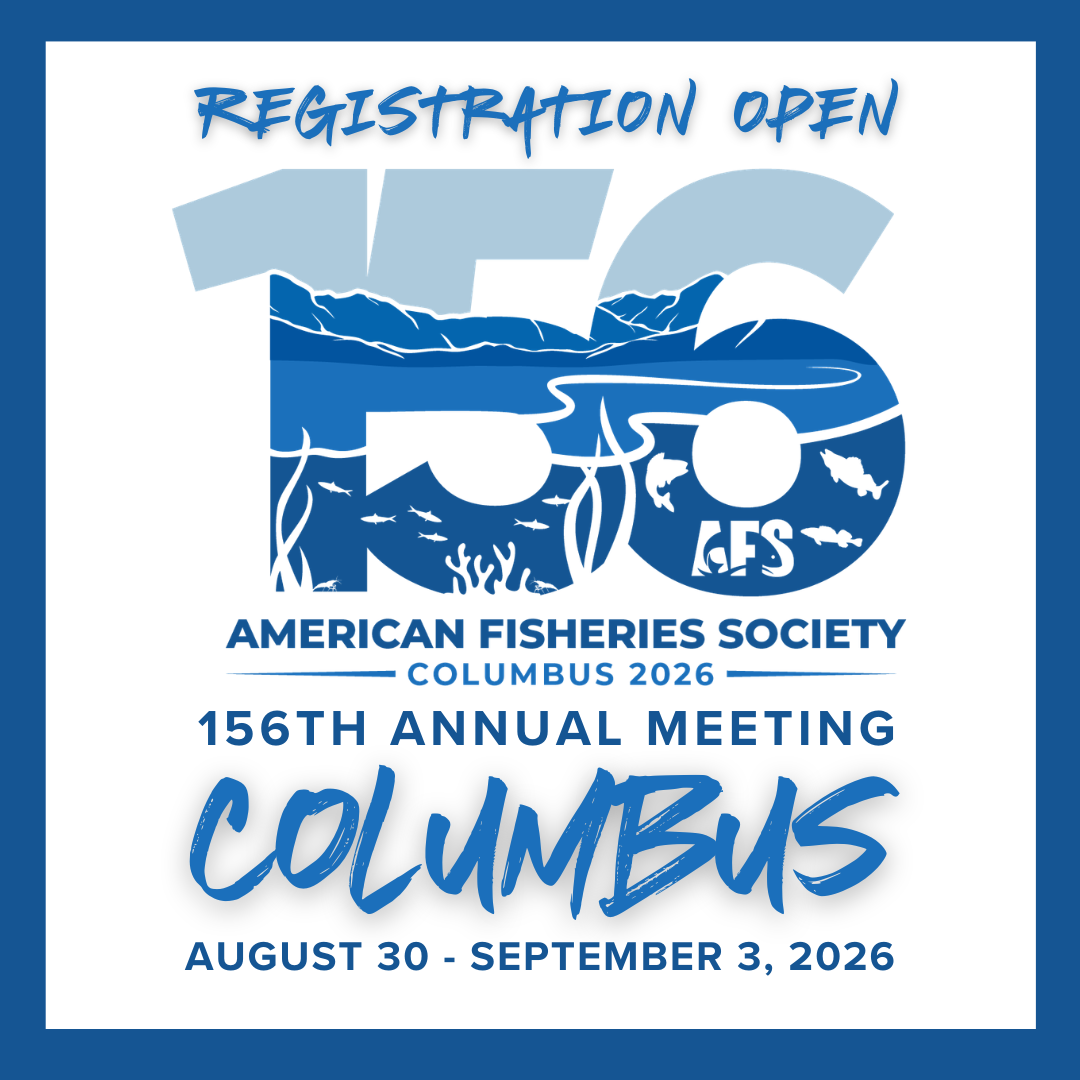
Annual Meeting

Join us in Columbus in 2026

Divisions, Chapters, Sections

Find an AFS Unit near you or in your area of specialty

Fishbook

Fisheries Collaboration Network

Climate Change and Fisheries

Learn how to communicate the effects of climate change on fisheries

Hutton Junior Fisheries Biology Program

Summer internships for high school students

Community Growth and Connections

Explore our initiatives to build community in the Society and in the fisheries profession

Center for Fisheries Technology and Collaboration

Find fisheries science products and services

Center for Technology and Collaboration

Quick answers to common questions

Other Resources
  • Standard Methods for Sampling North American Freshwater Fish Website

  • Rotenone Stewardship Program Information Site

  • Fishionary: A blog about fish words! 
Latest News
2026 Officer Election Voting Now Open AFS Calls for Continued Protection of Boundary Waters from Mining Proposed Rule Would Undermine Science-based Endangered Species Act Future of Public Trust Resources – Statement of the American Fisheries Society Latest Newsletter
Donate
Login
Logout
$0.00 0 Cart
  • Who We Are

    Who We Are

    Governance

    Learn how AFS is structured

    Divisions, Sections, Chapters

    Find a community in your local
    area or in your expertise

    Committees

    Get engaged and volunteer

    Awards & Recognition

    Nominate your heroes

    Community Growth and Connections

    Learn more about our community-building efforts

    AFS Celebrates 150+ Years

    Explore our history

    AFS Fisheries Partnerships

    Meet our global partners

    Meet the Staff

    Dedicated to serving our members

    Contact Us

    Quick answers to common questions

    Support AFS

    Discover how you can support critical AFS programs

    What Are Fisheries?

    Explore fisheries professions

  • MEMBERSHIP

    Membership

    Learn about membership benefits and member types

    Member Directory

    Find your colleagues

    Types of Membership

    For all stages of your career

    Give the Gift
    of Membership

    Invest in an aspiring fisheries
    professional’s future

    Who Are Our Members

    From students to 50-year Golden Members

    Governance

    Learn about our organization and leadership

    My Account

    Log in to access member benefits or renew

    Join/Renew

    It’s Quick and Easy

    Organizational Membership

    Become a Strategic Partner!

  • POLICY

    POLICY

    Recovering America’s
    Wildlife Act

    Critical funding for state conservation programs

    Climate Change

    Communicate the impacts
    of climate change on fisheries

    Magnuson-Stevens Act

    Ensuring sustainability of marine fisheries

    Waters of the US

    News about Clean Water Act
    jurisdiction

    Water Quality

    Healthy fisheries require healthy waters

    Pebble Mine

    Protecting Bristol Bay salmon fisheries

    National Fish
    Habitat Partnership

    Addressing fish habitat regionally

    Infrastructure

    Funding impacts on fish habitat

    Aquaculture

    Providing food security for the future

    Future of the Nation’s
    Aquatic Resources

    Priorities for US fisheries policies

    Recent Policy Statements

    Official policy statements of AFS

    Policy Letters

    Comments on policy,
    legislation, and regulations

    Sport Fish Restoration Act

    Understanding its importance in funding state agency fisheries management

    Advocacy Guidelines

    For Units and members

    Science Guidelines

    Practicing science appropriately

    Briefings

    Congressional briefings with our partners

    Resolutions

    Member-approved resolutions
    on policy

  • NEWS

    News

    Announcements

    Official AFS news

    Annual Meeting

    News from the meeting

    Members in the News

    Awards and interviews

    Policy News

    Round-up of all policy news

    Beneath the Surface Podcast

    A deep dive into the programs and people at AFS

    Federal Workforce and Budget Cuts

    Resources and Ways to Take Action

    Newsletter

    Bi-weekly newsletter for members and partners

    Press Releases

    News media releases

  • EVENTS

    Events

    Annual Meeting

    Columbus 2026

    Future Annual Meetings

    Where we are heading

    Past Annual Meetings

    Where we’ve been

    World Fisheries Congress 2024

    Seattle, Washington

    Other Past Events

    Past special events

    Fisheries Events Calendar

    Events around the world

    Add Your Event Listing

    Submit your calendar item

  • JOBS

    Jobs

    Career Help from AFS

    Compilation of job listing boards

    Other Career Tips

    Career info for members

    Find a Job

    Listings from all over North America

    Post a Job

    Submit your job opening

  • PUBLICATIONS

    Publications

    AFS Journals Program

    More than 150 years of excellence

    AFS Books Program

    Publish with AFS

    Submit Journal Article

    Reach the right audience for your research

    Fisheries Magazine

    Monthly membership magazine

    Writing Tools

    Guides for authors and other resources

    Fishy Fridays

    Weekly blog highlighting AFS fisheries journal articles

    Bookstore

    Shop more than 180 titles

    Journal Online Access

    Log in to access journal articles

    Gray Literature Database

    Thousands of unpublished agency reports and research

  • Professional Development

    Professional Development

    Continuing Education

    Gain skills and enhance your career

    Professional Certification

    Official recognition of your expertise

    Hutton Junior Fisheries
    Biology Program

    Summer high school
    internship program

    Leadership Opportunities

    Hone your leadership skills, volunteer today!

    Training Opportunities Calendar

    Webinars, online courses, on-site workshops, and field training

    Webinars

    Check out upcoming sessions or browse our library

    More Online Resources

    Practical resources for fisheries professionals

  • Engagement

    Engagement

    Strategic Partners

    See how your organization can partner with AFS

    Support AFS

    Discover how you can support critical AFS programs

    The 1870 Society

    Recognizing generous individual donors who invest in the Society's mission

    2024 Annual Report

    Find out what AFS did for the fisheries community in 2024

    Shop AFS

    Check out the latest AFS merch here

Login
Logout

How Does Creativity Fit into Science Communication

  • February 2, 2016
  • Fisheries Magazine, Students • Early Career Professionals
  • Home
  • How Does Creativity Fit into Science Communication

Natalie Sopinka | AFS Contributing Writer; E-mail: natsopinka@gmail.com

This article was originally published on the Canadian Science Publishing blog as part of the series “Making Waves: The Future of #Scicomm in Fisheries Sciences.” The series was spawned from the science communication session held at last year’s Annual Meeting in Portland. An introduction to the blog series is available at: cdnsciencepub.com/blog.

Since childhood I’ve always been a “crafter.” I would spend all my birthday money on glitter and googly eyes at White Rose—a Canadian craft store that broke my young heart when it led for bankruptcy. I would make Christmas ornaments, without the aid of Pinterest, to give to family members. I wrote poems about vegetables and stories about stolen groundhog shadows. I proudly wore a purple sweatshirt and pair of purple sweatpants I had sewn. One might say I was creative.

Fast-forward two decades and I am an aquatic scientist. I want to know what happens to baby salmon when their mothers are stressed out. I observe the behavior of baby salmon swimming in aquaria. I measure hormones in the blood of baby salmon. I use computer software to graph and analyze data. I write structured articles that describe my research. I present my scientific findings on PowerPoint slides at conferences.

Would someone describe my profession as creative? Probably not. I’m a scientist after all, not an artist, and artists are synonymous with creativity. Scientists are rigid and analytical. They lack the passion and spirit that artists possess.

Where did this divide between scientists and artists originate? When the word “scientist” was proposed in the 19th century by William Whewell, individuals who pontificated about the natural world were already distinguished from artists and referred to as natural philosophers or cultivators of science. With Whewell’s definition, published in 1840, “that as an artist is a musician, painter, or poet, a scientist is a mathematician, physicist, or naturalist,” the division was formally articulated in the English language. As Duke University graduate student Megan Fork reflected, “We’ve been brought up to believe in an unspoken dichotomy between rational thinking (the realm of science) and creativity.”

Yet, when we go further back in history, notable artists were also what would have been described as scientists. Leonardo da Vinci painted The Mona Lisa, but he also dissected human cadavers and created meticulously detailed anatomical drawings, an important contribution to the emergence of evidence-based knowledge. Figures more well-known for their scientific contributions also possessed artistic talents. Albert Einstein played the piano and violin. He is thought to have very much appreciated the influence of music on his scientific discoveries, and is attributed to statements such as “The greatest scientists are artists as well.” Einstein also acknowledged and appreciated creativity, being ascribed to the quote “Creativity is contagious, pass it on.”

The truth is, scientists are creative. Megan Fork sums it up as “good science relies on creativity.” To be creative is to create. Scientists are constantly creating. They generate new knowledge to explain natural phenomena. They discover new ways to solve problems. In the 1950s, Archie Carr attached radio transmitters to weather balloons, the balloons to a float, and tied the float to sea turtles. This was one of the earliest examples of aquatic telemetry. Creativity is also evident in conservation initiatives. The International Crane Foundation prevented crane chicks from imprinting on their human caregivers by feeding the chicks with a hand puppet resembling an adult crane. Scientists are also creating new platforms to communicate their research— platforms that incorporate the tools of an artist.

Scientists are sharing science via:
• Dance – Dance Your Ph.D.
• Video – Ocean 180 Challenge
• Music – Daniel Crawford’s “A Song of Our Warming Planet”

• Animations – StemCellShorts
• Podcasts – Naturally Speaking: A Science Pod-yssey
• Cartoons – Buzz Hoot Roar
• Comics – Squidtoons
• Stories – Before the Abstract, The Story Collider, Anecdotal Evidence
• Interactive graphics – data.ecotrust.ca
• Poetry – Gregory Johnson’s Climate Change Science 2013: Haiku

Scientists are sharing science in:
• Three minutes – Three Minute Thesis (3MT)
• Two minutes – Ph.D. Comics 2 Minute Thesis
• Five seconds or less – UsefulScience.org
• Ways that use only the ten hundred most used words –Up-Goer Five Challenge

So why, in general, is science not considered a creative profession? Well, as science historian Laura Snyder pointed out, an unforeseen consequence of Whewell’s defining of the “modern scientist,” is “today’s disjunction between science and the rest of culture.” By being dissociated from artists—the musicians, painters, and poets—were scientists stripped of their capacity to be identified as creative?

I and others argue that creativity is inherent to science, but are external agents stifling that creativity? Agents such as shifted funding priorities and looming chants of “publish or perish.”

Despite progress in how scientists are extending their creativity to the way they communicate their findings, if there is a roadblock to creativity at the initial step of hypothesis formation, would that barricade scientists from honing their communication skills? What are the cascading effects of creatively-curbed scientists on the education and mentorship of future scientists?

The current state of creativity in science is unlikely to be improved upon simply or quickly.

So, where do we go from here?

From psychologist to dancer, the consensus is that creativity is a skill that can be sharpened. Would exercising creativity while communicating our science enhance our confidence in being creative at all stages of the scientific process?

I’ve fallen into many thought-avalanches trying to disentangle the connections among creativity, science, and science communication. We should continue having discussions about these connections. How can we embrace, cultivate and evaluate these connections?

I’ve asked a lot of questions here but have few answers. I do know that I am a scientist and I am creative. I still go to craft stores and buy glitter and googly eyes. I still write poems but the purple sweatpants have been packed away in the attic.

When I found myself in a scientific rut following my Ph.D., I was inspired by illustrator Bethann Merkle, and tried sketching. The results were comical at first but when you’re drawing a goofy-looking animal like a flatfish, it’s okay. I found myself surprisingly invigorated. When I have gone a few days without sketching, I have a sensation that I can only describe as a “low-fuel” light going off somewhere in my brain – an indicator that my tank of creativity is emptying.

I do believe that practicing creativity has made me a better communicator of science. I keep striving to flex my creativity muscles, so they don’t get stiff or worse, atrophied.  I encourage you to do the same. Whatever your creative outlet is, do it, if only for a few moments each day.

Members click below for the February 2016 Fisheries magazine’s complete issue. Non-members, join here.

This content is for members only. Please login.
  • Recent News

    • AFS Urges Modernization of Sporting Goods Excise Tax that Funds Fisheries Conservation May 13, 2026
    • Is Bigger Better for Hatchery Chinook Salmon? May 1, 2026
    • Webinar: A Perpetual Franchise to Cultivate Oysters April 30, 2026
    • Webinar: Skin Cancer Risk and Outdoor Workers: Early Detection and Sun Protection Could Save Your Life April 30, 2026
    • AFS Calls for Robust Funding for NOAA Fisheries April 27, 2026
  • About

    The American Fisheries Society is 501c Non-Profit Society


    Donate Now

    Quick Links

    • ABOUT
    • POLICY
    • EVENTS
    • PUBLICATIONS
    • MEMBERSHIP
    • NEWS
    • JOBS
    • Contact Us
    • ABOUT
    • POLICY
    • EVENTS
    • PUBLICATIONS
    • MEMBERSHIP
    • NEWS
    • JOBS
    • Contact Us

    Contact

    • 25 Century Boulevard
      Suite 505
      Nashville, TN 37214
    • (301) 897-8616
    Facebook-f Twitter Instagram Linkedin-in Vimeo-v

    Copyright © 2026 American Fisheries Society | Privacy Policy 

    This website uses cookies to improve your experience. Accept Read More
    Privacy & Cookies Policy

    Privacy Overview

    This website uses cookies to improve your experience while you navigate through the website. Out of these, the cookies that are categorized as necessary are stored on your browser as they are essential for the working of basic functionalities of the website. We also use third-party cookies that help us analyze and understand how you use this website. These cookies will be stored in your browser only with your consent. You also have the option to opt-out of these cookies. But opting out of some of these cookies may affect your browsing experience.
    Necessary
    Always Enabled
    Necessary cookies are absolutely essential for the website to function properly. This category only includes cookies that ensures basic functionalities and security features of the website. These cookies do not store any personal information.
    Non-necessary
    Any cookies that may not be particularly necessary for the website to function and is used specifically to collect user personal data via analytics, ads, other embedded contents are termed as non-necessary cookies. It is mandatory to procure user consent prior to running these cookies on your website.
    SAVE & ACCEPT