Skip to content

American Fisheries Society Family of Websites:

Fisheries.org

American Fisheries Society
Family of Websites

Journals

Read our five journals and Fisheries magazine

Gray Literature Database

Find thousands of unpublished agency reports and other information

Annual Meeting

Join us in Columbus in 2026

Divisions, Chapters, Sections

Find an AFS Unit near you or in your area of specialty

Fishbook

Fisheries Collaboration Network

Climate Change and Fisheries

Learn how to communicate the effects of climate change on fisheries

Hutton Junior Fisheries Biology Program

Summer internships for high school students

Community Growth and Connections

Explore our initiatives to build community in the Society and in the fisheries profession

Center for Fisheries Technology and Collaboration

Find fisheries science products and services

Center for Technology and Collaboration

Quick answers to common questions

Other Resources
  • Standard Methods for Sampling North American Freshwater Fish Website

  • Rotenone Stewardship Program Information Site

  • Fishionary: A blog about fish words! 
Latest News
2026 Officer Election Voting Now Open AFS Calls for Continued Protection of Boundary Waters from Mining Proposed Rule Would Undermine Science-based Endangered Species Act Future of Public Trust Resources – Statement of the American Fisheries Society Latest Newsletter
Donate
Login
Logout
$0.00 0 Cart
  • Who We Are

    Who We Are

    Governance

    Learn how AFS is structured

    Divisions, Sections, Chapters

    Find a community in your local
    area or in your expertise

    Committees

    Get engaged and volunteer

    Awards & Recognition

    Nominate your heroes

    Community Growth and Connections

    Learn more about our community-building efforts

    AFS Celebrates 150+ Years

    Explore our history

    AFS Fisheries Partnerships

    Meet our global partners

    Meet the Staff

    Dedicated to serving our members

    Contact Us

    Quick answers to common questions

    Support AFS

    Discover how you can support critical AFS programs

    What Are Fisheries?

    Explore fisheries professions

  • MEMBERSHIP

    Membership

    Learn about membership benefits and member types

    Member Directory

    Find your colleagues

    Types of Membership

    For all stages of your career

    Give the Gift
    of Membership

    Invest in an aspiring fisheries
    professional’s future

    Who Are Our Members

    From students to 50-year Golden Members

    Governance

    Learn about our organization and leadership

    My Account

    Log in to access member benefits or renew

    Join/Renew

    It’s Quick and Easy

    Organizational Membership

    Become a Strategic Partner!

  • POLICY

    POLICY

    Recovering America’s
    Wildlife Act

    Critical funding for state conservation programs

    Climate Change

    Communicate the impacts
    of climate change on fisheries

    Magnuson-Stevens Act

    Ensuring sustainability of marine fisheries

    Waters of the US

    News about Clean Water Act
    jurisdiction

    Water Quality

    Healthy fisheries require healthy waters

    Pebble Mine

    Protecting Bristol Bay salmon fisheries

    National Fish
    Habitat Partnership

    Addressing fish habitat regionally

    Infrastructure

    Funding impacts on fish habitat

    Aquaculture

    Providing food security for the future

    Future of the Nation’s
    Aquatic Resources

    Priorities for US fisheries policies

    Recent Policy Statements

    Official policy statements of AFS

    Policy Letters

    Comments on policy,
    legislation, and regulations

    Sport Fish Restoration Act

    Understanding its importance in funding state agency fisheries management

    Advocacy Guidelines

    For Units and members

    Science Guidelines

    Practicing science appropriately

    Briefings

    Congressional briefings with our partners

    Resolutions

    Member-approved resolutions
    on policy

  • NEWS

    News

    Announcements

    Official AFS news

    Annual Meeting

    News from the meeting

    Members in the News

    Awards and interviews

    Policy News

    Round-up of all policy news

    Beneath the Surface Podcast

    A deep dive into the programs and people at AFS

    Federal Workforce and Budget Cuts

    Resources and Ways to Take Action

    Newsletter

    Bi-weekly newsletter for members and partners

    Press Releases

    News media releases

  • EVENTS

    Events

    Annual Meeting

    Columbus 2026

    Future Annual Meetings

    Where we are heading

    Past Annual Meetings

    Where we’ve been

    World Fisheries Congress 2024

    Seattle, Washington

    Other Past Events

    Past special events

    Fisheries Events Calendar

    Events around the world

    Add Your Event Listing

    Submit your calendar item

  • JOBS

    Jobs

    Career Help from AFS

    Compilation of job listing boards

    Other Career Tips

    Career info for members

    Find a Job

    Listings from all over North America

    Post a Job

    Submit your job opening

  • PUBLICATIONS

    Publications

    AFS Journals Program

    More than 150 years of excellence

    AFS Books Program

    Publish with AFS

    Submit Journal Article

    Reach the right audience for your research

    Fisheries Magazine

    Monthly membership magazine

    Writing Tools

    Guides for authors and other resources

    Fishy Fridays

    Weekly blog highlighting AFS fisheries journal articles

    Bookstore

    Shop more than 180 titles

    Journal Online Access

    Log in to access journal articles

    Gray Literature Database

    Thousands of unpublished agency reports and research

  • Professional Development

    Professional Development

    Continuing Education

    Gain skills and enhance your career

    Professional Certification

    Official recognition of your expertise

    Hutton Junior Fisheries
    Biology Program

    Summer high school
    internship program

    Leadership Opportunities

    Hone your leadership skills, volunteer today!

    Training Opportunities Calendar

    Webinars, online courses, on-site workshops, and field training

    Webinars

    Check out upcoming sessions or browse our library

    More Online Resources

    Practical resources for fisheries professionals

  • Engagement

    Engagement

    Strategic Partners

    See how your organization can partner with AFS

    Support AFS

    Discover how you can support critical AFS programs

    The 1870 Society

    Recognizing generous individual donors who invest in the Society's mission

    2024 Annual Report

    Find out what AFS did for the fisheries community in 2024

    Shop AFS

    Check out the latest AFS merch here

Login
Logout

Morphological and Genetic Identification of Spontaneously Spawned Larvae of Captive Bluefin Tuna in the Adriatic Sea

  • May 28, 2015
  • News
  • Home
  • Morphological and Genetic Identification of Spontaneously Spawned Larvae of Captive Bluefin Tuna in the Adriatic Sea

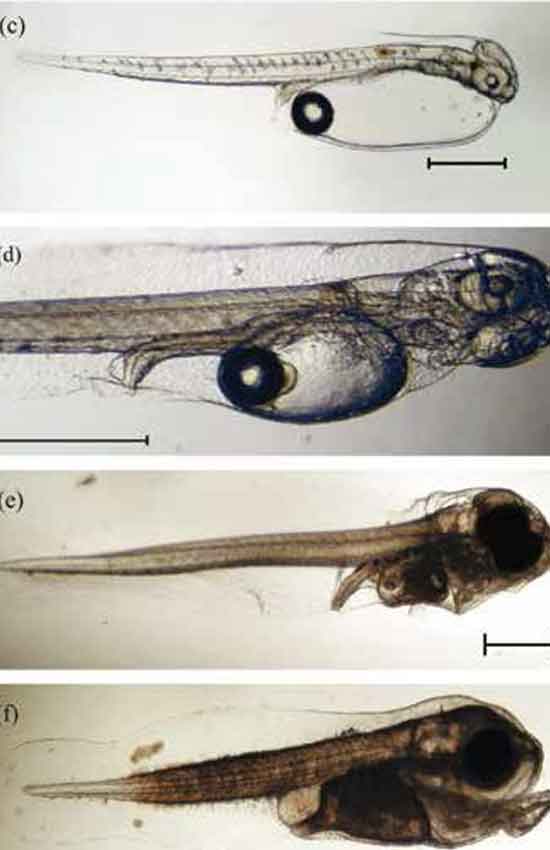
Adriatic-sea-Bluefin-Tuna-embryo-formed-Kupffer’s-vesicleMorphological and Genetic Identification of Spontaneously Spawned Larvae of Captive Bluefin Tuna in the Adriatic Sea
Leon Grubišić, Tanja Šegvić-Bubić, Ivana Lepen Pleić, Krstina Mišlov-Jelavić, Vjeko Tičina, Ivan Katavić, and Ivona Mladineo

ABSTRACT: The spawning behavior of captive Bluefin Tuna (Thunnus thynnus) was observed in cages at an Adriatic facility in summer 2011. Approximately 20,000 eggs were collected from cages and transferred to a land-based nursery, with an estimated fertilization success rate of 80%. Eggs were spheri-al with a diameter of 1,035.06 ± 20.16 µm and were pelagic with a single oil globule (227.63 ± 8.07 µm). Newly hatched larvae (3.08 ± 0.14 mm total length) followed scombrid larval development: melanophores were scattered over the body, head, notochord, and yolk, except finfold; eye pigmentation was ob-served 1.5 days posthatch, pectoral fins started to appear, and two-thirds of the yolk sac were absorbed; the mouth developed at 2.5 days posthatch, and larvae began feeding upon enriched rotifers. After mortalities occurred in the nursery (5 days post- hatch), DNA was extracted from a sample of larvae. An 890 base pair fragment of the mitochondrial partial control region was amplified and sequenced to genetically confirm fish species identity. Based on multiple sequence alignment, larval sequences showed no ambiguities to the T. thynnus mitochondrial control region, thereby confirming spontaneous spawning in captivity. Although such an event has previously been reported in the Mediterranean, this is the first report supported by both morphological and genetic data.


Identificación morfológica y genética de larvas espontáneamente desovadas de atún aleta azul cultivado en el mar Adriático

RESUMEN: a través de jaulas, se observó el comportamiento de desove del atún aleta azul (Thunnus thynnus) en cautiverio en el mar Adriático durante el verano de 2011. Se colectaron aproximadamente 20,000 huevos a partir de jaulas y se transfirieron a un criadero en tierra, con un éxito de fertilización del 80%. Los huevos pelágicos fueron esféricos con un diámetro de 1,035.06 ± 20.16 µm y un solo glóbulo de aceite (227.63 ± 8.07 µm). Las larvas recién eclosionadas (3.08 ± 0.14 mm longitud total) siguieron el desarrollo larval propio de los escómbridos: melanóforos dispersos en el cuerpo, cabeza, notocorda y vitelo, excepto en el pliegue de la aleta; se observó pigmentación ocular a los 1.5 días después de la eclosión, comenzaron a aparecer las aletas pectorales y se reabsorbieron dos tercios del saco vitelino; a los 2.5 días de la eclosión, se desarrolló la boca y la larva comenzó a alimentarse de rotíferos enriquecidos. Después de haber ocurrido la mortalidad en el criadero (5 días después de la eclosión) se extrajo una muestra de ADN de las larvas. Se amplificaron y secuenciaron 890 pares de bases de una región mitocondrial control con el fin de corroborar genéticamente la identidad de la especie. Sobre la base de una alineación secuencial múltiple, las secuencias de las larvas no mostraron ambigüedades en la región control mitocondrial de T. thynnus, por lo tanto se confirmó el desove espontáneo de la especie en cautiverio. Si bien tal evento ya se había documentado previamente en el Mediterráneo, este es el primer reporte basado en datos morfológicos y genéticos.

To cite this article: Volume 38, Issue 9, Fisheries, 38:9, 410-417
To access this article: http://dx.doi.org/10.1080/03632415.2013.839439

AUTHORS:
Leon Grubišić, Tanja Šegvić-Bubić, and Ivana Lepen Pleić
Institute of Oceanography & Fisheries, Split, Croatia

Krstina Mišlov-Jelavić
Kali Tuna d.o.o., Island of Ugljan, Croatia

Vjeko Tičina and Ivan Katavić
Institute of Oceanography & Fisheries, Split, Croatia

Ivona Mladineo
Institute of Oceanography & Fisheries, Šetalište Ivana Meštrovića
21000 Split, Croatia. E-mail: mladineo@izor.hr

  • Recent News

    • Webinar: A Perpetual Franchise to Cultivate Oysters April 30, 2026
    • Webinar: Skin Cancer Risk and Outdoor Workers: Early Detection and Sun Protection Could Save Your Life April 30, 2026
    • AFS Calls for Robust Funding for NOAA Fisheries April 27, 2026
    • AFS Urges Full Funding for US Fish and Wildlife Service, US Geological Survey, and US Forest Service April 24, 2026
    • Barotrauma Leads to Crappie Ice Fishing Woes April 10, 2026
  • About

    The American Fisheries Society is 501c Non-Profit Society


    Donate Now

    Quick Links

    • ABOUT
    • POLICY
    • EVENTS
    • PUBLICATIONS
    • MEMBERSHIP
    • NEWS
    • JOBS
    • Contact Us
    • ABOUT
    • POLICY
    • EVENTS
    • PUBLICATIONS
    • MEMBERSHIP
    • NEWS
    • JOBS
    • Contact Us

    Contact

    • 25 Century Boulevard
      Suite 505
      Nashville, TN 37214
    • (301) 897-8616
    Facebook-f Twitter Instagram Linkedin-in Vimeo-v

    Copyright © 2026 American Fisheries Society | Privacy Policy 

    This website uses cookies to improve your experience. Accept Read More
    Privacy & Cookies Policy

    Privacy Overview

    This website uses cookies to improve your experience while you navigate through the website. Out of these, the cookies that are categorized as necessary are stored on your browser as they are essential for the working of basic functionalities of the website. We also use third-party cookies that help us analyze and understand how you use this website. These cookies will be stored in your browser only with your consent. You also have the option to opt-out of these cookies. But opting out of some of these cookies may affect your browsing experience.
    Necessary
    Always Enabled
    Necessary cookies are absolutely essential for the website to function properly. This category only includes cookies that ensures basic functionalities and security features of the website. These cookies do not store any personal information.
    Non-necessary
    Any cookies that may not be particularly necessary for the website to function and is used specifically to collect user personal data via analytics, ads, other embedded contents are termed as non-necessary cookies. It is mandatory to procure user consent prior to running these cookies on your website.
    SAVE & ACCEPT