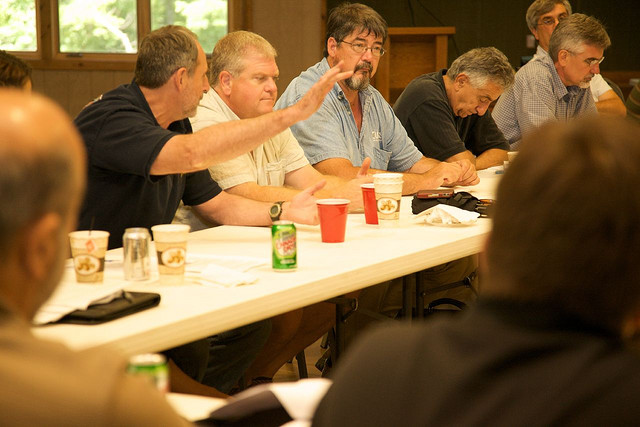
The AFS Rules provide an order of business for the annual Business Meeting that must be followed and which supersedes the order suggested in Robert’s Rules. For other AFS meetings, Robert’s Rules suggests that the meetings follow the following order of business:
Reading the Minutes of the previous meeting [and their approval]
Reports of Officers and Standing Committees
Reports of Special Committees
Special Orders
Unfinished Business and General Orders
New Business
Note that “Determination of a Quorum” is not part of the formal order of business, because the meeting must have a quorum before any official business is conducted.
“Special Orders” are usually motions or actions carrying over from past meetings, for which the members want to make certain are addressed at the present meeting. Unfinished actions can also be handled under “Unfinished Business.”
Reading of the minutes under the first order of business may be waived if the draft minutes are distributed to the members ahead of the meeting. If the minutes are distributed ahead of time, a motion to dispense with reading of the minutes may be made. This motion must be seconded, is neither debatable nor amendable, and requires a simple majority to pass.
If a matter arises during the meeting that is not “in order,” members attending may vote to suspend the rules to address that matter immediately. A motion to suspend the rules must be seconded, is neither debatable nor amendable, and requires a two-thirds majority vote to pass.
Approving Minutes
A formal motion to approve minutes of a previously held meeting is usually not necessary; approval can be handled by unanimous consent. The Chair should ask: “Are there any corrections to the minutes?” After all corrections have been offered, the Chair then asks: “Are there any further corrections?” If none are offered, then the Chair states: “There being no further corrections, the minutes stand approved as read [or as corrected].”
Minutes of a meeting can be corrected even after they have been formally approved.
Minutes of a meeting are usually approved at the beginning of the next scheduled meeting [see Order of Business].
A member’s absence from a meeting does not preclude that member from offering corrections to the minutes or voting for their approval.
Minutes do not become an official record of a meeting until they have been approved.
Since a number of draft minutes may be floating around, only the Secretary’s approved version of the minutes serve as the official record of the meeting to which they pertain.
If a member disapproves of a proposed correction to the minutes, that member may move to amend and offer an alternative correction. As with any motion to amend [see Handling Motions], the motion requires a second, is subject to debate, and requires a simple majority to pass.
Handling Motions
According to Robert’s Rules, the process for handling motions is as follows:
The member making the motion must obtain the floor (i.e., be recognized by the Chair), and then state the motion.
Unless a chair of a committee consisting of more than one individual is making the motion, another member must second the motion.
The Chair states the motion and then asks: “Is there any discussion [or debate].”
When debate is concluded (and proposed amendments disposed of), the Chair “calls the question” (restating the motion, as amended).
A vote is taken using the appropriate methods (e.g., voice, standing, roll call).
Or
The Chair, if no opposition to the motion is apparent, may ask: “Are there are any objections to the motion?” If no one objects, the motion passes by “unanimous consent” or “with no opposition.”
The Chair announces the outcome of the vote and states what action will be taken as a result of the vote.
Things to Remember When Handling Motions:
Seconding means that more than one member present believes the motion should be discussed. A motion made by a committee chair does not need to be seconded because the committee already voted to move the motion forward, meaning that at least two members already agreed that it should be discussed.
There is no need to enter the name of the person seconding the motion into the minutes; simply the fact that the motion has been seconded should suffice.
The person who makes a motion has the first opportunity to speak.
Up until the Chair “puts the question” to the assembly (i.e., formally states the motion proposed), the motion may be amended to improve its clarity or intent, or withdrawn by the proposer. After the Chair formally states the motion, it may be amended or withdrawn only by a motion from the floor.
A substitute motion should be introduced during the floor debate in the following manner. The member proposing the substitute motion should state: “If the motion on the floor is voted down, I will propose the following alternative motion” and state the motion.
An amendment to a motion cannot itself be amended.
No additional business can be conducted until the main motion on the floor is disposed of, either by being voted up or down, referred to a committee, postponed to a date or time certain, or postponed indefinitely (i.e., killed).
Each member can speak only twice on any motion, unless exceptions are made by the Chair. Members cannot take their second turn if anyone who has not spoken wishes to do so. Members should be brief and to the point.
Members should stand and speak only to the Chair when recognized. They do not comment directly to other members. In formal proceedings, members should avoid using another member’s name and, instead, refer to them by their position on the board.
In voting on motions:
The chair may vote only if the outcome of the vote is changed, i.e., to break a tie causing a vote to pass, or create a tie causing a vote to fail.
Simple or obviously acceptable amendments may be adopted by “unanimous consent.” Usually, the Chair would ask if there are any objections to the motion and, if there are none, the Chair will declare that the motion “passes by unanimous consent” or “passes without objection.”
Motions are handled slightly different in committee meetings:
A member may speak an unlimited number of times during debate of a pending motion.
The Chair may make motions, speak in informal debates, and vote on motions.
Members and the Chair need not stand to speak.
Motions need not be seconded.
Informal discussions of subjects are permitted with no motions pending.
If a proposal is perfectly clear to the committee members, a vote can be taken without a formal motion.
Robert’s Rules defines a motion as “a formal proposal by a member, in a meeting, that the assembly take certain action.” The basic motion is called a “main motion” and its intent is to bring business before the assembly. It is always wise to have each item of discussion on an agenda begin with a motion; a motion will help focus the discussion and debate of the issue, and also give an indication of the intended outcome.
There are also “subsidiary” motions, which are those motions intended to assist the assembly in handling the main motion. These include motions to amend, postpone to a time and date certain, table, and refer to a committee. Additionally, there are “privileged” motions, which are those motions not associated with the main motion but can be introduced while a main motion is pending because of matters that require immediate attention. These include adjourn, recess, point of order, and questions of privilege.
No motion is necessary to receive a report from an officer or a committee. Motions arising out of an officer’s report must be made and seconded by members other than the reporting officer, whereas motions arising out of committee reports can be made by the committee member delivering the report and do not require a second (unless it is a committee of one).
After the chair states a motion, the mover may request unanimous consent of the assembly to “modify” the motion. If rejected or if another member wishes to modify the motion, a formal motion to “amend” must be made and voted on.
A motion to “amend” must be germane (related) to the main motion.
No more than two levels of amendments can be pending at the same time. The secondary amendment must be decided before the primary amendment and then the main motion, as amended or not. To make additional changes beyond a secondary amendment, a member may either: a) state that if the secondary amendment is rejected, a different secondary amendment will be offered; or b) pose another amendment after the primary or secondary amendments have been decided and before voting on the main motion.
If the motion and its associated amendments are referred to a committee or postponed, no further votes are necessary until the motion once again comes before the assembly.
The subsidiary motion “division of the question” (call for a separate vote on each part of a motion or resolution) causes the motion to be subdivided into two or more issues to be decided individually.
If a member wishes to kill a motion and avoid a direct vote on it, the proper mechanism is not to “table” the motion, but to move to “postpone indefinitely” only when the main motion is under consideration (cannot be done while debating an amendment). The motion to postpone must be seconded, is debatable, and needs a simple majority vote to pass.
If a member wishes to defer consideration of a motion, the motion to “commit” or “refer to a committee” can be used, or the motion to “postpone to a time or date,” such as later in the same meeting or to a future meeting.
A motion to “table” for consideration at a later time during the session can be used if additional information is likely to be presented later in the same meeting that may affect the vote. At that designated time, a motion to “remove from the table” allows continuation of the debate.
If the member wishes to avoid any debate or vote on a main motion, a motion can be made to “object to consideration” as soon as the Chair has stated the motion and before any debate occurs. The Chair then asks members to vote for or against consideration of the question. This motion does not need a second, is not debatable, and needs a two-thirds vote to pass.
Moving the “previous question” or moving to “call the question” is to immediately close debate and cease amendments, except for the subsidiary motion to “lay on the table.” This motion must be seconded, is not debatable, and requires a two-thirds vote to pass. The maker of this motion must first be recognized by the Chair and cannot simply call out the request from the floor.
The assembly may vote to “ratify” an action taken by officers or committees to provide official approval after-the-fact, as long as it does not violate the bylaws or Constitution.
A complete list of Robert’s Rules related to motions can be found at the following link: http://www.rulesonline.com/rror–02.htm
Adjourning
A meeting is not closed until the Chair states that the meeting is adjourned (or “stands adjourned”). When there appears to be no further business in a meeting, and all the topics on the agenda have been addressed, a motion to adjourn is not necessary. Instead of waiting for a motion to adjourn, the Chair can state: “Is there any further business?” If none is offered, then the Chair states: “Since there is no further business, the meeting is adjourned [or stands adjourned].”
If the next meeting will be within three months, any matters temporarily but not finally disposed are taken up then, usually under special orders for the meeting [see Order of Business].
Any matters temporarily but not finally disposed of “fall to the ground” when a meeting is adjourned and the next meeting is not scheduled within three months. Those matters may be taken up again at an ensuing meeting as if they have never been addressed.
A motion to adjourn cannot be made while voting on a motion is taking place. The motion to adjourn can be made once the vote on a pending motion is announced. The motion must be seconded, is neither debatable nor amenable, and requires a simple majority to pass.
A motion to fix the time to adjourn can be made at any time during the meeting. It needs a second, can be debated, is amenable, and passes with a simple majority.
A recess, as opposed to an adjournment, is a short break in a meeting after which business is resumed at the point it left off. Unlike an adjournment, a recess does not close a meeting.
Action on a motion that is pending when adjournment is in order can be postponed to a time certain [usually as a “special order” for the next meeting, see Order of Business] so that the motion does not fall to the floor when the meeting is adjourned. The motion to postpone to a date certain needs a second, is debatable, can be amended, and in most cases requires a simple majority to pass.
Recording Minutes
The purpose of keeping minutes of a meeting is to create a written record of what was done at the meeting. Too often, minutes are turned into transcripts, recording the names of the people who spoke to an issue and what they said. This is overkill and not necessary, especially when digital recordings of the meeting can be made at the touch of a button and stored electronically for future reference.
Robert’s Rules (§48) offers the following guidance on the content of minutes:
“The essentials of the record are as follows:
The kind of meeting, “regular” (or stated) or “special,” or “adjourned regular” or “adjourned special”;
Name of the assembly;
Date of meeting and place, when it is not always the same;
The fact of the presence of the regular chairman and secretary, or in their absence the names of their substitutes;
Whether the minutes of the previous meeting[s] were approved, or their reading dispensed with, the dates of the meetings being given when it is customary to occasionally transact business at other than the regular business meetings;
All the main motions (except such as were withdrawn) and points of order and appeals, whether sustained or lost, and all other motions that were not lost or withdrawn; and
Usually the hours of meeting and adjournment, when the meeting is solely for business. Generally the name is recorded of the member who introduced a main motion, but not of the seconder.”
Motions recorded in the minutes should reflect the exact wording when the vote was taken or when the presiding officer declared a unanimous consent. The minutes should also record the numbers of those voting in favor of the motion and those opposed. It is not necessary to record the number of abstentions, since they do not influence the outcome of the vote.
In AFS meetings, usually the following items are also added:
List of attendees (when attendance is required to run for future office or for some other reason);
A summary of the major points made during discussion of a topic because of the relatively high turnover rate in membership (loss of “institutional memory”) between meetings.
Recent News
This website uses cookies to improve your experience. AcceptRead More
Privacy & Cookies Policy
Privacy Overview
This website uses cookies to improve your experience while you navigate through the website. Out of these, the cookies that are categorized as necessary are stored on your browser as they are essential for the working of basic functionalities of the website. We also use third-party cookies that help us analyze and understand how you use this website. These cookies will be stored in your browser only with your consent. You also have the option to opt-out of these cookies. But opting out of some of these cookies may affect your browsing experience.
Necessary cookies are absolutely essential for the website to function properly. This category only includes cookies that ensures basic functionalities and security features of the website. These cookies do not store any personal information.
Any cookies that may not be particularly necessary for the website to function and is used specifically to collect user personal data via analytics, ads, other embedded contents are termed as non-necessary cookies. It is mandatory to procure user consent prior to running these cookies on your website.