AFS Special Committee Report
Thomas J. Miller | Cynthia M. Jones | Chad Hanson | Selina Heppell | Olaf P. Jensen | Patricia Livingston | Kai Lornzen | Katherine Mills | Will Patterson | Patrick Sullivan | Richard Wong
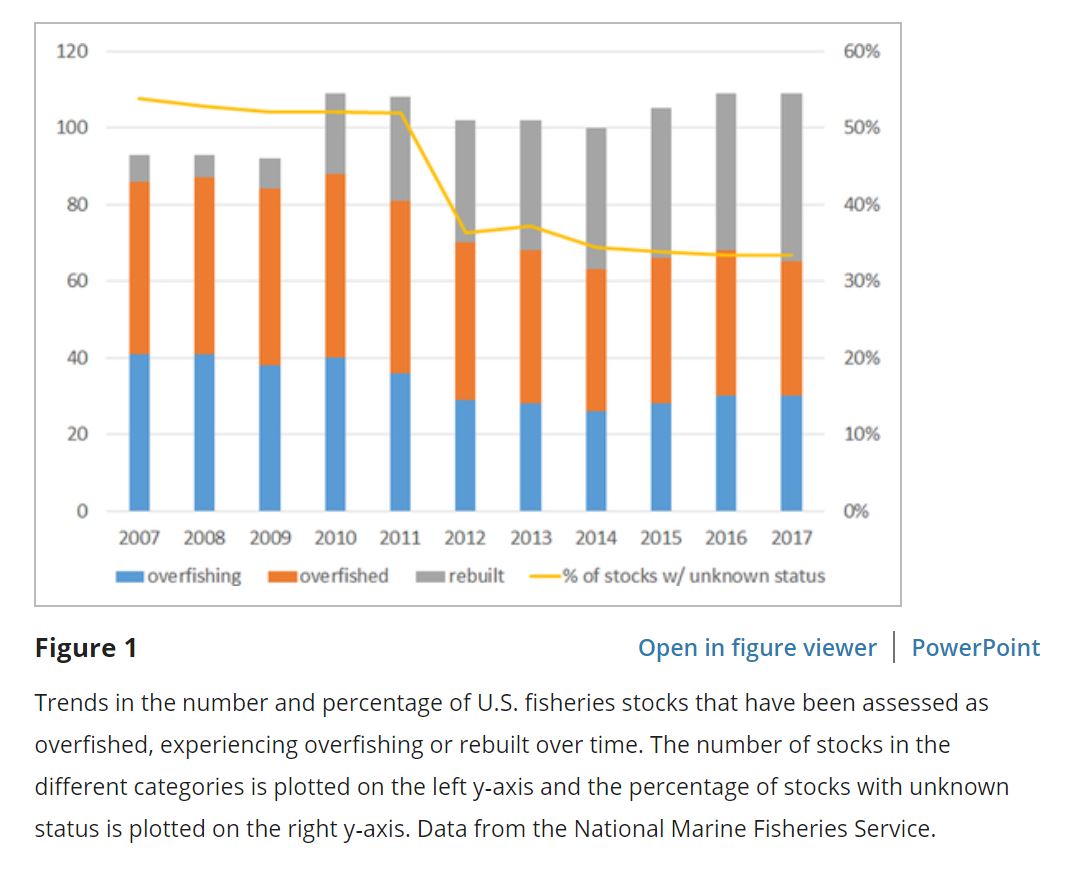
The Magnuson–Stevens Fishery Conservation and Management Act (hereafter, MSFCMA or the Act), which has been reauthorized twice since it was originally passed by the Congress in 1976, is the principal federal legislation governing fisheries management in the United States. The Act has promoted the application of an open and transparent process for developing scientific advice, regional flexibility in policy processes, and more accountable management. Together, foundational requirements of the fishery management process established by the Act have led to decreases in the levels of exploitation (proportion of the biomass harvested) and increases in biomass of fished stocks so that targeted species are overall in a healthier and more sustainable state than they were 40 years ago when the Act first passed (Figure 1). The 1996 reauthorization of the Act formally defined and prohibited overfishing, and the 2006 reauthorization established annual catch limits as an additional tool to end overfishing. In its most recent report, the National Marine Fisheries Service (NMFS) reported that 30 of 317 stocks with known status (9%) continued to experience overfishing (National Oceanic and Atmospheric Administration 2018). This represents a decline in the number of stocks experiencing overfishing by more than 10 in the past decade (Figure 1). As a direct result of requirements in the Act and its supporting technical guidance, the U.S. system ranks among the most successful in the world at preventing overfishing and rebuilding overfished stocks. (Worm et al. 2009; Ricard et al. 2012). But, even as stock status has improved, landings of seafood in the USA have remained relatively stable at 4.4 million metric tons for the past 27 years. In some fishery sectors and in some regions, concerns about overly constrained annual catch limits and allocations have led to a lack of trust in the management system and calls for substantial changes to the Act. Additionally, we are now facing new challenges that are not well covered by the Act. For example, changes in the ocean environment, including warming and acidification, are altering ecosystems, changing stock productivities, and causing widespread shifts in the distribution of many exploited species (Hare et al. 2016). Also, recreational fisheries are becoming increasingly important in many regions (Ihde et al. 2011), which creates new challenges because the motivation and hence the utility of the harvest, the ability to collect accurate data in a timely manner, and the approaches for managing harvests from recreational fisheries differ from those in the commercial sector. In combination, these changing features of the fisheries landscape suggest the need for a thorough examination and reauthorization of the MSFCMA.
In January 2018, the American Fisheries Society (hereafter, the Society or AFS) empaneled a special committee of members with expertise in fisheries science and management to provide scientific input into the current policy debate surrounding the proposed reauthorization and amendment of the Act. This committee was charged with providing recommendations for a policy statement that could be endorsed by the Society. There is a precedent for the Society to engage in this policy debate. In 1993, the Society published a similar legislative policy briefing in Fisheries (American Fisheries Society 1993). The present special committee membership included scientists and managers drawn from all regions of the nation and represented state and federal agencies, retired federal scientists, nongovernmental organizations, and academia. The committee met regularly by conference call over the next 6 months with this article constituting the consensus recommendations of the special committee to the Society. We quickly recognized that the special committee could not explore every policy option within fisheries management. Rather, the special committee decided to focus on policy options that specifically addressed questions surrounding assessment and management.
The special committee shared its recommendations and revised based on input from the Society’s Marine Fisheries Section. The committee provided a final report for debate to the Society’s Governing Board. Following this debate, the American Fisheries Society provides the following science‐based policy statement.
AFS notes the critical importance of scientific information as the cornerstone of fisheries management. The Society also recognizes however, that the ocean, our science, and our management systems are changing more rapidly today than they have in recent memory, making incorporation of adaptable and responsive policies in a future revision of the Act essential. AFS makes the following recommendations in the areas of (1) best scientific information available, (2) catch levels and rebuilding, (3) habitat and ecosystems, and (4) adapting to environmental change. Each subsequent section provides necessary background to understand the Society’s recommendations.
Best Scientific Information Available
AFS focuses on the application of the best scientific information available principle first because the advances in fisheries management and the application of science to management have gone hand in hand. By using clearly defined and accepted principles of what constitutes scientifically collected and reviewed information in analyses, management bodies have been able to focus their discussions on the benefits and risks of alternative policies or management actions rather than questioning underlying data. AFS further believes that continued application of these principles allows identification of key gaps in information and knowledge that, when filled, will lead to an improvement in the reliability of the resulting management decisions.
A best scientific information available (BSIA) standard is required to guide management in several environmentally‐related acts of the U.S. Congress, including the MSFCMA. The National Academy of Sciences (National Research Council 2004) and the American Fisheries Society (Sullivan et al. 2006) have evaluated the application of the BSIA standard within fisheries.
AFS views four components of BSIA to be of particular importance. All information entering the assessment process must:
- Be collected objectively. The objectivity criterion implies an unbiased foundation for data collection (National Research Council 2004). Reported values should also be quantifiable and methods assessed for their accuracy.
- Have a clear statistical foundation. The statistical foundation criterion implies that information from all sources is appropriately weighted and combined to produce the reported estimate for the population being studied (National Research Council 2004; Sullivan et al. 2006). This can be a difficult standard to meet because it requires the careful consideration of how to collect information if the inferences drawn from the sampling or analysis are to be reliable.
- Be peer‐reviewed. The information collected using these principles must subsequently be documented and subject to peer review as an ultimate check on quality and reliability (National Research Council 2002). The peer‐review criterion is an essential, but often misunderstood, cornerstone of the application of science in fisheries management. It has not been established to serve as a gatekeeper to block information from outside of fishery management agencies from entering the process, but as a way of ensuring, regardless of source, that best practices have been used throughout the collection and synthesis of the information, and that these best practices are described in sufficient detail that others can understand the assumptions and limitations of the information that has been gathered (Lee and Moher 2017). Peer review is not without error (Bohannon 2011), but it remains the single best guarantee of meeting the BSIA standard required under the Act.
- Be timely. Information is collected to inform management decisions. Thus, to be effective, the scientific information generated by the three steps above must be available when needed. Timeliness should scale with the life history of the species under management, or the desired responsiveness of the management system. For example, information that is timely for an ocean quahog Artica islandica (life span >200 years.) may be of limited use for the management of Northern Anchovy Engraulis mordax. (life span <4 years).
AFS recognizes that citizen science is becoming more widespread and is providing important ecological and biological insights. Information from people who fish, both commercially and recreationally, can be vitally important in recording changes in the distribution, population structure, and potentially movement rates of the species they target. Changes in these population characteristics, particularly related to species distributions, are becoming more frequent, and stakeholder‐collected data can provide an important early warning system. Cooperative research, in which stakeholders and scientists jointly design surveys or sample collection as well as share in responsibilities of data collection, is often an ideal approach to tapping the expertise of both groups to collect needed data while ensuring BSIA standards are met.
AFS supports the inclusion of citizen science into fisheries. Indeed, stakeholder‐generated information and data are critical to the assessment and management of many species, but these data must still adhere to the four principles of BSIA noted above if they are to be of highest utility. AFS recommends an active and enhanced outreach and education effort by NMFS and the regional fishery management councils (RFMC), and their Scientific and Statistical Committees (SSCs), to encourage people who fish to actively participate in data collection, assessment, and management processes. In addition to the various cooperative research programs ongoing regionally in the USA, organizations such as the National Science Foundation‐funded Science Center for Marine Fisheries (www.scemfis.org) may represent one approach to the collaborative and cooperative collection of information. The involvement of stakeholders in setting objectives through facilitated management strategy evaluations (MSE) also provides a direct pathway to increase stakeholder involvement in the fisheries management process (Miller et al. 2010).
Implementation of BSIA is covered by National Standard 2 of the MSFCMA. Based on the most recent reauthorization of the Act, National Standard 2 was extensively revised (78 FR 43066) and relied heavily on the National Academy of Sciences and AFS recommendations on characteristics of BSIA. The reliance on BSIA in fisheries management since the passage of the MSFCMA has served the nation, the nation’s fishers, and managers well. AFS strongly endorses a continued reliance on BSIA, and the best practice inherent in its application, in managing the nation’s fisheries. However, the principles of BSIA should not stifle innovation and development of new data collection, analyses, and approaches to management; on the contrary, additional resources are needed for innovation as we face changes in climate, markets, and fishing practices.
AFS also recognizes that the BSIA requirement and its practical implementation can lead to frustration, conflict, and a desire to remove or temporally sidestep this requirement through political means. NMFS, RFMCs, and SSCs should develop and strengthen a comprehensive communication strategy with stakeholders about the principles and application of BSIA. Communication may include outreach, review, and analysis of information collected by stakeholders in the light of BSIA requirements.
Suggested revisions to MSFCMA promote the use of self‐reported recreational harvest data through cell phone applications (apps) is a prime example of the need for adherence to the BSIA principles. Stakeholder reporting via mobile technologies seems attractive and ideally suited to collecting large volumes of data efficiently, particularly over large spatial scales. In their review of the Marine Recreational Information Program (MRIP), the National Academy of Sciences addressed the issue of electronic data reporting and emphasized the necessity of having a valid sampling frame (our second BSIA principle; National Research Council 2017). The use of electronic reporting in for‐hire fisheries was encouraged by the NAS report (National Research Council 2017) because there is a list of permit holders, sometimes with limited access, allowing mandatory reporting to be more feasible; thus, there is a valid statistical basis for the implementation of electronic reporting. However, in the absence of a complete national database of recreational anglers, the voluntary data obtained from angler phone apps would lack a sampling frame and pose daunting challenges to providing valid data upon which recreational fisheries can be managed. The National Academy of Sciences report (National Research Council 2017) pointed out that bias can be substantial if these data are used without meeting BSIA principles. The difficulty in evaluating self‐reported data has been recognized by the statistics community and is an area of ongoing research. Methods to estimate recreational catch from self‐reported sources (i.e., phone apps) are not sufficiently reliable to be codifed in legislation. However, AFS encourages development of innovative survey sampling methods to meet these challenges to enable collection of reliable and unbiased data from people who fish because such programs would increase the involvement of stakeholders in the assessment and management process (National Research Council 2017). On the contrary, without following statistical principles, self‐reported data may be unusable, causing more angst and frustration in the fishing community.
Catch Levels and Rebuilding
Fisheries management involves two central decisions: how much should we catch? And how should that catch be allocated? Given the economic, social, and political consequences of these decisions, both are often contentious. There is considerable pressure to increase the size of the harvest because of the immediate benefits that accrue to those who gain from the catch, which must be balanced against the risk to future generations of fish and fishers should sustainable harvest levels be exceeded.
Failure to end overfishing, despite the requirement of the original 1976 Act, led to a strengthening of management accountability in subsequent reauthorizations of the Act. The most recent reauthorization required each RFMC to set stock‐specific annual catch levels that are lower than that associated with overfishing—the overfishing limit (OFL; Methot et al. 2014). Specifically, the 2006 reauthorization required the SSC of each RFMC to establish both an OFL and to provide advice on an acceptable biological catch (ABC) for each managed fishery, which must be lower than the OFL to account for scientific uncertainty. The RFMC then sets an annual catch level (ACL), which can be no greater than the ABC but may be lower to account for management uncertainty. Finally, the optimum yield (OY) can be determined by the RFMC to be equivalent to ACL or a fraction below it, termed the annual catch target (ACT), to account for societal needs, or, increasingly, ecosystem needs and uncertainty in environmental conditions (Patrick and Link 2015). If annual catches exceed the ACL, accountability measures are triggered for future years.
Overall, the structure of the Act, and the associated technical guidance, effectively separates the establishment of sustainable harvest levels meant to avoid overfishing from the allocation of that harvest. Establishing the OFL and the ABC are technical and scientific processes undertaken by the SSC by using BSIA; allocating that harvest is a socio‐economic decision undertaken by the RFMC. This separation of roles has contributed to a continued reduction in the number of stocks experiencing overfishing over the past decade. AFS strongly recommends that the current separation of roles be maintained as a core principle of any future legislation.
Variability is an inherent feature of fish population dynamics, their life histories and biological characteristics, and their abundance estimates. This variability means that estimates of OFL should really be considered probability distributions around the true point estimate. Most stock assessments likely underestimate the uncertainty inherent in OFL estimates (Ralston et al. 2011), and this negatively impacts the performance of many of the control rules used to manage fisheries (Wiedenmann et al. 2017; Punt et al. 2018). NMFS revised the guidelines for National Standard 1 (74 FR 3178; 81 FR 7185873) in 2009 and again in 2016 to provide guidance to SSCs and the RFMCs on how the inherent management and scientific uncertainty should be incorporated into establishing annual catch limits (OFLs, ABCs, and ACLs) and associated accountability measures. National Standard 1 guidelines require that each RFMC establish risk policies that specify the probability of exceeding the OFL (legally restrained to being less than a 50% probability) to be used in setting the ABC. The risk policy and control rules for implementing the policy are developed by the RFMC with scientific and stakeholder input prior to ABC determination. The SSC uses the risk policy to recommend the ABC given the OFL. AFS recognizes that the explicit recognition of uncertainty is a strong feature of the implementation of the Act. It provides RFMCs some latitude to express the specific characteristics of how the fishery operates, the socio‐economic importance of the fishery to the region, and the current status of the stock. It allows an RFMC to take on more risk when the stock is at a high level of abundance, and assume less risk when the stock is more depleted. This flexibility is an important factor in the success of the current Act. Specifically, RFMC risk policies are an exemplar of how flexibility and adaptability can and should be built into future revisions of the Act. There is considerable scope for working within the current risk policy structure. Nevertheless, AFS emphasizes the importance of maintaining the constraint that ABC must be less than the OFL.
The Act places great emphasis on avoiding thresholds for exploitation (overfishing) and abundance (overfished). When these thresholds are exceeded, the Act mandates specific and often strict responses by the RFMCs. The responses can be a priori in that setting an ACT ≪ ACL can represent an accountability measure (AM). When ABCs are exceeded, the AMs can include a “payback” of the quota exceedance in subsequent years. Accountability measures have been a source of significant controversy in select fisheries, particularly in recreational fisheries in the Southeast, but also in some commercial fisheries. For example, a combination of ACTs and payback AMs in several recreational and commercial fisheries in the Gulf of Mexico have led to very short seasons in some fisheries and complete harvest closures in recent years, primarily for rebuilding species. Other regional AMs include trip limit reductions to slow fishing down, gear requirements, and area closures. In some cases, seasons have been extended when observed catch rates were lower than projected. In part, accountability measures have helped maintain catch within limits preventing overfishing in many cases. But, while AFS recognizes that accountability measures can help maintain catch within overfishing limits, their use indicates the inadequacy of current harvest control rules (HCR) employed by many RFMCs. Rather, AFS strongly recommends increased use of HCR that have been simulation tested in a management strategy evaluation (MSE) framework to ensure the risk of exceeding ABCs is controlled within the RFMC’s risk policy and to reduce the likelihood of implementing AMs.
MSFMCA requires that the RFMCs establish catch levels for all stocks under their jurisdiction that are not considered simply ecosystem components or that have life cycles of a year or less. As described above, the development of ACLs for assessed species is a data‐ and model‐intensive process. When data are available and informative, stock assessments can yield estimates of current abundances and exploitation rates that are unbiased and relatively accurate. It is hoped that as the amount and information content of the data decreases, assessments continue to provide unbiased estimates of abundance and exploitation rates, albeit less accurate ones. However, at some point, the data are simply insufficient or uninformative to support the application of modern, sophisticated assessments. Such data‐poor or model‐resistant stocks challenge the ability of RFMCs to set ACLs. Indeed, Berkson and Thorson (2015) estimated that more than half of the stocks assessed by the RFMCs are considered data‐poor stocks. Driven by the requirements of the Act, approaches to setting catch advice for data‐poor stocks have advanced over the past decade (Carruthers et al. 2014; Newman et al. 2015). Wiedenmann et al. (2013) used an MSE framework to explore the utility of data‐poor approaches and concluded that many perform poorly in simulation testing. This has led to calls for continued research to improve data‐poor assessment approaches (Berkson and Thorson 2015). AFS supports this call for continued research to improve assessment approaches for data‐poor species and recommends increased flexibility in the Act with regard to the need to define the suite of OFLs, ABCs, and ACLs for every stock.
But even when adaptive and flexible approaches are implemented for the management of single stocks, problems will remain. For example, many species are caught in mixed‐stock fisheries. In these fisheries, management is limited by the dynamics of the least productive stock (so‐called “choke” species). In other cases, landings of a highly productive species in a mixed‐stock fishery are limited because the ACL of another, less productive species has already been landed. This can give rise to excessive discarding. The new European Common Fisheries Policy bans discarding and implements an obligation to land the entire catch. Managing species complexes in mixed‐stock fisheries inherently involves trade‐offs for both individual fishers and agencies (Mackinson et al. 2018; Mortensen et al. 2018). AFS recommends that revisions to the Act should pay attention to the role of mixed‐stock fisheries and approaches to managing for “choke” species, which can restrict harvest through dynamic time‐area closures and other policies (Scales et al. 2017; Hazen et al. 2018).
The Act requires that the RFMCs act to end overfishing immediately (within 2 years) and, when a stock is determined to be overfished, to enact a rebuilding plan. The requirement to implement rebuilding plans for stocks determined by NMFS to be in an overfished state is arguably the strongest accountability measure included in the Act. Rebuilding plans supersede the normal management sequence leading to an ACL. The rebuilding process creates a forcing mechanism to return the abundance of individual species to a healthy level in a relatively short time (typically 10 years) while providing limited flexibility for biology and environmental factors. In achieving the objective of a healthy stock, rebuilding plans limit the flexibility of the RFMCs to adjust management for socio‐economic factors—and as a result have been widely criticized by some stakeholders. Indeed, some have criticized the focus on rebuilding processes in current management, which they argue creates a culture in which the number of stocks that have been rebuilt is emphasized, rather than avoiding the need to implement a rebuilding plan in the first place. While there is certainly scope for improvement in the triggering, structure, and implementation of rebuilding plans, there is no doubt that rebuilding plans, in general, have provided an important tool in ensuring fisheries today are healthier and more sustainable than they were 40 years ago.
However, thresholds introduce discontinuities into the management process that can be a challenge for managers and stakeholders alike (National Research Council 2014). They place a demand for precision in estimates of the levels of exploitation and abundance that are difficult to achieve. The transition into and out of a period of overfishing or rebuilding can be particularly challenging. To overcome these issues, the NAS study committee called for an adaptive and flexible approach (National Research Council 2014). AFS supports that call, but notes that increased flexibility is not an excuse for delaying action or for ignoring scientific advice. AFS recommends using well‐designed harvest control rules as a best practice to avoid overfishing stocks or allowing them to become overfished. Such harvest control rules would reduce rates of exploitation adaptively prior to reaching the threshold. Ideally, the performance of such HCRs would be tested in an MSE prior to implementation. A focus on management of exploitation rates is likely to be more effective than a focus on abundance because exploitation rates are estimated more reliably and can be related to the inherent productivity of the stock (i.e., generation time, fecundity, and maturation rate) more directly. Additionally, for failed rebuilding plans, more stringent requirements should be considered to ensure catch levels are set appropriately to ensure rebuilding in the new time frame.
Recreational fisheries are becoming more and more important (Ihde et al. 2011). The MSFCMA was originally drafted primarily with commercial fisheries in mind, and one of the key criticisms of the Act has been the perception that it does not adequately serve the needs of recreational fisheries. These criticisms are based in part on the inherent difficulties of estimating recreational catches and managing such fisheries to stay within catch limits. Three questions are important in addressing recreational fisheries: do marine recreational fisheries differ fundamentally from commercial fisheries; what are appropriate management reference points for recreational fisheries; and how should recreational fisheries be managed given the difficulties of estimating catches accurately and in a timely manner?
It has been suggested that recreational fishing is a fundamentally different activity from commercial fishing and that it therefore cannot be and should not be managed within the same framework (and by the same methods). Indeed, recreational fishing can differ in terms of the motivations of participants and the way they obtain value. Rather than generating an income from the harvesting of fish as in commercial fishing, recreational anglers expend money for a recreational experience that involves attempting to catch and possibly harvest fish. The opportunity to harvest fish can be an important motivation in some fisheries but may be very unimportant in others. In the latter case, catch‐and‐release fishing may be common or mandatory. Such fisheries can be sustainable without active regulation of fishing, particularly if the released fish suffer little additional mortality. On the other hand, recreational fisheries in which harvesting of fish is an important motivation and/or released fish suffer significant mortality, the potential to affect stocks exists in much the same way as commercial fishing, and these fisheries generally need to be managed to avoid overfishing and degradation of the resource and the fishing experience. Many federally managed recreational marine fisheries, e.g., the highly contentious Gulf of Mexico reef fisheries, require active management.
AFS holds that the two sectors cannot be managed separately because, from a first principles viewpoint, fish caught by commercial and recreational harvests are both removed from the same population. Resolving the conflicting interests among the sectors will require a more adaptable approach to defining OY in the individual fisheries. AFS recognizes that alternative approaches to managing catch limits and exploitation rates, such as direct measurement of exploitation rates, exist and encourages the full exploration and pilot testing of such approaches. Where such approaches are shown to be effective, they can likely be implemented without a need to seek exemption from the catch limit provision of the Act.
The MSFCMA broadly stipulates the goal of managing fisheries so that they generate the maximum sustainable yield, or the greatest possible long‐term average catch. While this may not be the most appropriate management target or limit for every recreational fishery, it is clearly relevant to the management of harvest‐oriented recreational fisheries. In recreational fisheries that are not strongly harvest‐oriented, stakeholders often show a preference for restricting fishing to levels below those that would generate maximum sustainable yield, to benefit from higher stock abundance and therefore higher catch rates. The opposite situation where fishing pressure exceeds the level that would yield maximum sustainable yield and stock abundance and catch rates are low is generally viewed as a poor management outcome and one that is explicitly outlawed on the Act. It is possible, but seems unlikely, that this outcome would be economically optimal and/or preferred by stakeholders in some recreational fisheries. Catch limits are relevant to marine recreational fisheries management in principle and that exemption of recreational fisheries from the catch limit requirement carries a risk of degrading fisheries and the recreational fishing experience. AFS therefore recommends retaining a catch limit requirement for recreational fisheries. But, AFS also recommends the management community and stakeholders systematically explore alternative options for regulating fishing activities that may maximize recreational utility while remaining within catch limits (e.g., options that allow greater opportunities to fish without exceeding catch limits).
Environmental Change
Global warming, ocean acidification, and increased competing uses (e.g., offshore energy, commerce) are rapidly changing coastal oceans. These changes can have profound effects on marine fishes and invertebrates, with implications for most of the national standards specified by the MSFCMA. Consideration of these changes on fisheries were largely absent from previous reauthorizations.
Changes in productivity and distribution of fish and invertebrate species, both positive and negative, are widely documented and are expected to continue with climate change (Nye et al. 2009; Pinsky et al. 2013). These changes influence fisheries management in a variety of ways. First, the scientific advice that grounds fisheries management can be affected by both shifts in productivity and distribution. As species distributions change, catchability of the species in surveys and fisheries may be affected (Kohut et al. 2012), thereby altering perceptions of relative abundance and biomass in time series indices. Spatial distribution changes can also result in a misalignment with stock area delineations; stock assessments that are based on these delineations may become less representative as the misalignment increases (Link et al. 2011). In addition, population vital rates (e.g., recruitment, growth, mortality) can be directly affected by warming, acidification, and other physical changes, and they may also be indirectly affected by changes in predator–prey overlap and trophic relationships as species shift their distributions at different rates (Friedland 2013; Pershing et al. 2015a; Selden et al. 2017). Estimates of stock productivity and potential productivity may be inaccurate if these effects are not considered, resulting in stock reference points, catch limits, and rebuilding time frames that may need to be adjusted periodically under directional trends in ecosystem conditions (e.g., Mueter et al. 2011; Pershing et al. 2015b). Given the many potential influences of climate change on resource populations and stock assessments, AFS highlights the importance of monitoring and evaluating the effects of climate‐related factors on population structure and biological rates and, as needed, incorporating these factors into stock assessments and science advice. Additional resources will need to be invested to achieve this task.
Changes in spatial and temporal distribution of species also influence the operation, economic efficiency, and management of fisheries. As species’ distributions shift, their availability and accessibility from different ports and by vessel categories change (Kleisner et al. 2017). As species move into new areas, fishers often do not have permits or quota allocations to target them, as both are typically based on historical participation in a fishery. In addition, a lack of infrastructure may constrain the development of fisheries for emerging species. These changes can impact the economic efficiency of individual fishers as well as social and economic benefits that accrue to fishing communities. Ongoing social and economic analyses that evaluate the outcomes of different fishery management options applied under climate change scenarios will be important for achieving several of the national standards defined in MSFCMA. Distributional shifts of species may cause them to cross over into other management jurisdictions—from international boundaries (Miller and Muncro 2004) to domestic RFMCs or into areas that have not previously been actively managed, such as the Arctic (Stram and Evans 2009). As these cases occur, it is unclear whether and how management authority will be modified or how information will be provided to manage newly accessible ecosystems effectively (Stram and Evans 2009). In addition, the efficacy of some approaches that are commonly used to achieve fishery management goals—including spatial closures, spawning closures, and season opening dates—will be altered by changing spatial and temporal shifts of species they are designed to protect (Peer and Miller 2014). Taking these influences together, AFS recommends that procedures used to collect both fishery‐independent and fishery‐dependent information and to manage fisheries must be responsive to these environmental changes.
Studies have demonstrated the value of fisheries management measures that preserve stock size and age structure, protect reproductive females and spawning congregations, and maintain abundance for enhancing the resilience of fish and invertebrate populations to climate impacts (Pershing et al. 2015a; Le Bris et al. 2018). As such, recognition that climate conditions can play a role in stock outcomes should not be viewed as an opportunity to relax the management standards established by the MSFCMA. In the case of Gulf of Maine Atlantic Cod Gadus morhua, warmer temperatures have contributed to lower stock productivity, which allowed unintentional overfishing on the stock initially followed by a drastic reduction in the allowable catch level and a longer stock rebuilding time frame (Pershing et al. 2015a). As the climate changes, fisheries and fishery management will operate more and more under non‐stationary conditions. Management tools may become less or more effective; goals may be attained more easily or may become more difficult; recovery time frames may be lengthened or shortened. These conditions create situations in which greater uncertainty should be expected. The roles of fishing and climate may need to be distinguished, and precaution should be heightened when considering management measures for stocks being negatively affected by climate conditions. AFS recommends that the MSFCMA should continue to support achievement of stock status standards through precautionary catch limits and realistic rebuilding time frames that account for uncertainty and change in the climate and ecosystem.
Habitats and Ecosystems
It is universally accepted that healthy and sustainable fisheries require healthy habitats and associated ecosystems. The 1996 reauthorization of the MSFCMA required NMFS to identify essential fish habitat as a precursor to ensuring that management agencies can target their actions on those habitats that will be most supportive of fish populations. The intent of this habitat focus was certainly laudable. Except for the establishment of marine protected areas (e.g., South Atlantic deepwater snapper‐grouper complex marine protected areas, West Florida Gag Mycteroperca microlepis marine protected areas) and some gear restrictions (e.g., prohibition of bottom trawls in sensitive coral habitats), the implementation of the habitat protections have lagged behind that envisioned by the drafters of the Act. Many reasons account for the lack of progress. A primary reason may be attributed to the simple fact that much ocean habitat is dynamic in space and time. Many species use ocean currents as they complete their life cycles. Similarly, seasonal frontal zones can be important source of primary and secondary production on which fished species may rely for forage. In such a dynamic environment, it is difficult to imagine management having the jurisdiction to be able to influence the multidimensional drivers of ocean habitat. However, management can respond to this dynamic landscape (Hazen et al. 2018). It is also true that fisheries are not the sole use of the nation’s coastal oceans. The need to balance multiple, sometimes competing users inevitably crosses federal and state jurisdictional lines, which may be better understood through the approach of marine spatial planning. A single piece of fisheries legislation may be insufficient to motivate protection of fisheries habitats in this complex arena. Moreover, many stocks managed under the MSFCMA use nearshore and estuarine habitats for reproduction and juvenile growth (Minello et al. 2003). These coastal and estuarine nursery habitats are among the most threatened aquatic ecosystems and are also outside the jurisdiction of the federal agency charged with implementing the MSFCMA. As a result, the Act has been largely ineffective at protecting these habitats from further decline.
Progress has been made in expanding our understanding of the interaction between fishing practices that directly impact the habitat and the productivity of those areas (National Research Council 2002). For example, Bellman et al. (2005) reported that restrictions on trawl footropes and trawl effort implemented by the Pacific Management Council in 2000 were effective in protecting rocky seafloor habitats on Oregon fishing grounds.
The recognition of the importance of habitat in the 1996 Reauthorization is early evidence of the move to embrace ecosystem‐based fisheries management (EBFM). EBFM is a holistic approach to fisheries management that explicitly recognizes the trade‐offs that exist when multiple species are exploited at the same time (Link 2010). EBFM tries to account for the diverse factors that influence production (see Link 2010). When fully enacted, EBFM can include the entire socio‐ecological system and can lead to complex management challenges (Leslie and McLeod 2007; Fletcher et al. 2010; Gaichas et al. 2016), but offering the potential for increased value, less risk, improved stability, and better fisheries (Minello et al. 2003).
Ecosystem factors, such as habitat noted above, are already being considered in fisheries management under the existing MSFCMA. But RFMCs are increasingly exploring more holistic approaches to EBFM. Many RFMCs are focusing on forage fish as an essential element in the fishery ecosystem because of the direct and indirect ecosystem services they provide. Since marine ecosystems are so strongly size‐structured, it has been suggested that managing small‐bodied forage species is an essential step toward EBFM (Pikitch et al. 2014). Essington et al. (2015) have shown that such stocks are vulnerable to fishing, with important consequences for overall ecosystem structure, function, and productivity. But while many would agree on the importance of managing forage species, approaches to managing these species within an EBFM context has become controversial (see Hilborn et al. 2017; Pikitch et al. 2018). There are important scientific issues arising from this controversy, but AFS believes broader issues still need to be addressed. AFS suggests that much of the challenge in implementing EBFM reflects the lack of a clear definition of the management objectives of EBFM in the Act that parallels OY in the single species case. More specifically, AFS suggest there is limited recognition that, because of the trade‐offs at the heart of EBFM, setting objectives is a socio‐economic political decision as much as a scientific one. Only when stakeholders and managers can agree on the objectives can science help inform which HCRs are best suited to achieve the stated objectives. Examples of the contribution of science to assessing the performance of management strategies under climate and ecosystem scenarios are only now starting to be considered in a few demonstration cases (Punt et al. 2014). As climate change can influence many elements that are critical to the success of a management option, routine evaluation of management strategies for robustness under climate and ecosystem conditions may become increasingly important as conditions move away from stationary historical baselines. AFS suggests that clarity regarding objectives for EBFM in the Act or in its related national standards would be an important step forward.
CONCLUSIONS
Like other signature environmental legislation of the same era, the MSFCMA has pushed scientific advances in fisheries assessment and management since its first passage in 1976. Much of the original act was aspirational, seeking expansion of domestic fisheries, supported by rigorous and transparent scientifically based management. Some of the act’s goals have been achieved; fisheries science and management has advanced rapidly to support the demands of MSFCMA and both are more transparent and participatory than they were prior to the Act. However, after an initial increase, fishery landings have not continued to increase. Current constraints on harvest, which are leading to stakeholder concerns and external drivers of change—such as climate change—combine to suggest that a re‐examination of the goals of the MSFCMA with an eye to a potential reauthorization by the U.S. Congress is appropriate.
In reviewing issues affecting the nation’s fisheries, AFS suggests policymakers focus on certain key attributes and gaps in the current legislation. First and foremost, AFS strongly endorses the current focus on best scientific information available as the foundation of fishery resource assessment and management advice. AFS also strongly endorses the separation of the determination of the catch level by the SSCs from the allocation of the catch by the RFMCs themselves—the former is a scientific question, the latter a policy one. AFS notes that important drivers of change in fishery ecosystems have changed since the original MSFCMA was enacted. AFS believes that this new dynamism requires an increased focus on adaptability and flexibility in the Act. Such adaptability and flexibility should not be taken as a way to avoid hard conservation decisions, but rather reflect the fact that fisheries productivity is changing at time scales in line with the management process, such that medium‐term projections will likely have to be updated regularly. AFS supports a focus on catch levels and management accountability in the Act, but notes the need to develop and test HCR that avoid the discontinuities in management currently imposed by the existing canalized approach. Finally, AFS recommends continued focus on habitat and EBFM as ways of improving stability and value of the nation’s fisheries, but notes that clearer policy guidance regarding the objectives of EBFM is necessary before it will yield the gains, which have been ascribed to the approach.
The findings and viewpoints expressed in this article represent a consensus opinion of the AFS Special Committee on Magnuson–Stevens Reauthorization and do not necessarily reflect the opinion or position(s) of the authors’ respective institutions.
ACKNOWLEDGMENT
The authors have received research funding from a broad range of sources with interests in the MSFMCA, including: NOAA, fishing industry groups, private foundations, and environmental nongovernmental organizations.