Skip to content

American Fisheries Society Family of Websites:

Fisheries.org

American Fisheries Society
Family of Websites

Journals

Read our five journals and Fisheries magazine

Gray Literature Database

Find thousands of unpublished agency reports and other information

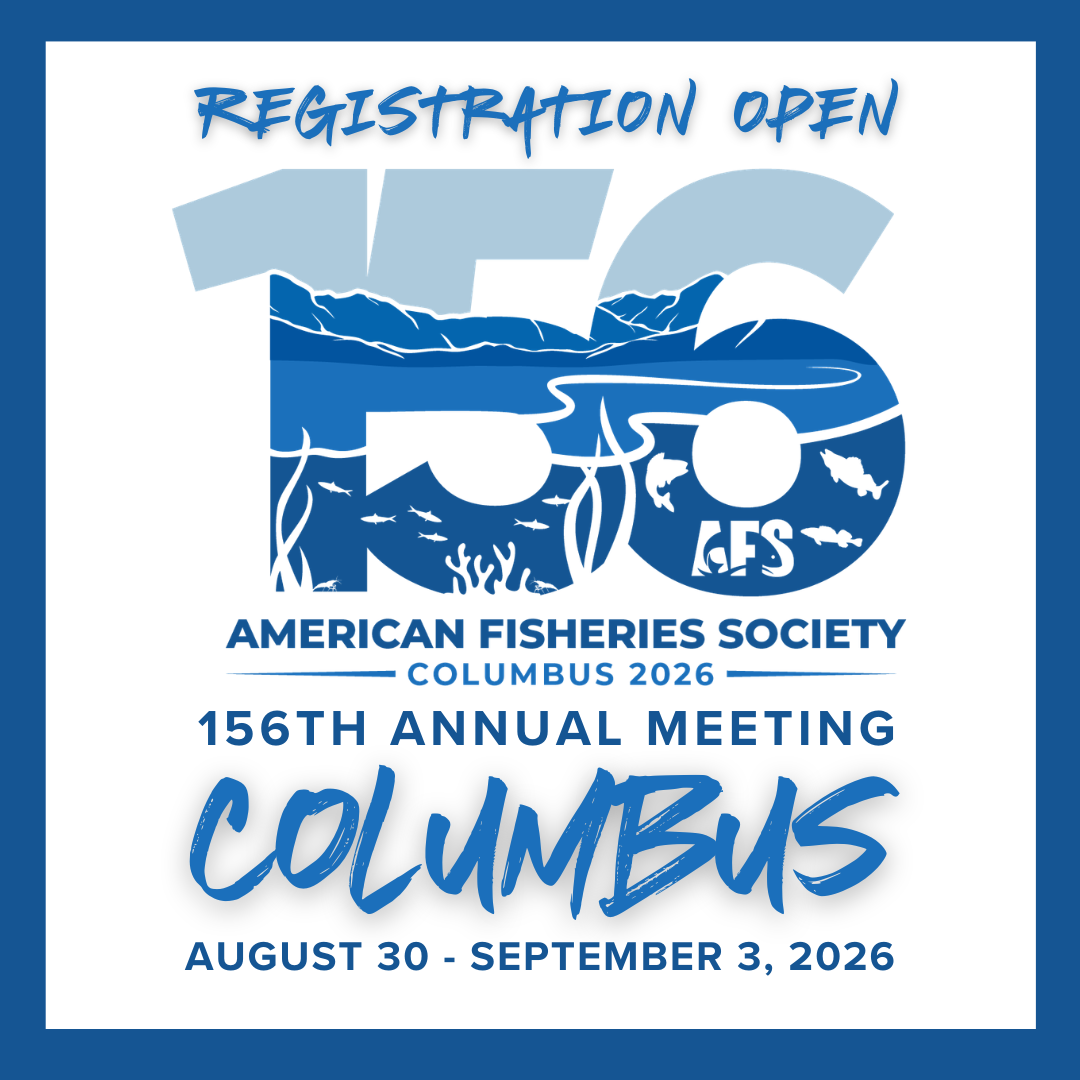
Annual Meeting

Join us in Columbus in 2026

Divisions, Chapters, Sections

Find an AFS Unit near you or in your area of specialty

Fishbook

Fisheries Collaboration Network

Climate Change and Fisheries

Learn how to communicate the effects of climate change on fisheries

Hutton Junior Fisheries Biology Program

Summer internships for high school students

Community Growth and Connections

Explore our initiatives to build community in the Society and in the fisheries profession

Center for Fisheries Technology and Collaboration

Find fisheries science products and services

Center for Technology and Collaboration

Quick answers to common questions

Other Resources
  • Standard Methods for Sampling North American Freshwater Fish Website

  • Rotenone Stewardship Program Information Site

  • Fishionary: A blog about fish words! 
Latest News
2026 Officer Election Voting Now Open AFS Calls for Continued Protection of Boundary Waters from Mining Proposed Rule Would Undermine Science-based Endangered Species Act Future of Public Trust Resources – Statement of the American Fisheries Society Latest Newsletter
Donate
Login
Logout
$0.00 0 Cart
  • Who We Are

    Who We Are

    Governance

    Learn how AFS is structured

    Divisions, Sections, Chapters

    Find a community in your local
    area or in your expertise

    Committees

    Get engaged and volunteer

    Awards & Recognition

    Nominate your heroes

    Community Growth and Connections

    Learn more about our community-building efforts

    AFS Celebrates 150+ Years

    Explore our history

    AFS Fisheries Partnerships

    Meet our global partners

    Meet the Staff

    Dedicated to serving our members

    Contact Us

    Quick answers to common questions

    Support AFS

    Discover how you can support critical AFS programs

    What Are Fisheries?

    Explore fisheries professions

  • MEMBERSHIP

    Membership

    Learn about membership benefits and member types

    Member Directory

    Find your colleagues

    Types of Membership

    For all stages of your career

    Give the Gift
    of Membership

    Invest in an aspiring fisheries
    professional’s future

    Who Are Our Members

    From students to 50-year Golden Members

    Governance

    Learn about our organization and leadership

    My Account

    Log in to access member benefits or renew

    Join/Renew

    It’s Quick and Easy

    Organizational Membership

    Become a Strategic Partner!

  • POLICY

    POLICY

    Recovering America’s
    Wildlife Act

    Critical funding for state conservation programs

    Climate Change

    Communicate the impacts
    of climate change on fisheries

    Magnuson-Stevens Act

    Ensuring sustainability of marine fisheries

    Waters of the US

    News about Clean Water Act
    jurisdiction

    Water Quality

    Healthy fisheries require healthy waters

    Pebble Mine

    Protecting Bristol Bay salmon fisheries

    National Fish
    Habitat Partnership

    Addressing fish habitat regionally

    Infrastructure

    Funding impacts on fish habitat

    Aquaculture

    Providing food security for the future

    Future of the Nation’s
    Aquatic Resources

    Priorities for US fisheries policies

    Recent Policy Statements

    Official policy statements of AFS

    Policy Letters

    Comments on policy,
    legislation, and regulations

    Sport Fish Restoration Act

    Understanding its importance in funding state agency fisheries management

    Advocacy Guidelines

    For Units and members

    Science Guidelines

    Practicing science appropriately

    Briefings

    Congressional briefings with our partners

    Resolutions

    Member-approved resolutions
    on policy

  • NEWS

    News

    Announcements

    Official AFS news

    Annual Meeting

    News from the meeting

    Members in the News

    Awards and interviews

    Policy News

    Round-up of all policy news

    Beneath the Surface Podcast

    A deep dive into the programs and people at AFS

    Federal Workforce and Budget Cuts

    Resources and Ways to Take Action

    Newsletter

    Bi-weekly newsletter for members and partners

    Press Releases

    News media releases

  • EVENTS

    Events

    Annual Meeting

    Columbus 2026

    Future Annual Meetings

    Where we are heading

    Past Annual Meetings

    Where we’ve been

    World Fisheries Congress 2024

    Seattle, Washington

    Other Past Events

    Past special events

    Fisheries Events Calendar

    Events around the world

    Add Your Event Listing

    Submit your calendar item

  • JOBS

    Jobs

    Career Help from AFS

    Compilation of job listing boards

    Other Career Tips

    Career info for members

    Find a Job

    Listings from all over North America

    Post a Job

    Submit your job opening

  • PUBLICATIONS

    Publications

    AFS Journals Program

    More than 150 years of excellence

    AFS Books Program

    Publish with AFS

    Submit Journal Article

    Reach the right audience for your research

    Fisheries Magazine

    Monthly membership magazine

    Writing Tools

    Guides for authors and other resources

    Fishy Fridays

    Weekly blog highlighting AFS fisheries journal articles

    Bookstore

    Shop more than 180 titles

    Journal Online Access

    Log in to access journal articles

    Gray Literature Database

    Thousands of unpublished agency reports and research

  • Professional Development

    Professional Development

    Continuing Education

    Gain skills and enhance your career

    Professional Certification

    Official recognition of your expertise

    Hutton Junior Fisheries
    Biology Program

    Summer high school
    internship program

    Leadership Opportunities

    Hone your leadership skills, volunteer today!

    Training Opportunities Calendar

    Webinars, online courses, on-site workshops, and field training

    Webinars

    Check out upcoming sessions or browse our library

    More Online Resources

    Practical resources for fisheries professionals

  • Engagement

    Engagement

    Strategic Partners

    See how your organization can partner with AFS

    Support AFS

    Discover how you can support critical AFS programs

    The 1870 Society

    Recognizing generous individual donors who invest in the Society's mission

    2024 Annual Report

    Find out what AFS did for the fisheries community in 2024

    Shop AFS

    Check out the latest AFS merch here

Login
Logout

House Natural Resources Subcommittee Holds Hearing on Magnuson-Stevens Act

  • July 28, 2017
  • Magnuson-Stevens Act, Policy News
  • Home
  • House Natural Resources Subcommittee Holds Hearing on Magnuson-Stevens Act

On July 19, the House Natural Resources Committee’s Water, Power and Oceans Subcommittee held an oversight hearing to explore regional successes and challenges associated with federal fisheries management under the Magnuson-Stevens Fishery Conservation and Management Act (MSA). Stakeholders from various regions testified on specific management challenges they have faced, and highlighted reforms that could be made to the act to afford regional fishery managers and the Secretary of Commerce the flexibility to tailor management plans to the unique circumstances of different fisheries – both commercial and recreational – in different regions across the U.S.

First passed in 1976, MSA is the primary law governing commercial and recreational marine fisheries management in U.S. federal waters out to 200 nautical miles from shore. The law seeks to prevent overfishing, rebuild overfished stocks, increase long-term economic and social benefits, and ensure a safe and sustainable supply of seafood. Congress made significant revisions to MSA in 1996 with the passage of the Sustainable Fisheries Act, and again in 2007 with the Magnuson-Stevens Fishery Conservation and Management Reauthorization Act.  Federal fisheries are managed for Maximum Sustainable Yield (MSY), the amount of fish that can be removed from the stock without impacting the long-term stability of the population. MSY can be adjusted for the ecological, economic, and social goals of the country to achieve Optimal Yield.

There are a number of bills that have been introduced in this Congress to reform federal fisheries management. Congressman Don Young (R-AK) sponsored a MSA reauthorization bill, H.R. 200, the Strengthening Fishing Communities and Increasing Flexibility in Fisheries Management Act, provides for flexibility in the currently mandated 10-year rebuilding timeframes that would allow Fishery Management Councils to take economic factors such as the effects of the fishing restrictions on the fishing communities into account while still rebuilding the fishery.  Congressman Garret Graves (R-LA) introduced H.R. 2023, the Modernization Recreational Fisheries Management Act of 2017, to address recreational fisheries concerns with federal management of red snapper in the Gulf of Mexico.  Both bills are awaiting subcommittee action.

Republicans expressed concern about access for commercial and recreational fishing, lack of reliable data to inform stock assessments, inflexible regulations, and limited fishing areas resulting from expanded Marine Protected Areas associated with Marine National Monuments and Marine Sanctuaries. Democrats highlighted the existing flexibility in the law and touted the successes in rebuilding fish stocks through science-based catch limits, accountability measures and rebuilding plans under MSA.

Nick Wiley, executive director for the Florida Fish and Wildlife Conservation Commission (FWC) testified that he believes MSA, as currently written, needs to be modified and improved to better balance today’s need for access and conservation. In his written testimony, he noted “The Act has worked best when applied to the commercial sector, but not so well when applied to the recreational sector.” Further, he noted “the requirements to manage fisheries under strict annual catch limits, the overly prescriptive constraints for stock rebuilding plans, and general inflexibility within the current version of the law have hindered management of fish stocks in the South Atlantic and Gulf of Mexico. This inflexibility has fostered a serious erosion of public confidence, trust, and support for this fishery management system.”

Sean Martin testified on behalf of the Hawaii Longline Association.  He expressed concern with the establishment of national marine monuments in the Pacific Ocean under the Antiquities Act of 1906 which, in his view, circumvented MSA and excluded the fishing industry. He recommended that the MSA be amended to ensure that the act is the only process by which regulations affecting U.S. fisheries can be adopted to ensure a transparent, public, and science-based process.

Jeff Kaelin, representing a Cape May, New Jersey commercial fishing enterprise, Lund’s Fisheries, expressed support for H.R. 200, Rep. Young’s MSA re-authorization bill and highlighted the need for reforms to the existing law, particularly in light of what he views as challenges to consistently achieving Optimum Yield.  He testified that insufficient data on many stocks and scientific uncertainty has resulted in robust precautionary buffers around quotas and yields below MSY at the expense of the industry and our Nation.

Charles Witek, a recreational angler and outdoor writer specializing in saltwater fishery conservation from New York, spoke in favor of the existing conservation and management provisions of MSA. He testified that Annual Catch Limits and rebuilding deadlines were the only framework that has met with consistent success. He explained that New York’s inshore fisheries are managed in cooperation with the Atlantic States Marine Fisheries Commission (ASMFC) under a “flexible management system that does not require overfishing to be ended, stocks to be rebuilt by a particular deadline or the best scientific information to be used when evaluating the health of the stock.” He testified that federally managed stocks have been successfully rebuilt since the 1996 amendment to MSA, but the ASMFC has failed to rebuild a single stock under its sole jurisdiction and a number of stocks have even declined since then. He also called for the best peer reviewed science to be used in assessments and advocated for ecosystem-based management.

The need for improved data and data collection methods was discussed repeatedly in the hearing. Rep. Don Beyer (D-Va.) asked each panelist whether they supported more funding for fishery science. All of the panelists expressed support for increased funding, but Mr. Wiley cautioned that funding should be directed towards the greatest needs. State fisheries agencies in the Gulf of Mexico have been critical of the federal Marine Recreational Information Program (MRIP) which relies on mail surveys for catch data and argue that it cannot provide data at the level of timeliness and accuracy needed for managing effort by quota-based Annual Catch Limits. In response, the Gulf Coast states have developed data collection surveys that rely on more frequent in-season surveys and have made other data-collection improvements.  All five Gulf States have developed or are developing state-specific reef fish angler harvest data programs to identify the pool of reef fish anglers and collect harvest data in, or close to, real-time. In addition, they are investing in smart phone technology for anglers to log their catch and contribute significant data to the management system.

The Senate has scheduled a number of hearings on MSA in August.  We will continue to track legislative developments on efforts to reauthorize MSA and will provide periodic updates.

Upcoming Hearings on MSA:

The Senate Commerce, Science, and Transportation Committee’s Subcommittee on Oceans, Atmosphere, Fisheries, and Coast Guard will hold a hearing on August 1, 2017 at 10:00 a.m., titled “Reauthorization of the Magnuson-Stevens Fishery Conservation and Management Act: NOAA and Council Perspectives“.

Witnesses will be:

  • Christopher Oliver, Assistant Administrator for the National Marine Fisheries Service, National Oceanic and Atmospheric Administration
  • John Quinn, Chair, Council Coordination Committee and Northeast Fishery Management Council

The hearing can be viewed at:

https://www.commerce.senate.gov/public/index.cfm/hearings?ID=E9AFCF43-4EFC-4F3E-8110-1C3EACCED887


The Senate Commerce, Science, and Transportation Committee will hold a hearing titled “Reauthorization of the Magnuson-Stevens Fishery Conservation and Management Act: Oversight of Fisheries Management Successes and Challenges on August 23, 2017 at 1:00 p.m. (Alaska Standard Time).  The hearing will be held at the Kenai Peninsula College, Soldotna, Alaska.

A witness list is not available for this hearing yet and it is unclear whether this hearing will be webcast.  If so, it will be available at:  https://www.commerce.senate.gov/public/index.cfm/hearings?ID=B41AA74D-2FE6-4945-AAFF-4B43AD0ACCF7



  • Recent News

    • Is Bigger Better for Hatchery Chinook Salmon? May 1, 2026
    • Webinar: A Perpetual Franchise to Cultivate Oysters April 30, 2026
    • Webinar: Skin Cancer Risk and Outdoor Workers: Early Detection and Sun Protection Could Save Your Life April 30, 2026
    • AFS Calls for Robust Funding for NOAA Fisheries April 27, 2026
    • AFS Urges Full Funding for US Fish and Wildlife Service, US Geological Survey, and US Forest Service April 24, 2026
  • About

    The American Fisheries Society is 501c Non-Profit Society


    Donate Now

    Quick Links

    • ABOUT
    • POLICY
    • EVENTS
    • PUBLICATIONS
    • MEMBERSHIP
    • NEWS
    • JOBS
    • Contact Us
    • ABOUT
    • POLICY
    • EVENTS
    • PUBLICATIONS
    • MEMBERSHIP
    • NEWS
    • JOBS
    • Contact Us

    Contact

    • 25 Century Boulevard
      Suite 505
      Nashville, TN 37214
    • (301) 897-8616
    Facebook-f Twitter Instagram Linkedin-in Vimeo-v

    Copyright © 2026 American Fisheries Society | Privacy Policy 

    This website uses cookies to improve your experience. Accept Read More
    Privacy & Cookies Policy

    Privacy Overview

    This website uses cookies to improve your experience while you navigate through the website. Out of these, the cookies that are categorized as necessary are stored on your browser as they are essential for the working of basic functionalities of the website. We also use third-party cookies that help us analyze and understand how you use this website. These cookies will be stored in your browser only with your consent. You also have the option to opt-out of these cookies. But opting out of some of these cookies may affect your browsing experience.
    Necessary
    Always Enabled
    Necessary cookies are absolutely essential for the website to function properly. This category only includes cookies that ensures basic functionalities and security features of the website. These cookies do not store any personal information.
    Non-necessary
    Any cookies that may not be particularly necessary for the website to function and is used specifically to collect user personal data via analytics, ads, other embedded contents are termed as non-necessary cookies. It is mandatory to procure user consent prior to running these cookies on your website.
    SAVE & ACCEPT