Skip to content

American Fisheries Society Family of Websites:

Fisheries.org

American Fisheries Society
Family of Websites

Journals

Read our five journals and Fisheries magazine

Gray Literature Database

Find thousands of unpublished agency reports and other information

Annual Meeting

Join us in Columbus in 2026

Divisions, Chapters, Sections

Find an AFS Unit near you or in your area of specialty

Fishbook

Fisheries Collaboration Network

Climate Change and Fisheries

Learn how to communicate the effects of climate change on fisheries

Hutton Junior Fisheries Biology Program

Summer internships for high school students

Community Growth and Connections

Explore our initiatives to build community in the Society and in the fisheries profession

Center for Fisheries Technology and Collaboration

Find fisheries science products and services

Center for Technology and Collaboration

Quick answers to common questions

Other Resources
  • Standard Methods for Sampling North American Freshwater Fish Website

  • Rotenone Stewardship Program Information Site

  • Fishionary: A blog about fish words! 
Latest News
2026 Officer Election Voting Now Open AFS Calls for Continued Protection of Boundary Waters from Mining Proposed Rule Would Undermine Science-based Endangered Species Act Future of Public Trust Resources – Statement of the American Fisheries Society Latest Newsletter
Donate
Login
Logout
$0.00 0 Cart
  • Who We Are

    Who We Are

    Governance

    Learn how AFS is structured

    Divisions, Sections, Chapters

    Find a community in your local
    area or in your expertise

    Committees

    Get engaged and volunteer

    Awards & Recognition

    Nominate your heroes

    Community Growth and Connections

    Learn more about our community-building efforts

    AFS Celebrates 150+ Years

    Explore our history

    AFS Fisheries Partnerships

    Meet our global partners

    Meet the Staff

    Dedicated to serving our members

    Contact Us

    Quick answers to common questions

    Support AFS

    Discover how you can support critical AFS programs

    What Are Fisheries?

    Explore fisheries professions

  • MEMBERSHIP

    Membership

    Learn about membership benefits and member types

    Member Directory

    Find your colleagues

    Types of Membership

    For all stages of your career

    Give the Gift
    of Membership

    Invest in an aspiring fisheries
    professional’s future

    Who Are Our Members

    From students to 50-year Golden Members

    Governance

    Learn about our organization and leadership

    My Account

    Log in to access member benefits or renew

    Join/Renew

    It’s Quick and Easy

    Organizational Membership

    Become a Strategic Partner!

  • POLICY

    POLICY

    Recovering America’s
    Wildlife Act

    Critical funding for state conservation programs

    Climate Change

    Communicate the impacts
    of climate change on fisheries

    Magnuson-Stevens Act

    Ensuring sustainability of marine fisheries

    Waters of the US

    News about Clean Water Act
    jurisdiction

    Water Quality

    Healthy fisheries require healthy waters

    Pebble Mine

    Protecting Bristol Bay salmon fisheries

    National Fish
    Habitat Partnership

    Addressing fish habitat regionally

    Infrastructure

    Funding impacts on fish habitat

    Aquaculture

    Providing food security for the future

    Future of the Nation’s
    Aquatic Resources

    Priorities for US fisheries policies

    Recent Policy Statements

    Official policy statements of AFS

    Policy Letters

    Comments on policy,
    legislation, and regulations

    Sport Fish Restoration Act

    Understanding its importance in funding state agency fisheries management

    Advocacy Guidelines

    For Units and members

    Science Guidelines

    Practicing science appropriately

    Briefings

    Congressional briefings with our partners

    Resolutions

    Member-approved resolutions
    on policy

  • NEWS

    News

    Announcements

    Official AFS news

    Annual Meeting

    News from the meeting

    Members in the News

    Awards and interviews

    Policy News

    Round-up of all policy news

    Beneath the Surface Podcast

    A deep dive into the programs and people at AFS

    Federal Workforce and Budget Cuts

    Resources and Ways to Take Action

    Newsletter

    Bi-weekly newsletter for members and partners

    Press Releases

    News media releases

  • EVENTS

    Events

    Annual Meeting

    Columbus 2026

    Future Annual Meetings

    Where we are heading

    Past Annual Meetings

    Where we’ve been

    World Fisheries Congress 2024

    Seattle, Washington

    Other Past Events

    Past special events

    Fisheries Events Calendar

    Events around the world

    Add Your Event Listing

    Submit your calendar item

  • JOBS

    Jobs

    Career Help from AFS

    Compilation of job listing boards

    Other Career Tips

    Career info for members

    Find a Job

    Listings from all over North America

    Post a Job

    Submit your job opening

  • PUBLICATIONS

    Publications

    AFS Journals Program

    More than 150 years of excellence

    AFS Books Program

    Publish with AFS

    Submit Journal Article

    Reach the right audience for your research

    Fisheries Magazine

    Monthly membership magazine

    Writing Tools

    Guides for authors and other resources

    Fishy Fridays

    Weekly blog highlighting AFS fisheries journal articles

    Bookstore

    Shop more than 180 titles

    Journal Online Access

    Log in to access journal articles

    Gray Literature Database

    Thousands of unpublished agency reports and research

  • Professional Development

    Professional Development

    Continuing Education

    Gain skills and enhance your career

    Professional Certification

    Official recognition of your expertise

    Hutton Junior Fisheries
    Biology Program

    Summer high school
    internship program

    Leadership Opportunities

    Hone your leadership skills, volunteer today!

    Training Opportunities Calendar

    Webinars, online courses, on-site workshops, and field training

    Webinars

    Check out upcoming sessions or browse our library

    More Online Resources

    Practical resources for fisheries professionals

  • Engagement

    Engagement

    Strategic Partners

    See how your organization can partner with AFS

    Support AFS

    Discover how you can support critical AFS programs

    The 1870 Society

    Recognizing generous individual donors who invest in the Society's mission

    2024 Annual Report

    Find out what AFS did for the fisheries community in 2024

    Shop AFS

    Check out the latest AFS merch here

Login
Logout

STUDENT ANGLE: Winter: The Forgotten Study Season

  • January 10, 2016
  • News, Students • Early Career Professionals
  • Home
  • STUDENT ANGLE: Winter: The Forgotten Study Season

2015 Student Writing Contest: WINNER

Michelle Lavery, E-mail: lavery.j.m@gmail.com
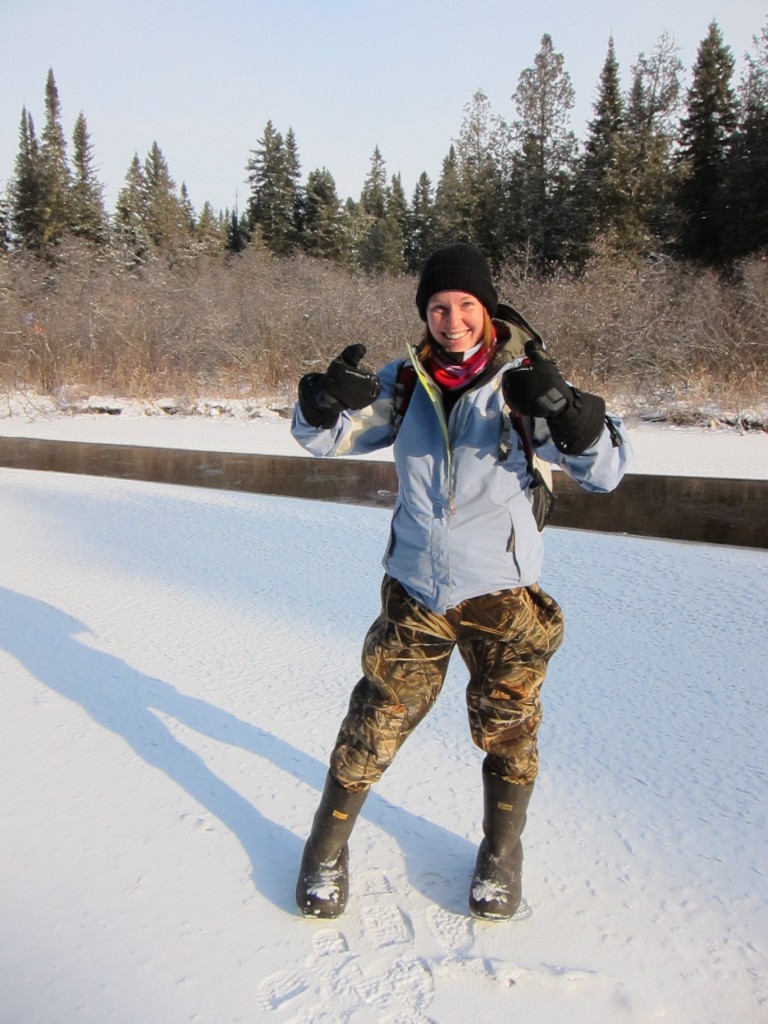
 

MichelleLaveryFor many hydrologic regimes of the world, streams and rivers are ice covered for the majority of the year, yet minimal research is conducted during this period compared with the more “researcher-friendly” open-water water period. Without a doubt, scientific progress is hampered by the logistical difficulties and high cost associated with conducting “winter” research. (Prowse, 2001 [part II])

It seems as though every winter ecology paper contains some variant of this sentiment—we know that winter is important, but we’re not crazy enough to study it. As researchers, we’ve built sampling regimes that ignore an entire season because winter is considered harsh and unforgiving. It’s cold, sharp, and sometimes deadly to us, and so we operate under the assumption that the same goes for the creatures we study.

Alas, it is not so. There’s a lot going on under the snow, and even more going on under the ice. For example, Atlantic Salmon Salmo salar eggs incubate in the gravel under river ice in Eastern Canada for six frigid, snowy months at water temperatures barely above freezing. They emerge from the gravel during the spring melt period, when ice jams bulldoze forests and water levels climb meters in minutes. These tiny fish are at the mercy of a dynamic and unpredictable season, yet we barely know anything about it.

As a pampered girl from “tropical” Toronto, I never imagined myself riding a snowmobile and hacking through river ice in the middle of the woods. However, through a serendipitous connection, I recently found myself doing both—while pursuing a master’s degree supervised by Richard Cunjak at the Canadian Rivers Institute.

In Eastern Canada’s Miramichi River system, salmon eggs incubate in the gravel riverbed from late October to early May, during which time they experience highly variable winter conditions. In November, air temperatures can drop dramatically overnight (usually to about -20°C or -4°F), causing water to reach its freezing point quickly and inconsistently. As water crystallizes, it can stick to itself and the river substrate, forming anchor ice—a squishy carpet of ice crystals on the riverbed. If this ice forms on top of salmon nests (or “redds”), it can block water flow through the gravel and alter the temperature and dissolved oxygen levels surrounding the developing eggs.

Once full ice cover forms and surface runoff is locked up in the snowpack, long-residence groundwater may be the major contributor to river discharge. “Long-residence” groundwater refers to water that has spent a considerable amount of time in an aquifer deep underground. Consequently, it is often warmer than the surface water in the winter, and can have significantly lower dissolved oxygen concentrations (since it has not been recently aerated). As this groundwater seeps through the river substrate, the conditions in salmon redds can change dramatically. Depending on the size of the seep, eggs may develop faster due to warmer water temperatures and require more oxygen to sustain this accelerated rate of development. However, the oxygen-poor groundwater is usually unable to meet their biological demands. Without enough oxygen, these eggs may die or experience “sub-lethal” effects—onsequences that may impact their survival later in life as free-swimming fish. These may include stunted growth or developmental deformities that may impair gas exchange, swimming ability, neurological function, etc.

During the spring melt period, silt and clay can be eroded into rivers by the surface runoff water. Depending on the grain size, these sediments may clog the egg membrane and prevent diffusion of oxygen to the embryo, effectively suffocating the fish. Furthermore, as ice breaks up and moves out of rivers, scour along the riverbed may significantly disturb the gravel and damage the embryos underneath.

It is hard to believe, after considering all of the variation inherent in winter and its potential effects on one life stage of one species in one type of habitat, that winter goes largely unnoticed in the scientific literature. It is, certainly, a challenging season to research. I’ve had my fair share of winter mishaps, including digging a snowmobile out of a slush puddle for three  hours, miscalculating ice thickness (not ideal!), hypothermic near-misses, and tethering myself to a tree during the spring melt. However, if we can get past our numb fingers and dripping noses, there’s a whole season waiting to be studied. One could argue that winter research is the last true frontier of freshwater ecology—there are so many unknowns to explore, and so many questions left unanswered. It might not be a “researcher-friendly” season, but it’s definitely exciting! Plus, who doesn’t love a good mid-river snowball fight?

REFERENCE

Prowse, T. D. 2001. River-ice ecology. 2: Biological aspects. Journal of Cold Regions Engineering 15:17-33.

RELATED MATERIALS

Cunjak, R. A., T. D. Prowse, and D. L. Parrish. 1998. Atlantic Salmon Salmo salar in winter: “the season of parr discontent”? Canadian Journal of Fisheries and Aquatic Sciences 55(1):161-180.

Flanagan, J. J. 2003. The impacts of fine sediments and variable flow regime on the habitat and survival of Atlantic Salmon Salmo salar eggs. Master’s thesis: University of New Brunswick, Fredericton.

 Greig, S. M., D. A. Sear, and P. A. Carling. 2005. The impact of fine sediment accumulation on the survival of incubating salmon

progeny: Implications for sediment management. Science of the Total Environment 344(1-3):241-258.

Kane, T. R. 1988. Relationship of temperature and time of initial feeding of Atlantic Salmon. Progressive Fish-Culturist 50:93-97.

Louhi, P., M. Ovaska, A. Maki-Petays, J. Erkinaro, T. Muotka, and J. Rosenfeld. 2011. Does fine sediment constrain salmonid alevin development and survival? Canadian Journal of Fisheries and Aquatic Sciences 68(10):1819-1826.

Malcolm, I. A., S. M. Greig, A. F. Youngson, and C. Soulsby. 2008. Hyporheic influences on salmon embryo survival and performance. Pages 1-24 in D. A. Sear and P. DeVries, editors. Salmonid spawning habitat in rivers: physical controls, biological responses, and approaches to remediation. American Fisheries Society, Symposium 65, Bethesda, Maryland.

Malcolm, I. A., C. Soulsby, A. F. Youngson, D. M. Hannah, I. S. McLaren, and A. Thorne. 2004. Hydrological influences on hyporheic water quality: implications for salmon egg survival. Hydrological Processes 18(9):1543-1560.

Malcolm, I. A., C. Soulsby, A. F. Youngson, and D. M. Hannah. 2005. Catchment-scale controls on groundwater-surface water interactions in the hyporheic zone: implications for salmon embryo survival. River Research and Applications 21(9):977-989.

Malcolm, I. A., C. Soulsby, A. F. Youngson, and D. Tetzlaff. 2008b. Fine scale variability of hyporheic hydrochemistry in salmon spawning gravels with contrasting groundwater-surface water interactions. Hydrogeology Journal 17(1):161-174.

Malcolm, I. A., A. F. Youngson, and C. Soulsby. 2003. Survival of salmonid eggs in a degraded gravel-bed stream: effects of groundwater-surface water interactions. River Research and Applications 19(4):303-316.

Prowse, T. D. 2001. River-ice ecology. 1: hydrologic, geomorphic, and water-quality aspects. Journal of Cold Regions Engineering 15:1-16.

Soulsby, C., A. F. Youngson, H. J. Moir, and I. A. Malcolm. 2001. Fine ediment influence on salmonid spawning habitat in a lowland agricultural stream: a preliminary assessment. Science of the Total Environment 265(1-3):295-307.

Member click below for the January 2016 Fisheries magazine’s complete issue. Non-members, join here.

This content is for members only. Please login.

  • Recent News

    • AFS Urges Modernization of Sporting Goods Excise Tax that Funds Fisheries Conservation May 13, 2026
    • Is Bigger Better for Hatchery Chinook Salmon? May 1, 2026
    • Webinar: A Perpetual Franchise to Cultivate Oysters April 30, 2026
    • Webinar: Skin Cancer Risk and Outdoor Workers: Early Detection and Sun Protection Could Save Your Life April 30, 2026
    • AFS Calls for Robust Funding for NOAA Fisheries April 27, 2026
  • About

    The American Fisheries Society is 501c Non-Profit Society


    Donate Now

    Quick Links

    • ABOUT
    • POLICY
    • EVENTS
    • PUBLICATIONS
    • MEMBERSHIP
    • NEWS
    • JOBS
    • Contact Us
    • ABOUT
    • POLICY
    • EVENTS
    • PUBLICATIONS
    • MEMBERSHIP
    • NEWS
    • JOBS
    • Contact Us

    Contact

    • 25 Century Boulevard
      Suite 505
      Nashville, TN 37214
    • (301) 897-8616
    Facebook-f Twitter Instagram Linkedin-in Vimeo-v

    Copyright © 2026 American Fisheries Society | Privacy Policy 

    This website uses cookies to improve your experience. Accept Read More
    Privacy & Cookies Policy

    Privacy Overview

    This website uses cookies to improve your experience while you navigate through the website. Out of these, the cookies that are categorized as necessary are stored on your browser as they are essential for the working of basic functionalities of the website. We also use third-party cookies that help us analyze and understand how you use this website. These cookies will be stored in your browser only with your consent. You also have the option to opt-out of these cookies. But opting out of some of these cookies may affect your browsing experience.
    Necessary
    Always Enabled
    Necessary cookies are absolutely essential for the website to function properly. This category only includes cookies that ensures basic functionalities and security features of the website. These cookies do not store any personal information.
    Non-necessary
    Any cookies that may not be particularly necessary for the website to function and is used specifically to collect user personal data via analytics, ads, other embedded contents are termed as non-necessary cookies. It is mandatory to procure user consent prior to running these cookies on your website.
    SAVE & ACCEPT