Skip to content

American Fisheries Society Family of Websites:

Fisheries.org

American Fisheries Society
Family of Websites

Journals

Read our five journals and Fisheries magazine

Gray Literature Database

Find thousands of unpublished agency reports and other information

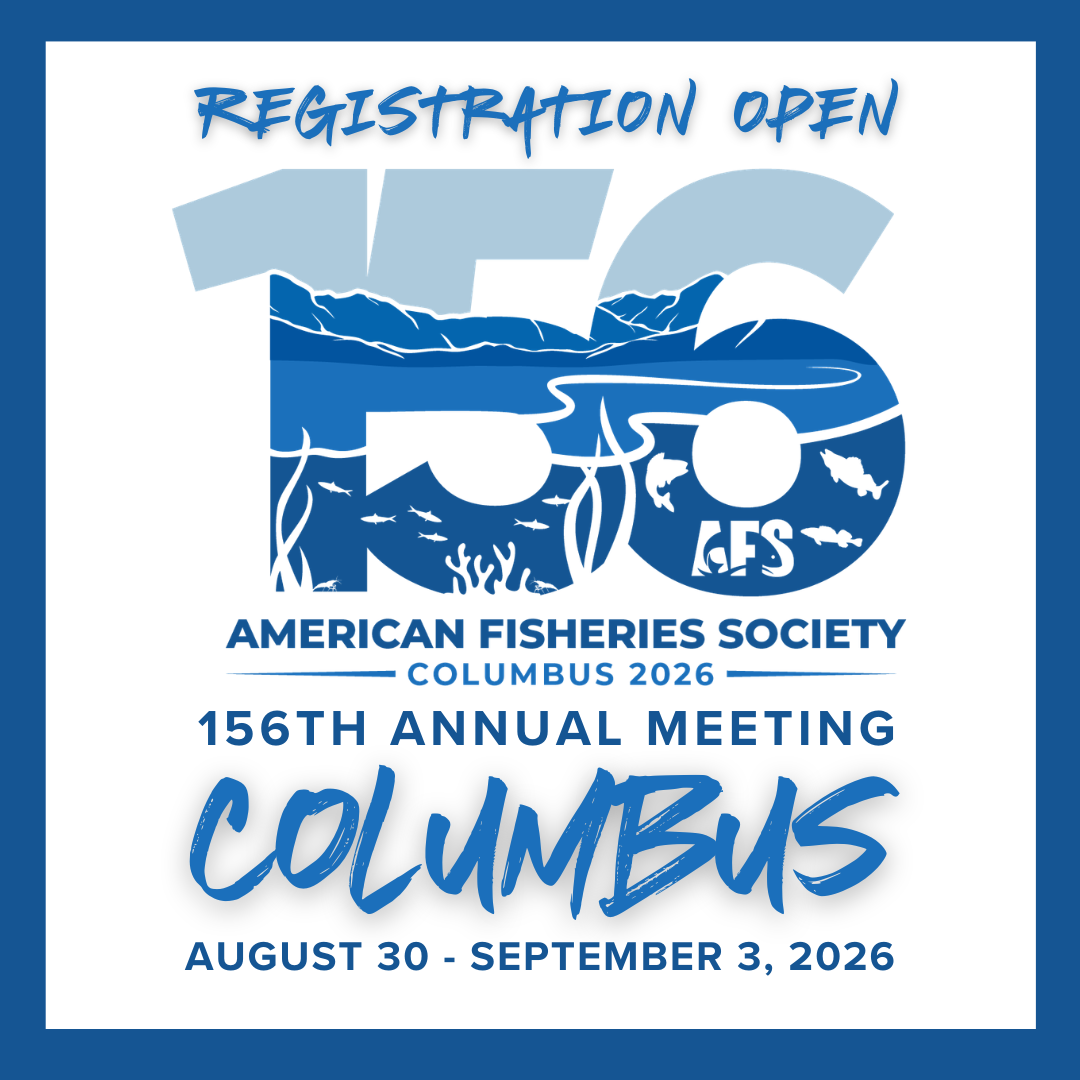
Annual Meeting

Join us in Columbus in 2026

Divisions, Chapters, Sections

Find an AFS Unit near you or in your area of specialty

Fishbook

Fisheries Collaboration Network

Climate Change and Fisheries

Learn how to communicate the effects of climate change on fisheries

Hutton Junior Fisheries Biology Program

Summer internships for high school students

Community Growth and Connections

Explore our initiatives to build community in the Society and in the fisheries profession

Center for Fisheries Technology and Collaboration

Find fisheries science products and services

Center for Technology and Collaboration

Quick answers to common questions

Other Resources
  • Standard Methods for Sampling North American Freshwater Fish Website

  • Rotenone Stewardship Program Information Site

  • Fishionary: A blog about fish words! 
Latest News
2026 Officer Election Voting Now Open AFS Calls for Continued Protection of Boundary Waters from Mining Proposed Rule Would Undermine Science-based Endangered Species Act Future of Public Trust Resources – Statement of the American Fisheries Society Latest Newsletter
Donate
Login
Logout
$0.00 0 Cart
  • Who We Are

    Who We Are

    Governance

    Learn how AFS is structured

    Divisions, Sections, Chapters

    Find a community in your local
    area or in your expertise

    Committees

    Get engaged and volunteer

    Awards & Recognition

    Nominate your heroes

    Community Growth and Connections

    Learn more about our community-building efforts

    AFS Celebrates 150+ Years

    Explore our history

    AFS Fisheries Partnerships

    Meet our global partners

    Meet the Staff

    Dedicated to serving our members

    Contact Us

    Quick answers to common questions

    Support AFS

    Discover how you can support critical AFS programs

    What Are Fisheries?

    Explore fisheries professions

  • MEMBERSHIP

    Membership

    Learn about membership benefits and member types

    Member Directory

    Find your colleagues

    Types of Membership

    For all stages of your career

    Give the Gift
    of Membership

    Invest in an aspiring fisheries
    professional’s future

    Who Are Our Members

    From students to 50-year Golden Members

    Governance

    Learn about our organization and leadership

    My Account

    Log in to access member benefits or renew

    Join/Renew

    It’s Quick and Easy

    Organizational Membership

    Become a Strategic Partner!

  • POLICY

    POLICY

    Recovering America’s
    Wildlife Act

    Critical funding for state conservation programs

    Climate Change

    Communicate the impacts
    of climate change on fisheries

    Magnuson-Stevens Act

    Ensuring sustainability of marine fisheries

    Waters of the US

    News about Clean Water Act
    jurisdiction

    Water Quality

    Healthy fisheries require healthy waters

    Pebble Mine

    Protecting Bristol Bay salmon fisheries

    National Fish
    Habitat Partnership

    Addressing fish habitat regionally

    Infrastructure

    Funding impacts on fish habitat

    Aquaculture

    Providing food security for the future

    Future of the Nation’s
    Aquatic Resources

    Priorities for US fisheries policies

    Recent Policy Statements

    Official policy statements of AFS

    Policy Letters

    Comments on policy,
    legislation, and regulations

    Sport Fish Restoration Act

    Understanding its importance in funding state agency fisheries management

    Advocacy Guidelines

    For Units and members

    Science Guidelines

    Practicing science appropriately

    Briefings

    Congressional briefings with our partners

    Resolutions

    Member-approved resolutions
    on policy

  • NEWS

    News

    Announcements

    Official AFS news

    Annual Meeting

    News from the meeting

    Members in the News

    Awards and interviews

    Policy News

    Round-up of all policy news

    Beneath the Surface Podcast

    A deep dive into the programs and people at AFS

    Federal Workforce and Budget Cuts

    Resources and Ways to Take Action

    Newsletter

    Bi-weekly newsletter for members and partners

    Press Releases

    News media releases

  • EVENTS

    Events

    Annual Meeting

    Columbus 2026

    Future Annual Meetings

    Where we are heading

    Past Annual Meetings

    Where we’ve been

    World Fisheries Congress 2024

    Seattle, Washington

    Other Past Events

    Past special events

    Fisheries Events Calendar

    Events around the world

    Add Your Event Listing

    Submit your calendar item

  • JOBS

    Jobs

    Career Help from AFS

    Compilation of job listing boards

    Other Career Tips

    Career info for members

    Find a Job

    Listings from all over North America

    Post a Job

    Submit your job opening

  • PUBLICATIONS

    Publications

    AFS Journals Program

    More than 150 years of excellence

    AFS Books Program

    Publish with AFS

    Submit Journal Article

    Reach the right audience for your research

    Fisheries Magazine

    Monthly membership magazine

    Writing Tools

    Guides for authors and other resources

    Fishy Fridays

    Weekly blog highlighting AFS fisheries journal articles

    Bookstore

    Shop more than 180 titles

    Journal Online Access

    Log in to access journal articles

    Gray Literature Database

    Thousands of unpublished agency reports and research

  • Professional Development

    Professional Development

    Continuing Education

    Gain skills and enhance your career

    Professional Certification

    Official recognition of your expertise

    Hutton Junior Fisheries
    Biology Program

    Summer high school
    internship program

    Leadership Opportunities

    Hone your leadership skills, volunteer today!

    Training Opportunities Calendar

    Webinars, online courses, on-site workshops, and field training

    Webinars

    Check out upcoming sessions or browse our library

    More Online Resources

    Practical resources for fisheries professionals

  • Engagement

    Engagement

    Strategic Partners

    See how your organization can partner with AFS

    Support AFS

    Discover how you can support critical AFS programs

    The 1870 Society

    Recognizing generous individual donors who invest in the Society's mission

    2024 Annual Report

    Find out what AFS did for the fisheries community in 2024

    Shop AFS

    Check out the latest AFS merch here

Login
Logout

January 2016: Revisiting the Protection/Restoration Debate

  • January 10, 2016
  • News, Policy News, The Policy Column
  • Home
  • January 2016: Revisiting the Protection/Restoration Debate
Thomas E. Bigford, AFS Policy Director

This column coalesced around four actions last October. First, as a frequent partner with the U.S. Bureau of Land Management (BLM), the American Fisheries Society (AFS) was invited to a presentation on the agency’s river restoration efforts, land-use planning, and regional mitigation strategies in the Arctic. Second, President Obama announced plans to pursue two new national marine sanctuaries. Third, and on the same day as the sanctuary action, the U.S. Justice Department revealed a $20.8 billion civil settlement addressing a portion of the environmental harm associated with BP’s Gulf of Mexico oil spill in 2010. Finally, to punctuate the flurry of poignant messages, Palau designated a 193,000 square-mile marine reserve, the sixth largest protected area in the world. From the Arctic to Palau, there are policies to debate and lessons to learn. You’ll sense some anguish in this column, prompted because we absolutely must find better balance in these two extremes—protect and restore.

At the heart of these actions is a choice. The options apply to fish habitat (the traditional bounds) but equally to fish stocks. In both arenas, the options can be clarified by parallels in our personal life. Consider our overall health, where the protective course of action is regular check-ups with timely immunizations and perhaps some vitamin supplements; the restoration approach to our well-being would be reactive, kicking into full gear after our health declines, then relying on prescription medicine and surgery to address serious disease. In dentistry, protection is akin to fluoride, flossing, and brushing, supplemented with regular visits. Restoration is decisive, but not until damage is detected, and we’re fighting cavities, drilling root canals, and perhaps checking our insurance coverage for dentures. Back in the fish world, my two extremes are not nearly so distinct. Regardless of where we draw the lines, it still makes obvious sense to invest in protection rather than settle for restoration.

As noted, this debate often focuses on habitat, but projecting those examples to fish is hardly a stretch. The ecological and economic costs of both options are at the root of the four actions mentioned in my opening paragraph. Protection is a strong decision to defend human values while reducing risks. It’s about minimizing and avoiding. In its simplest form, protecting stocks from unwise harvest or pressure from non-fishing threats simply makes ecological and economic sense. In the habitat world, the bottom line is that protecting a necessary hydrologic regime or spawning bed is light years easier than attempting to build one.

These options are clear and logical. Why, then, do we all too often practice poor hygiene with fish, to continue the metaphor? Why do we settle for expensive restoration when our wallets argue otherwise? Why don’t we invest more in protecting species from known threats rather than hoping our technical skills will enable us to restore them after their health has been severely compromised? And why is protection deemed to be a bad word to many sectors, including those, such as fishers, who gain from marine protected areas with fishing closures? Unacceptable answers to those policy questions are the root cause of my latent, fish-related anxiety.

Back to those current events noted at the top. BLM’s Arctic focus was the Jack Wade Creek Restoration Project in the Fortymile Wild and Scenic corridor in Alaska. Its efforts aim to reclaim fish habitats and restore stocks decimated by placer mining in the 1800s for alluvial mineral deposits such as gold. Now, equipped with new policies reflecting the latest reclamation techniques, BLM seeks to reclaim values lost for many decades.

Together, the four actions last fall typify our prospects for improved success across all systems. BLM’s challenges in Alaska, and comparable efforts in river systems in the lower 48, are immense, but perhaps not much more than the entire ecosystems at risk in tropical Palau. BLM’s focus on stream design, construction, and monitoring is comparable to work in marine sanctuaries, where successful management hinges on realistic objectives, adequate funding, and thorough monitoring.

The AFS has dabbled in this arena, but not nearly as much as it could and should. AFS wrote to the National Oceanic and Atmospheric Administration in mid-2015 urging a strong scientific approach to designating new sanctuaries. The Society also wrote to the U.S. Environmental Protection Agency and Congress to support their efforts to clarify wetland rules and regulations implementing the Clean Water Act. While those discussions continue, AFS must apply similar logic to fish, fish stocks, and fish habitat. All are easier to protect than to restore.

I usually end my column with a suggestion. Here I implore each of you to be proactive, to balance your options, to be realistic. We can do better.

Opinions are those of the author and not necessarily AFS. Letters to the Editor are invited.

Members click below for the January 2016 Fisheries magazine’s comple issue. Non-members, join here.

This content is for members only. Please login.
  • Recent News

    • Is Bigger Better for Hatchery Chinook Salmon? May 1, 2026
    • Webinar: A Perpetual Franchise to Cultivate Oysters April 30, 2026
    • Webinar: Skin Cancer Risk and Outdoor Workers: Early Detection and Sun Protection Could Save Your Life April 30, 2026
    • AFS Calls for Robust Funding for NOAA Fisheries April 27, 2026
    • AFS Urges Full Funding for US Fish and Wildlife Service, US Geological Survey, and US Forest Service April 24, 2026
  • About

    The American Fisheries Society is 501c Non-Profit Society


    Donate Now

    Quick Links

    • ABOUT
    • POLICY
    • EVENTS
    • PUBLICATIONS
    • MEMBERSHIP
    • NEWS
    • JOBS
    • Contact Us
    • ABOUT
    • POLICY
    • EVENTS
    • PUBLICATIONS
    • MEMBERSHIP
    • NEWS
    • JOBS
    • Contact Us

    Contact

    • 25 Century Boulevard
      Suite 505
      Nashville, TN 37214
    • (301) 897-8616
    Facebook-f Twitter Instagram Linkedin-in Vimeo-v

    Copyright © 2026 American Fisheries Society | Privacy Policy 

    This website uses cookies to improve your experience. Accept Read More
    Privacy & Cookies Policy

    Privacy Overview

    This website uses cookies to improve your experience while you navigate through the website. Out of these, the cookies that are categorized as necessary are stored on your browser as they are essential for the working of basic functionalities of the website. We also use third-party cookies that help us analyze and understand how you use this website. These cookies will be stored in your browser only with your consent. You also have the option to opt-out of these cookies. But opting out of some of these cookies may affect your browsing experience.
    Necessary
    Always Enabled
    Necessary cookies are absolutely essential for the website to function properly. This category only includes cookies that ensures basic functionalities and security features of the website. These cookies do not store any personal information.
    Non-necessary
    Any cookies that may not be particularly necessary for the website to function and is used specifically to collect user personal data via analytics, ads, other embedded contents are termed as non-necessary cookies. It is mandatory to procure user consent prior to running these cookies on your website.

    SAVE & ACCEPT