Skip to content

American Fisheries Society Family of Websites:

Fisheries.org

American Fisheries Society
Family of Websites

Journals

Read our five journals and Fisheries magazine

Gray Literature Database

Find thousands of unpublished agency reports and other information

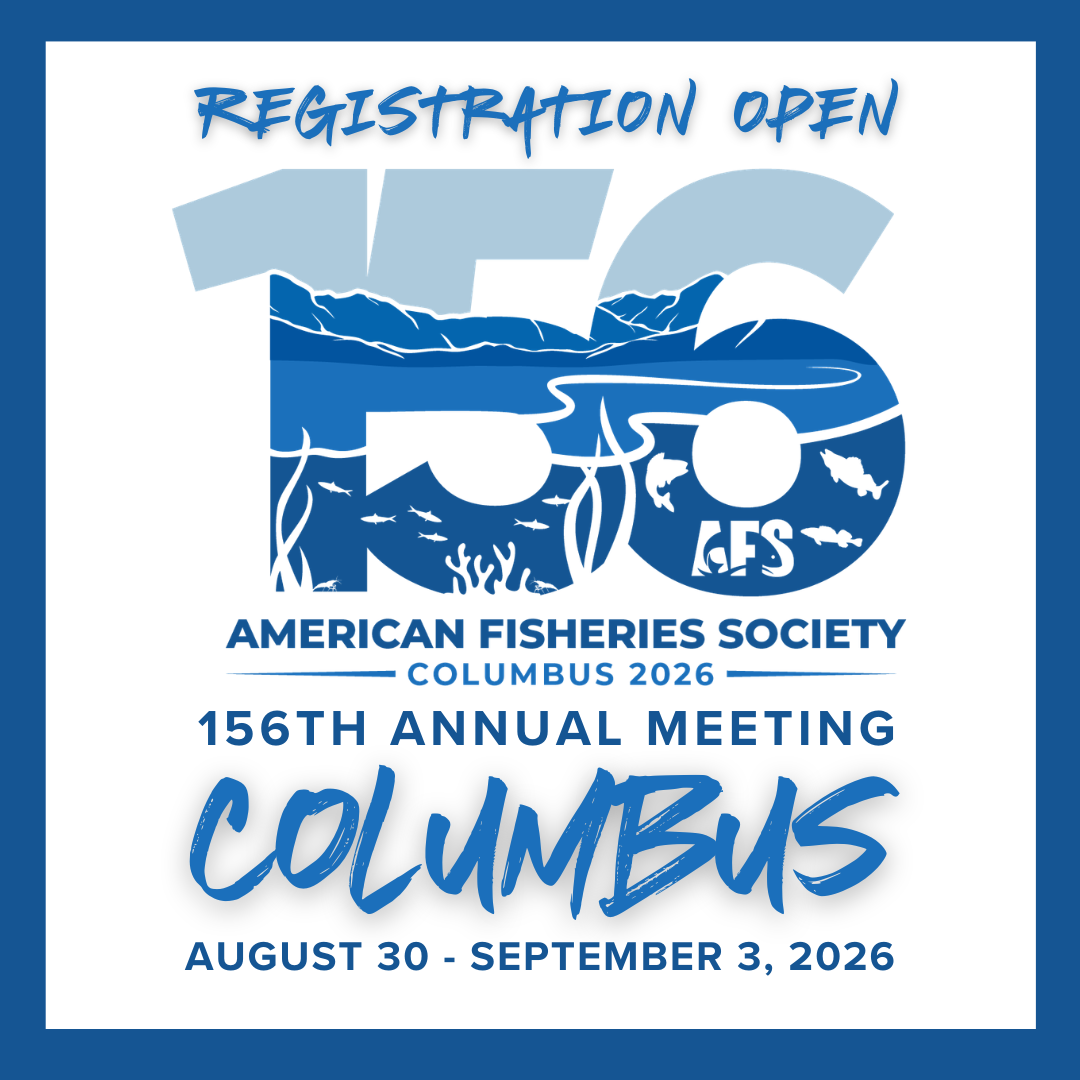
Annual Meeting

Join us in Columbus in 2026

Divisions, Chapters, Sections

Find an AFS Unit near you or in your area of specialty

Fishbook

Fisheries Collaboration Network

Climate Change and Fisheries

Learn how to communicate the effects of climate change on fisheries

Hutton Junior Fisheries Biology Program

Summer internships for high school students

Community Growth and Connections

Explore our initiatives to build community in the Society and in the fisheries profession

Center for Fisheries Technology and Collaboration

Find fisheries science products and services

Center for Technology and Collaboration

Quick answers to common questions

Other Resources
  • Standard Methods for Sampling North American Freshwater Fish Website

  • Rotenone Stewardship Program Information Site

  • Fishionary: A blog about fish words! 
Latest News
2026 Officer Election Voting Now Open AFS Calls for Continued Protection of Boundary Waters from Mining Proposed Rule Would Undermine Science-based Endangered Species Act Future of Public Trust Resources – Statement of the American Fisheries Society Latest Newsletter
Donate
Login
Logout
$0.00 0 Cart
  • Who We Are

    Who We Are

    Governance

    Learn how AFS is structured

    Divisions, Sections, Chapters

    Find a community in your local
    area or in your expertise

    Committees

    Get engaged and volunteer

    Awards & Recognition

    Nominate your heroes

    Community Growth and Connections

    Learn more about our community-building efforts

    AFS Celebrates 150+ Years

    Explore our history

    AFS Fisheries Partnerships

    Meet our global partners

    Meet the Staff

    Dedicated to serving our members

    Contact Us

    Quick answers to common questions

    Support AFS

    Discover how you can support critical AFS programs

    What Are Fisheries?

    Explore fisheries professions

  • MEMBERSHIP

    Membership

    Learn about membership benefits and member types

    Member Directory

    Find your colleagues

    Types of Membership

    For all stages of your career

    Give the Gift
    of Membership

    Invest in an aspiring fisheries
    professional’s future

    Who Are Our Members

    From students to 50-year Golden Members

    Governance

    Learn about our organization and leadership

    My Account

    Log in to access member benefits or renew

    Join/Renew

    It’s Quick and Easy

    Organizational Membership

    Become a Strategic Partner!

  • POLICY

    POLICY

    Recovering America’s
    Wildlife Act

    Critical funding for state conservation programs

    Climate Change

    Communicate the impacts
    of climate change on fisheries

    Magnuson-Stevens Act

    Ensuring sustainability of marine fisheries

    Waters of the US

    News about Clean Water Act
    jurisdiction

    Water Quality

    Healthy fisheries require healthy waters

    Pebble Mine

    Protecting Bristol Bay salmon fisheries

    National Fish
    Habitat Partnership

    Addressing fish habitat regionally

    Infrastructure

    Funding impacts on fish habitat

    Aquaculture

    Providing food security for the future

    Future of the Nation’s
    Aquatic Resources

    Priorities for US fisheries policies

    Recent Policy Statements

    Official policy statements of AFS

    Policy Letters

    Comments on policy,
    legislation, and regulations

    Sport Fish Restoration Act

    Understanding its importance in funding state agency fisheries management

    Advocacy Guidelines

    For Units and members

    Science Guidelines

    Practicing science appropriately

    Briefings

    Congressional briefings with our partners

    Resolutions

    Member-approved resolutions
    on policy

  • NEWS

    News

    Announcements

    Official AFS news

    Annual Meeting

    News from the meeting

    Members in the News

    Awards and interviews

    Policy News

    Round-up of all policy news

    Beneath the Surface Podcast

    A deep dive into the programs and people at AFS

    Federal Workforce and Budget Cuts

    Resources and Ways to Take Action

    Newsletter

    Bi-weekly newsletter for members and partners

    Press Releases

    News media releases

  • EVENTS

    Events

    Annual Meeting

    Columbus 2026

    Future Annual Meetings

    Where we are heading

    Past Annual Meetings

    Where we’ve been

    World Fisheries Congress 2024

    Seattle, Washington

    Other Past Events

    Past special events

    Fisheries Events Calendar

    Events around the world

    Add Your Event Listing

    Submit your calendar item

  • JOBS

    Jobs

    Career Help from AFS

    Compilation of job listing boards

    Other Career Tips

    Career info for members

    Find a Job

    Listings from all over North America

    Post a Job

    Submit your job opening

  • PUBLICATIONS

    Publications

    AFS Journals Program

    More than 150 years of excellence

    AFS Books Program

    Publish with AFS

    Submit Journal Article

    Reach the right audience for your research

    Fisheries Magazine

    Monthly membership magazine

    Writing Tools

    Guides for authors and other resources

    Fishy Fridays

    Weekly blog highlighting AFS fisheries journal articles

    Bookstore

    Shop more than 180 titles

    Journal Online Access

    Log in to access journal articles

    Gray Literature Database

    Thousands of unpublished agency reports and research

  • Professional Development

    Professional Development

    Continuing Education

    Gain skills and enhance your career

    Professional Certification

    Official recognition of your expertise

    Hutton Junior Fisheries
    Biology Program

    Summer high school
    internship program

    Leadership Opportunities

    Hone your leadership skills, volunteer today!

    Training Opportunities Calendar

    Webinars, online courses, on-site workshops, and field training

    Webinars

    Check out upcoming sessions or browse our library

    More Online Resources

    Practical resources for fisheries professionals

  • Engagement

    Engagement

    Strategic Partners

    See how your organization can partner with AFS

    Support AFS

    Discover how you can support critical AFS programs

    The 1870 Society

    Recognizing generous individual donors who invest in the Society's mission

    2024 Annual Report

    Find out what AFS did for the fisheries community in 2024

    Shop AFS

    Check out the latest AFS merch here

Login
Logout

Nature-Based Remedies to Societal Woes

  • July 12, 2015
  • Infrastructure, News, Policy News
  • Home
  • Nature-Based Remedies to Societal Woes
AFS Policy Director, Tom Bigford

Doesn’t everyone revere Mother Nature? Granted, some might not be as love-struck as me, but I suspect most AFS members appreciate Mother’s ability to get things right. It was while reading about the science and policy of habitat conservation (protection and restoration) that I began to sense a theme, or at least imagine one. If this is simply my imagination, I’ll gladly settle for starting a trend. This idea leapt to me while I was reviewing a manuscript by Bilkovic et al. (in press) from the Virginia Institute of Marine Science. Their work on “living shorelines” summarized the growing interest in protecting and restoring our coasts using natural materials—native vegetation, local substrates, etc. At the same time, I am hearing more about “nature-based infrastructure” as an ecosystem tool in FY16 federal budgets. The theory is that old-school “hard” approaches such as vertical seawalls, concrete revetments, and caged-wire gabions simply don’t serve societal needs as well as “soft” systems like a mix of plants and sediments that offer a more natural slope and texture. Plus, soft environs can migrate in response to whatever Mother Nature has in store for us in the coming decades. See, I didn’t even mention relative sea-level rise or Hurricane Katrina, but you know what I’m talking about. We need to be resilient, and nature offers some obvious suggestions when based on the best science, when considering management applications, and when developing policy. This concept extends well beyond living shorelines, which are most often used to mitigate unavoidable habitat losses associated with federal construction permits in wetlands or waterways. Tobey et al. (2010) traces nature-based approaches back more than a decade. Now, this potential trend is gaining momentum. Among practitioners, the titles and approaches vary but the basic ingredients are consistent—diverse, perhaps non-regulatory, often interdisciplinary, usually less expensive, applicable at multiple geographic scales, and usually embraced after the requisite challenges from traditionalists. Examples abound, differentiated by a matter of intensity or time. Nature can work in a backyard, during the spring melt, in a watershed or basin, or in a Great Lake or reservoir. An action on land may have intended affects downhill, downwind, or downstream. If we’re patient, we’ll see natural solutions to many problems facing our fish and fisheries. No doubt, human intervention can hasten our progress, but it seems rare that an exotic solution (non-native in any respect) meets expectations over any timeframe. Of course, that axiom doesn’t hold true if your goal is to grow a lush marsh or increase angling opportunities, with secondary concern about whether those plants are invasive or the fish are competing with native strains. As I’ve already stated, I lean toward Mother Nature, not toward artificial. Opportunities abound. How about creating special management areas with reduced fishing pressure so fish populations can get a head start on recovery from overharvest or some catastrophic event; setting instream flow standards to let a river provide its ecosystem services; planting shellfish “gardens” to clean waters and perhaps provide an occasional meal; or encouraging consumption of nasty invasives like lionfish (which provided a nice dinner for many at the AFS Governing Board meeting in Savannah, Georgia, back in March)? Could Asian carp kabobs or snakehead sushi be far behind? In my mind, those “natural” alternatives are better than labor-intensive, structure-oriented, enforcement-driven catch restrictions or simply just worth trying rather than settling for more of the same. Now, I know structure is the basis of most fish habitat and stocking is a basic tenet of fishery management, but we can build natural habitat and stock with native species. Why make our jobs more difficult than they are? A common thread through these ideas is common sense. Why not rely more on nature’s powers rather than pinning our hopes a bit too much on technology and wizardry? I’m certainly not against advances across all natural resource fields, but sometimes the costs don’t seem to support the results, or should I say, projected results, since our hopes are often elusive. For example, when envisioning the New Jersey shore post-Superstorm Sandy, why would we rely overly on habitat restoration (costly and oftentimes requiring decades for acceptable results) when protection of existing habitat might retain the same ecosystem services we hope to mimic through restoration, creation, or some other approach? Especially when the logic behind protection was made evident by every wildlife refuge, salt marsh, and dune system? When we see those areas absorb storm surge and protect at-risk neighborhoods, why not invest in protecting nature rather than attempting to reinvent it? Let’s give natural, oftentimes simpler, solutions a fair chance. Whether instream flows, living shorelines, native plants, or another nature-tested option, let us consider them before jumping to an alternative that may not be a good or cost-effective solution over the long haul. REFERENCES Bilkovic et al. (in press). The role of living shorelines as estuarine habitat conservation strategies. In: Special Issue on “Conserving Coastal and Estuarine Habitats.” Thomas E. Bigford and TyAnn Lee, editors. Coastal Management. Tobey, J., P. Rubinoff, D. Robadue Jr., G. Ricci, R. Volk, J. Furlow, and G. Anderson. 2010. Practicing coastal adaptation to climate change: lessons from integrated coastal management. Coastal Management 38(3): 317–335. Policy Column Tom Bigford, Policy Director, tbigford@fisheries.org

  • Recent News

    • Is Bigger Better for Hatchery Chinook Salmon? May 1, 2026
    • Webinar: A Perpetual Franchise to Cultivate Oysters April 30, 2026
    • Webinar: Skin Cancer Risk and Outdoor Workers: Early Detection and Sun Protection Could Save Your Life April 30, 2026
    • AFS Calls for Robust Funding for NOAA Fisheries April 27, 2026
    • AFS Urges Full Funding for US Fish and Wildlife Service, US Geological Survey, and US Forest Service April 24, 2026
  • About

    The American Fisheries Society is 501c Non-Profit Society


    Donate Now

    Quick Links

    • ABOUT
    • POLICY
    • EVENTS
    • PUBLICATIONS
    • MEMBERSHIP
    • NEWS
    • JOBS
    • Contact Us
    • ABOUT
    • POLICY
    • EVENTS
    • PUBLICATIONS
    • MEMBERSHIP
    • NEWS
    • JOBS
    • Contact Us

    Contact

    • 25 Century Boulevard
      Suite 505
      Nashville, TN 37214
    • (301) 897-8616
    Facebook-f Twitter Instagram Linkedin-in Vimeo-v

    Copyright © 2026 American Fisheries Society | Privacy Policy 

    This website uses cookies to improve your experience. Accept Read More
    Privacy & Cookies Policy

    Privacy Overview

    This website uses cookies to improve your experience while you navigate through the website. Out of these, the cookies that are categorized as necessary are stored on your browser as they are essential for the working of basic functionalities of the website. We also use third-party cookies that help us analyze and understand how you use this website. These cookies will be stored in your browser only with your consent. You also have the option to opt-out of these cookies. But opting out of some of these cookies may affect your browsing experience.
    Necessary
    Always Enabled
    Necessary cookies are absolutely essential for the website to function properly. This category only includes cookies that ensures basic functionalities and security features of the website. These cookies do not store any personal information.
    Non-necessary
    Any cookies that may not be particularly necessary for the website to function and is used specifically to collect user personal data via analytics, ads, other embedded contents are termed as non-necessary cookies. It is mandatory to procure user consent prior to running these cookies on your website.

    SAVE & ACCEPT