Skip to content

American Fisheries Society Family of Websites:

Fisheries.org

American Fisheries Society
Family of Websites

Journals

Read our five journals and Fisheries magazine

Gray Literature Database

Find thousands of unpublished agency reports and other information

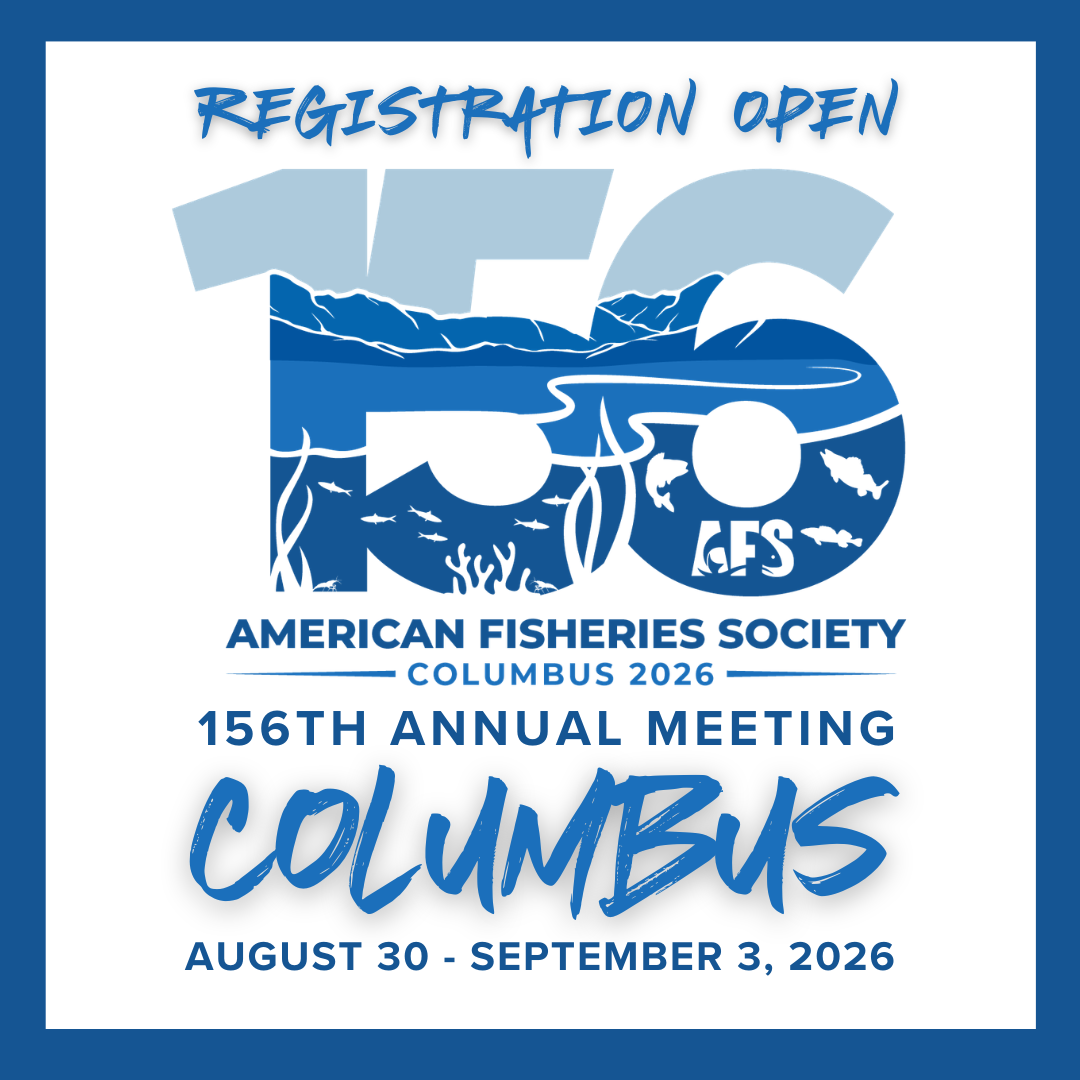
Annual Meeting

Join us in Columbus in 2026

Divisions, Chapters, Sections

Find an AFS Unit near you or in your area of specialty

Fishbook

Fisheries Collaboration Network

Climate Change and Fisheries

Learn how to communicate the effects of climate change on fisheries

Hutton Junior Fisheries Biology Program

Summer internships for high school students

Community Growth and Connections

Explore our initiatives to build community in the Society and in the fisheries profession

Center for Fisheries Technology and Collaboration

Find fisheries science products and services

Center for Technology and Collaboration

Quick answers to common questions

Other Resources
  • Standard Methods for Sampling North American Freshwater Fish Website

  • Rotenone Stewardship Program Information Site

  • Fishionary: A blog about fish words! 
Latest News
2026 Officer Election Voting Now Open AFS Calls for Continued Protection of Boundary Waters from Mining Proposed Rule Would Undermine Science-based Endangered Species Act Future of Public Trust Resources – Statement of the American Fisheries Society Latest Newsletter
Donate
Login
Logout
$0.00 0 Cart
  • Who We Are

    Who We Are

    Governance

    Learn how AFS is structured

    Divisions, Sections, Chapters

    Find a community in your local
    area or in your expertise

    Committees

    Get engaged and volunteer

    Awards & Recognition

    Nominate your heroes

    Community Growth and Connections

    Learn more about our community-building efforts

    AFS Celebrates 150+ Years

    Explore our history

    AFS Fisheries Partnerships

    Meet our global partners

    Meet the Staff

    Dedicated to serving our members

    Contact Us

    Quick answers to common questions

    Support AFS

    Discover how you can support critical AFS programs

    What Are Fisheries?

    Explore fisheries professions

  • MEMBERSHIP

    Membership

    Learn about membership benefits and member types

    Member Directory

    Find your colleagues

    Types of Membership

    For all stages of your career

    Give the Gift
    of Membership

    Invest in an aspiring fisheries
    professional’s future

    Who Are Our Members

    From students to 50-year Golden Members

    Governance

    Learn about our organization and leadership

    My Account

    Log in to access member benefits or renew

    Join/Renew

    It’s Quick and Easy

    Organizational Membership

    Become a Strategic Partner!

  • POLICY

    POLICY

    Recovering America’s
    Wildlife Act

    Critical funding for state conservation programs

    Climate Change

    Communicate the impacts
    of climate change on fisheries

    Magnuson-Stevens Act

    Ensuring sustainability of marine fisheries

    Waters of the US

    News about Clean Water Act
    jurisdiction

    Water Quality

    Healthy fisheries require healthy waters

    Pebble Mine

    Protecting Bristol Bay salmon fisheries

    National Fish
    Habitat Partnership

    Addressing fish habitat regionally

    Infrastructure

    Funding impacts on fish habitat

    Aquaculture

    Providing food security for the future

    Future of the Nation’s
    Aquatic Resources

    Priorities for US fisheries policies

    Recent Policy Statements

    Official policy statements of AFS

    Policy Letters

    Comments on policy,
    legislation, and regulations

    Sport Fish Restoration Act

    Understanding its importance in funding state agency fisheries management

    Advocacy Guidelines

    For Units and members

    Science Guidelines

    Practicing science appropriately

    Briefings

    Congressional briefings with our partners

    Resolutions

    Member-approved resolutions
    on policy

  • NEWS

    News

    Announcements

    Official AFS news

    Annual Meeting

    News from the meeting

    Members in the News

    Awards and interviews

    Policy News

    Round-up of all policy news

    Beneath the Surface Podcast

    A deep dive into the programs and people at AFS

    Federal Workforce and Budget Cuts

    Resources and Ways to Take Action

    Newsletter

    Bi-weekly newsletter for members and partners

    Press Releases

    News media releases

  • EVENTS

    Events

    Annual Meeting

    Columbus 2026

    Future Annual Meetings

    Where we are heading

    Past Annual Meetings

    Where we’ve been

    World Fisheries Congress 2024

    Seattle, Washington

    Other Past Events

    Past special events

    Fisheries Events Calendar

    Events around the world

    Add Your Event Listing

    Submit your calendar item

  • JOBS

    Jobs

    Career Help from AFS

    Compilation of job listing boards

    Other Career Tips

    Career info for members

    Find a Job

    Listings from all over North America

    Post a Job

    Submit your job opening

  • PUBLICATIONS

    Publications

    AFS Journals Program

    More than 150 years of excellence

    AFS Books Program

    Publish with AFS

    Submit Journal Article

    Reach the right audience for your research

    Fisheries Magazine

    Monthly membership magazine

    Writing Tools

    Guides for authors and other resources

    Fishy Fridays

    Weekly blog highlighting AFS fisheries journal articles

    Bookstore

    Shop more than 180 titles

    Journal Online Access

    Log in to access journal articles

    Gray Literature Database

    Thousands of unpublished agency reports and research

  • Professional Development

    Professional Development

    Continuing Education

    Gain skills and enhance your career

    Professional Certification

    Official recognition of your expertise

    Hutton Junior Fisheries
    Biology Program

    Summer high school
    internship program

    Leadership Opportunities

    Hone your leadership skills, volunteer today!

    Training Opportunities Calendar

    Webinars, online courses, on-site workshops, and field training

    Webinars

    Check out upcoming sessions or browse our library

    More Online Resources

    Practical resources for fisheries professionals

  • Engagement

    Engagement

    Strategic Partners

    See how your organization can partner with AFS

    Support AFS

    Discover how you can support critical AFS programs

    The 1870 Society

    Recognizing generous individual donors who invest in the Society's mission

    2024 Annual Report

    Find out what AFS did for the fisheries community in 2024

    Shop AFS

    Check out the latest AFS merch here

Login
Logout

Diversity and the Ecology of AFS

  • March 2, 2017
  • Fisheries Magazine, News
  • Home
  • Diversity and the Ecology of AFS

By Joe Margraf, AFS President.

The concept of diversity is ubiquitous throughout biology, ecology, and sociology and implies a greater likelihood of success and resilience. This is true of organizations as well, and the American Fisheries Society is no exception. The negative perception is that diversity comes at a cost to the most common demographic; generally, we are talking about the potential loss of jobs to underrepresented individuals or the potential of feeling ill at ease in our new human surroundings. The truth is that failure to achieve diversity comes at the far greater cost of surviving as an organization or as a profession. Without diversity, we cannot expect to be prepared for the inevitable changes that will occur in our environs, which will result in our eventual demise.

I have come to the conclusion that the issue is one of the perceived relevance of our profession… If a potential student is bright enough to enter the fisheries profession, why not go into a profession that will clearly be of benefit to and understood by their community?

Diversity is usually quantified as the number of nontraditional individuals employed in the endeavor. However, what we really mean is diversity of ideas, ways of thinking, experiences, solutions to problems, value to decision makers, relevance to society, and so forth. The American Fisheries Society and the fisheries profession—scientists and managers—have been making some progress in achieving greater diversity, but we still have a long way to go. What I want to do is explore some of the thoughts I have had on the roadblocks that stand in our way. I also want to make it clear that I am willing to open this column to other ideas that folks might have on this topic, but only if their objective is to help recognize and dissolve the roadblocks.

I have been concerned about diversity in our profession for some time now and have tried to do what I could to help. In the mid-1990s, I decided to help start a new Cooperative Fish and Wildlife Research Unit at the University of Maryland Eastern Shore, which is a historically black university. The cost to me was in giving up a rather comfy research setting for a potentially tenuous one at what had been mainly an undergraduate teach- ing institution, where I would be immersed in a mostly nonwhite environment. The major upside to this situation was access to a highly educated African-American community. As it turned out, research needs and funding were not a problem, and while we had some success recruiting, it was less than overwhelming. It was not because I was not of the appropriate demographic to serve as a good mentor; people of color that I worked with had limited success recruiting students of color to the program, too. My thought was that the reasons had something to do with a lack of understanding about the resource and perhaps a lack of appreciation for the natural world.

While I really liked the Eastern Shore, I had an opportunity to go to the co-op unit at the University of Alaska Fairbanks. This was an opportunity of a lifetime for someone like me who had never worked in a landscape that was not highly in uenced by hu- mans. Also, I thought that recruiting and educating Native Alas- kans would be relatively simple because I would not be ghting against a lack of understanding and appreciation of nature and the importance of sustaining healthy sh populations. Alaska was the only place I lived where the general public had some notion about the importance of fisheries management. After several unsuccess- ful attempts to recruit rural Native Alaskans, I was once again faced with far less than I expected in terms of success. Perhaps I was just getting too old to relate or be attractive as a potential mentor, but younger colleagues were not having much success either. This and other experiences (like the incident I related in an earlier column) got me thinking about the very nature of the fisheries science and management profession. It is a very difficult field, perhaps every bit as hard as rocket science; we ask a lot from our students educationally and expect even more from them to be successful as professionals.

Based on these two experiences, I have come to the conclusion that the issue is one of the perceived relevance of our profession. It takes a lot of academic training to become a fisheries scientist or manager. If a potential student is bright enough to enter the fisheries profession, why not go into a profession that will clearly be of bene t to and understood by their community? There could be little that is worse than going home and having your family or community leaders ask why you wasted your tal- ents and education. The truth is that fisheries science and manage- ment are, at their heart, providing sustainable sh populations for use as sustenance for Native Alaskans and other rural citizens. Yet this is not understood. To most people, if you are smart enough to succeed as a fisheries scientist or manager, then why not go into the medical or legal professions or, for that matter, become a rocket scientist? Notice that I have not mentioned money, but that may be an issue too. In general, the profession is accomplished by government or university employees that are typically paid less relative to private enterprise or at least that is the perception. In many communities, working for state or federal government is not looked upon favorably—pay is only part of the equation. So, how do we fix it? Clearly, if I had a simple concrete answer, I would forcefully act on it. The answers are not simple, and they are not hard and fast. Increasing the relevance of the profession will not be accomplished without a huge amount of work on our part. It is something that we must do, and do over and over again. I have appointed a committee to start working on this issue, but I expect they will find it very difficult. But as I said at the onset, it is the survival of our profession that is at stake.

Members click below for the February 2017 Fisheries magazine’s complete issue. Non-members, join here.

This content is for members only. Please login.

  • Recent News

    • AFS Urges Modernization of Sporting Goods Excise Tax that Funds Fisheries Conservation May 13, 2026
    • Is Bigger Better for Hatchery Chinook Salmon? May 1, 2026
    • Webinar: A Perpetual Franchise to Cultivate Oysters April 30, 2026
    • Webinar: Skin Cancer Risk and Outdoor Workers: Early Detection and Sun Protection Could Save Your Life April 30, 2026
    • AFS Calls for Robust Funding for NOAA Fisheries April 27, 2026
  • About

    The American Fisheries Society is 501c Non-Profit Society


    Donate Now

    Quick Links

    • ABOUT
    • POLICY
    • EVENTS
    • PUBLICATIONS
    • MEMBERSHIP
    • NEWS
    • JOBS
    • Contact Us
    • ABOUT
    • POLICY
    • EVENTS
    • PUBLICATIONS
    • MEMBERSHIP
    • NEWS
    • JOBS
    • Contact Us

    Contact

    • 25 Century Boulevard
      Suite 505
      Nashville, TN 37214
    • (301) 897-8616
    Facebook-f Twitter Instagram Linkedin-in Vimeo-v

    Copyright © 2026 American Fisheries Society | Privacy Policy 

    This website uses cookies to improve your experience. Accept Read More
    Privacy & Cookies Policy

    Privacy Overview

    This website uses cookies to improve your experience while you navigate through the website. Out of these, the cookies that are categorized as necessary are stored on your browser as they are essential for the working of basic functionalities of the website. We also use third-party cookies that help us analyze and understand how you use this website. These cookies will be stored in your browser only with your consent. You also have the option to opt-out of these cookies. But opting out of some of these cookies may affect your browsing experience.
    Necessary
    Always Enabled
    Necessary cookies are absolutely essential for the website to function properly. This category only includes cookies that ensures basic functionalities and security features of the website. These cookies do not store any personal information.
    Non-necessary
    Any cookies that may not be particularly necessary for the website to function and is used specifically to collect user personal data via analytics, ads, other embedded contents are termed as non-necessary cookies. It is mandatory to procure user consent prior to running these cookies on your website.
    SAVE & ACCEPT