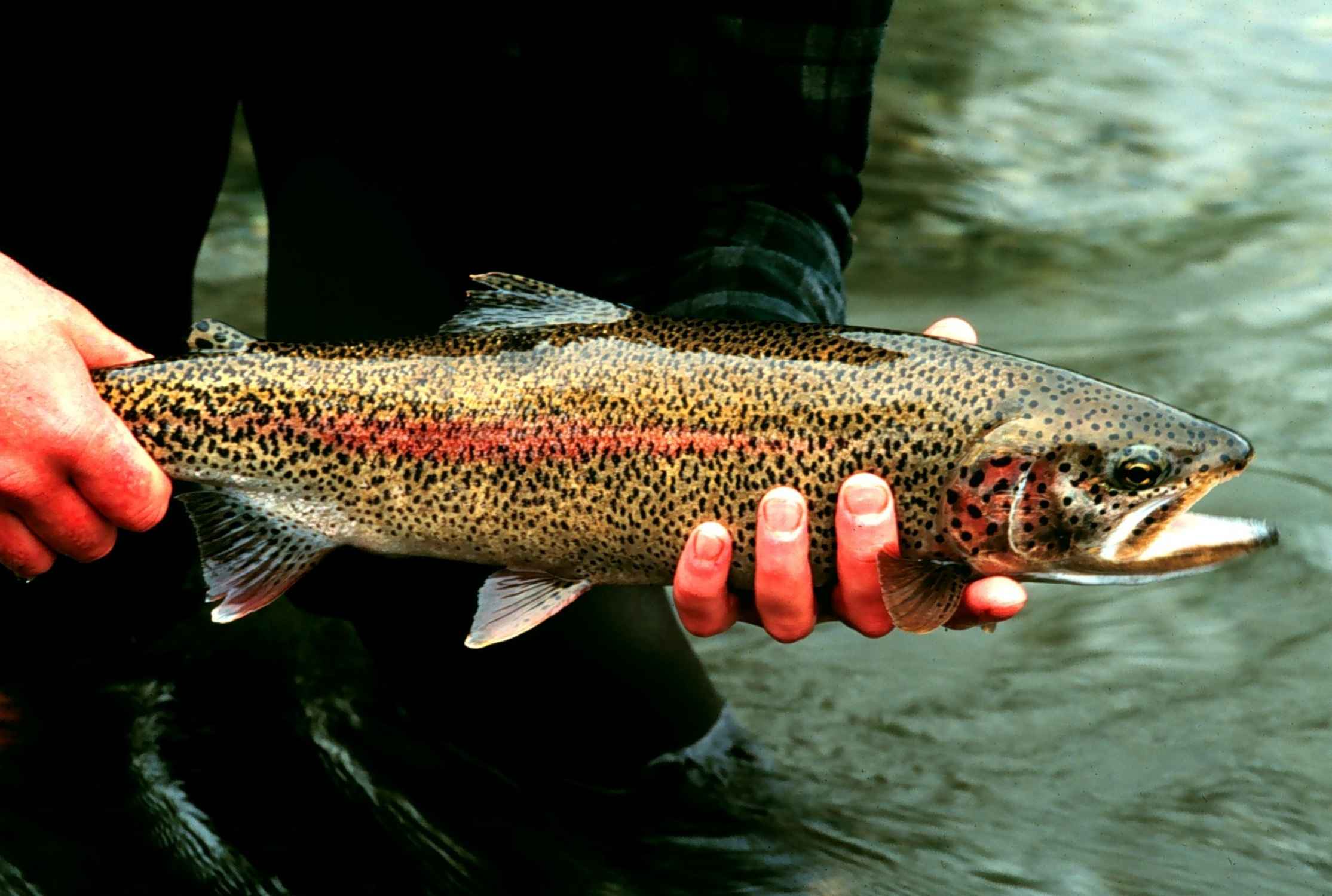
Credit: wikipedia.org “The Cost of Trout Fishing,” a recent op-ed piece by Douglas Thompson in the New York Times (Thompson 2015), included several inaccurate statements and fundamental misunderstandings of fisheries management and aquaculture. As fisheries research and management professionals, the American Fisheries Society would like to set the record straight. The mission of the American Fisheries Society is to improve the conservation and sustainability of fishery resources and aquatic ecosystems by advancing fisheries and aquatic science and promoting the development of fisheries professionals. We can fulfill that mission, in part, by addressing misinformation about fisheries science that appears in popular media, and helping the interested public to better understand the facts. Native trout and our aquatic systems in general have been subjected to a wide variety of environmental degradations over the past two centuries or more. Widespread timber cutting, intense mining, dam construction, industrial pollution, invasive species, and many other human activities, not fishing pressure as suggested by Mr. Thompson, resulted in greatly reduced fish populations, including trout, throughout the United States. Only through strong water quality laws and other actions, in many cases advocated for by anglers, have many of our rivers, streams, and lakes recovered. Furthermore, anglers working with other conservationists have helped to ensure that our waters can sustain trout and other fish populations and support fishing. Thompson suggested that hatchery fish create more problems than they address. Natural resource agencies stock fish to compensate for the inability of impaired ecosystems, especially in urban areas, to support self-sustaining fish assemblages and to meet perceived demands for fish by anglers. In the United States, approximately 1.75 billion fish of all species are stocked annually to counter the effects of habitat loss, harvest, and other stressors affecting fish and fishing opportunities (Halverson 2008). Regarding trout specifically, if wild populations are strong and self-sustaining, they are generally no longer stocked; for streams where natural populations are absent, dwindling or unable to support angling pressures, resource managers weigh costs and benefits before approving a stocking program (Weber et al. 2010; Hyatt et al. n.d.). Although some fish are raised in aquaculture systems to a catchable size prior to release, nationwide the majority of fish are stocked as juveniles. Collectively, stocked fish weigh just over 44 million pounds annually (Halverson 2008), meaning that the average size of the fish at release is less than half an ounce. These fish grow to support recreational fisheries that also produce economic benefits and provide a means for an increasingly disconnected population to become acquainted with nature. There are approximately 60 million U.S. anglers—more people than play golf or tennis combined—who contribute $62 billion dollars annually to the gross domestic product (GDP), generate $115 billion in total economic output, and support more than 828,000 jobs. Anglers also generate an additional $15 billion in state and federal taxes, a portion of which goes back into sport fish restoration (Southwick Associates 2013). It has been estimated that hatchery fish support about half of this economic activity. Another concern suggested by Mr. Thompson is that hatchery production is supported by pellet feed derived from fish and that these fish populations are being devastated by the use of fish meal and oil. In fact, “reduction” fisheries—the ones that give us fish meal and oil—are some of the most carefully and aggressively managed in the world and are actually expected to support modest growth in the future (FAO 2014). Advances in fish nutrition have allowed soy, wheat, corn, and agricultural byproducts to replace fish meal and oil in most fish feeds. In 2000, trout and salmon diets typically contained 30-40% fish meal and 15-25% fish oil; by 2010, estimated fish meal and oil inclusions were down to 17-25% and 8-15%, respectively (Tacon and Metian 2008). By 2022, half of the fish meal and oil will come from improved processing of seafood byproducts, and not wild fish (FAO 2014). What’s more, fish are strikingly efficient at turning feed to flesh. Terrestrial animals consume 2-8 pounds of feed or more for every pound of weight gained. For fish, it is routinely near 1 to 1, meaning that most of the feed going into a hatchery comes out “on the fin,” not as waste. Fish hatchery effluents are regulated by the U.S. Environmental Protection Agency (EPA) and state water quality agencies in accordance with the National Pollutant Discharge Elimination System (NPDES) (EPA 2014). NPDES limits protect the quality of public waters, and hatchery effluents are subject to monitoring and enforcement of the permit’s conditions. To comply, hatcheries direct effluents through on-site wastewater treatment systems. Of more than 400 “hatchery” records in the EPA’s Enforcement and Compliance History Online database, only 7—less than 2%—are currently in violation of their permits (EPA 2015). Fish hatchery contributions to nutrient loadings are dwarfed by those from agriculture, other confined animal feeding operations, or municipal wastewater discharges. Hatchery operations also must comply with U.S. Food and Drug Administration (FDA) oversight if they use any drugs in the course of fish production. Drugs are not approved for use until proven safe to the environment, safe to fish, and safe to people who consume fish. Regulatory authorities take a highly precautionary approach to such evaluations (Bowker and Trushenski 2015). In fact, the most common water treatments applied in hatcheries are low doses of hydrogen peroxide (a household antiseptic) and chloramine (the most common disinfectant for U.S. drinking water). As with nutrient discharges, the amount of these hatchery effluents is minor compared to pharmaceutical and personal care products that enter our nation’s waters via municipal and agricultural wastewater discharges. Fish stocked to bolster wild populations have pedigrees to match that intent, and spawning in hatcheries is carefully managed to maintain the genetic integrity of the wild populations; however, genetic and behavioral factors remain serious concerns (e.g., Reisenbichler and Rubin 1999; Putman et al. 2014). Hatchery-origin and wild fish interact, sometimes with negative consequences (e.g., competition for resources (Daly et al. 2012), straying (Araki et al. 2007), ecological effects (Pearsons 2008)), and which must be taken into consideration. A few “conservation” hatcheries employ naturalized conditions to better condition fish for success in the wild (Maynard et al. 2004; Evans et al. 2014). For fish whose only destiny is the creel, breeding programs are relaxed, but are hardly a haphazard mingling of genes. In some cases, hatchery fish are sterilized to prevent reproduction in the wild (Kozfkay et al. 2006). In other cases, hatchery fish are managed to reduce the probability that they occur on the same spawning grounds as wild fish at the same time (HSRG 2014). Hatcheries can also conserve biodiversity. For example, Redfish Lake Sockeye Salmon Oncorhynchus nerka are slowly coming back from the brink of extinction because hatchery biologists managed to rescue and successfully breed the few remaining individuals, preserving the species as well as their genetic diversity (Kline and Flagg 2014). Recovery of Lake Trout Salvelinus namaycush—now considered self-sustaining in Lake Superior and on track in Lake Huron—is also attributable, in part, to hatchery support (Muri et al. 2012). Fisheries managers often face conflicting mandates to recover and conserve wild populations while also creating fishing opportunities in the same waters. The most effective management strategies involving hatcheries incorporate all three “Hs”—harvest control, habitat protection or improvement, and hatchery supplementation. The American Fisheries Society has championed that approach and the use of sound science, holding forums every decade to refine recommendations for the best use of hatchery-origin fish in natural resource management (Trushenski et al. 2015). These issues are important, and we encourage readers to learn more. The American Fisheries Society and the expertise of our membership are excellent places to start. Our collective efforts will succeed if we focus on the greatest threats to wild trout and other fish, including both habitat loss and introduced species. ACKNOWLEDGMENTS This article was prepared thanks to contributions and review comments by a wide variety of AFS members and sections including Jesse Trushenski, Doug Austen, Bob Hughes, Peter Aarrestad, Lee Blankenship, Bill Bosch, Jim Bowker, Gary Byrne, Ron Essig, Dave Fast, Jeff Heindel, Alan Johnson, Carl Kittel, Randy MacMillan, Mark Porath, Jeff Schaeffer, Dan Schill, Tom Flagg, Mick Walsh, Gary Whelan, and Nat Wilke. REFERENCES Araki, H., B. Cooper, and M. S. Blouin. 2007. Genetic effects of captive breeding cause a rapid, cumulative fitness decline in the wild. Science 318:100-103. Bowker, J. D., and J. T. Trushenski. 2015. Mythbusters: What’s real and what’s not when it comes to fish drugs. North American Journal of Aquaculture 77:358-366. Daly E. A., R. D. Broduer, J. P. Fisher, L. A. Weitkamp, D. J. Teel, and B. R. Beckman. 2012. Spatial and trophic overlap of marked and unmarked Columbia River basin spring Chinook Salmon during early marine residence with implications for competition between hatchery and naturally produced fish. Environmental Biology of Fishes 94:117–134. EPA (Environmental Protection Agency). 2014. NPDES Permit Program Basics. Website. Available: water.epa.gov/polwaste/npdes/ basics/index.cfm. (April 2015). EPA (Environmental Protection Agency). 2015. Enforcement and Compliance History Online. Database. Available: echo.epa. gov/. (April 2015). Evans, M. L. N. F. Wilke, P. T. O’Reilly, and I. A. Fleming. 2014. Transgenerational effects of parental rearing environment influence the survivorship of captive-born offspring in the wild. Conservation Letters 7:371-379. FAO (Food and Agriculture Organization). 2014. The State of World Fisheries and Aquaculture 2014. Food and Agriculture Organization of the United Nations, Rome. Halverson, M. A. 2008. Stocking trends: a quantitative review of governmental fish stocking in the United States, 1930 to 2004. Fisheries 33:69-75. HSRG (Hatchery Scientific Review Group). 2014. On the Science of Hatcheries: An updated perspective on the role of hatcheries in salmon and steelhead management in the Pacific Northwest. Available: hatcheryreform.us/. (April 2015). Hyatt, W.A., M. Humphreys, and N.T. Hagstrom. n.d. A trout management plan for Connecticut’s rivers and streams. State of Connecticut Department of Environmental Protection. Kline, P.A., and T.A. Flagg. 2014. Putting the red back in Redfish Lake, 20 years of progress toward saving the Pacific Northwest’s most endangered salmon population. Fisheries 39:488-500. Kozfkay, J.R., J.C. Dillon, and D.J. Schill. 2006. Routine use of sterile fish in salmonid sport fisheries: are we there yet? Fisheries 31 392-401. Maynard, D. J., T. A. Flagg, R. N. Iwamoto, and C. V. M. Mahnken. 2004. A review of recent studies investigating seminatural rearing strategies as a tool for increasing Pacific salmon postrelease survival. Pages 569-580 in M. Nickum, P. Mazik, J. Nickum, and D. MacKinlay, editors. Propagated fishes in resource management. American Fisheries Society, Symposium 44, Bethesda, Maryland. Muri, A. M., C. C. Krueger, and M. J. Hansen. 2012. Re-establishing Lake Trout in the Laurentian Great Lakes: past, present, and future. Pages 533-588 in W. W. Taylor, A. J. Lynch, N. J. Leonard, editors. Great Lakes fisheries policy and management: a binational perspective. Michigan State University Press. Pearsons T.N. 2008. Misconception, reality, and uncertainty about ecological interactions and risks between hatchery and wild salmonids. Fisheries 33:278–290. Putman, N.F., A.M. Meinke and D.L.G. Noakes. 2014. Rearing in a distorted magnetic field disrupts the ‘map sense’ of juvenile steelhead trout. Biology Letters 10:20140169. dx.doi.org/10.1098/ rsbl.2014.0169 Reisenbichler, R. R. and S. Rubin. 1999. Genetic changes from artificial propagation of Pacific salmon affect the productivity and viability of supplemented populations. ICES Journal of Marine Science 56:459–466. Richter, B., D. Braun, M. Mendelson and L. Master. 1997. Threats to imperiled freshwater fauna. Conservation Biology 11: 1081–1093. Southwick Associates. 2013. Sportfishing in America, an economic force for conservation. American Sportfishing Association. Tacon, A.G.J., and M. Metian. 2008. Global overview on the use of fish meal and fish oil in industrially compounded aquafeeds: trends and future prospects. Aquaculture 285:146-158. Thompson, D.M. 2015. The cost of trout fishing. New York Times Opinion Pages. Available: www.nytimes.com/2015/04/11/opinion/ the-cost-of-trout-fishing.html?_r=0. (April 2015). Trushenski, J.T., H.L. Blankenship, J.D. Bowker, T.A. Flagg, J.A. Hesse, K.M. Leber, D.D. MacKinlay, D.J. Maynard, C.M. Moffitt, V.A. Mudrak, K.T. Scribner, S.F. Stuewe, J.A. Sweka, G.E. Whelan, C. Young-Dubovsky. 2015. Introduction to a special section: Hatcheries and Management of aquatic resources (HaMAR) considerations for use of hatcheries and hatchery-origin fish. North American Journal of Aquaculture 77:327-342. Weber, R., R.T. Greene, J. Arway, R.S. Carney, and L. Young. 2010. History of the management of trout fisheries in Pennsylvania. Pennsylvania Fish and Boat Commission.
Recent News
This website uses cookies to improve your experience. AcceptRead More
Privacy & Cookies Policy
Privacy Overview
This website uses cookies to improve your experience while you navigate through the website. Out of these, the cookies that are categorized as necessary are stored on your browser as they are essential for the working of basic functionalities of the website. We also use third-party cookies that help us analyze and understand how you use this website. These cookies will be stored in your browser only with your consent. You also have the option to opt-out of these cookies. But opting out of some of these cookies may affect your browsing experience.
Necessary cookies are absolutely essential for the website to function properly. This category only includes cookies that ensures basic functionalities and security features of the website. These cookies do not store any personal information.
Any cookies that may not be particularly necessary for the website to function and is used specifically to collect user personal data via analytics, ads, other embedded contents are termed as non-necessary cookies. It is mandatory to procure user consent prior to running these cookies on your website.