
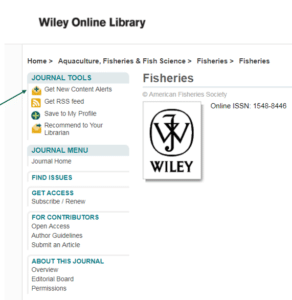
Sign Up Now for Content Alerts for Your New Free Online Journal Access
Starting in 2018, your AFS membership includes free online access to all five AFS journals and Fisheries magazine. You can sign up now for emailed content alerts to let you
American Fisheries Society Family of Websites:
Read our five journals and Fisheries magazine
Find thousands of unpublished agency reports and other information
Join us in Columbus in 2026
Find an AFS Unit near you or in your area of specialty
Fisheries Collaboration Network
Learn how to communicate the effects of climate change on fisheries
Summer internships for high school students
Explore our initiatives to build community in the Society and in the fisheries profession
Find fisheries science products and services
Quick answers to common questions

Starting in 2018, your AFS membership includes free online access to all five AFS journals and Fisheries magazine. You can sign up now for emailed content alerts to let you

On November 15, the USDA Forest Service released Rise to the Future: National Fish and Aquatic Strategy. In the 30 years since the inception of Rise to the Future, the

Sorry, but you do not have permission to view this content. Members may Log In to view it. If you are unable to view the content after logging in, please click the “refresh” button on your browser and try again, or clear your browser cache and try again.

In November, join AFS Policy Director Drue Winters, as she reviews fisheries policy issues that are trending in Washington, DC. We’ll take a look back at what’s been happening on Capitol Hill and in the administration related to fisheries in 2017 and a look forward at what we expect to happen in 2018. This is your chance to learn more about policy related to your field and have your questions addressed.
President’s Commentary The Future of AFS Journals Policy Fish Need Infrastructure, Too Communications Expanding Our Reach: How AFS Staff and Units Have Advanced Communications in Just a Few Years FEATURES Fish Bioenergetics 4.0:
Sometimes it seems like biologists would prefer interacting more with fish than with people. But we all know that in this high-paced world of technology, multisector demands on natural resources,

By Steve McMullin, AFS President. E-mail: mcmullintraining@gmail.com You probably have heard by now that one of the benefits of the Society’s new publishing contract with Wiley is that all AFS

President Trump’s push for a US$1 trillion infrastructure package offers an opportunity to pursue benefits for aquatic resources. Most infrastructure is inextricably connected to water.

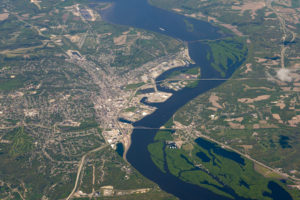
The Mississippi River is a multijurisdictional and multiuse resource that has been variously altered and is foremost managed for navigation and flood control throughout much of its 3,734-km passage from its origin at Lake Itasca, Minnesota, to its outlet at the Gulf of Mexico

Bioenergetics modeling is a widely used tool in fisheries management and research. Although popular, currently available software (i.e., Fish Bioenergetics 3.0) has not been updated in over 20 years and is incompatible with newer operating systems (i.e., 64-bit).