Skip to content

American Fisheries Society Family of Websites:

Fisheries.org

American Fisheries Society
Family of Websites

Journals

Read our five journals and Fisheries magazine

Gray Literature Database

Find thousands of unpublished agency reports and other information

Annual Meeting

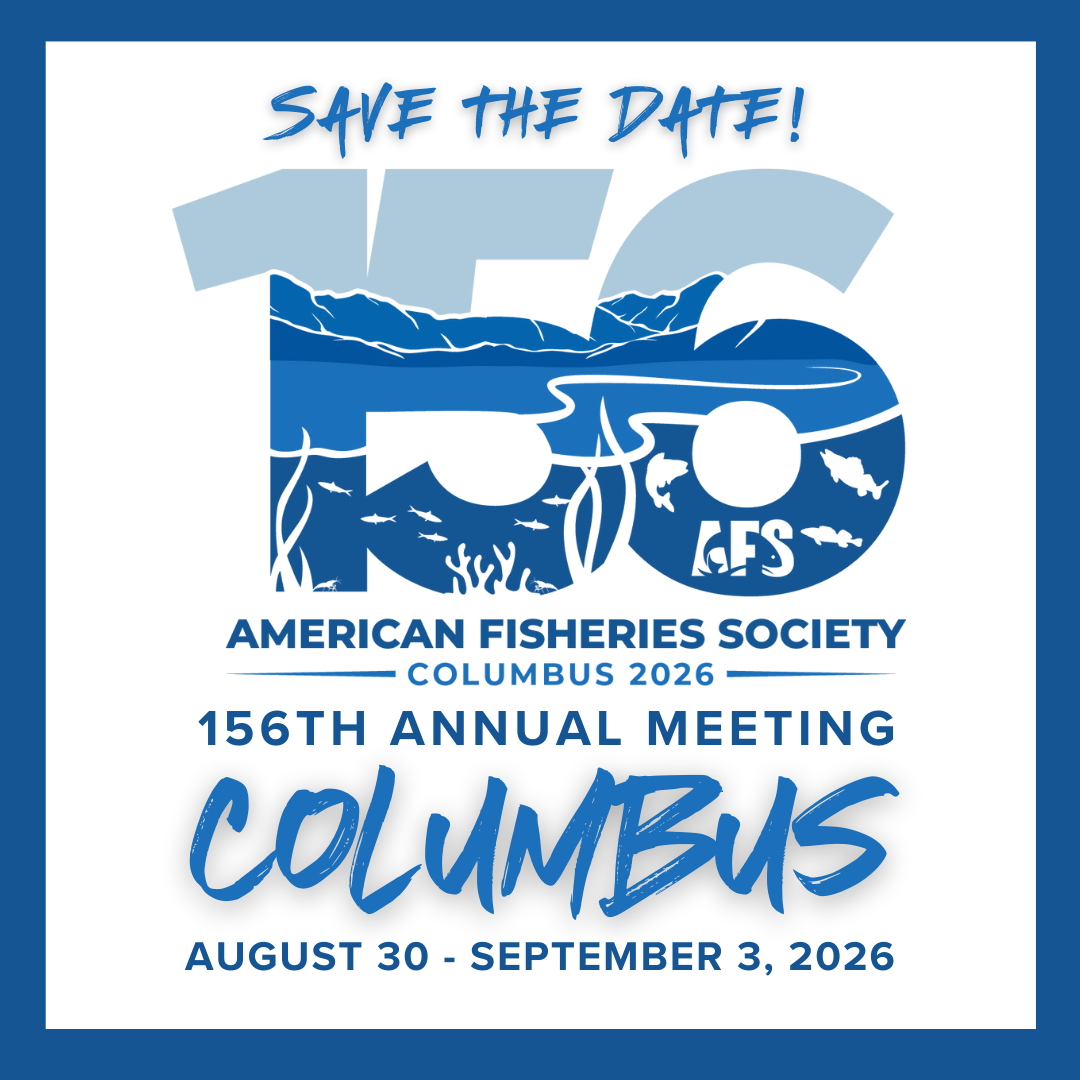
Join us in Columbus in 2026

Divisions, Chapters, Sections

Find an AFS Unit near you or in your area of specialty

Fishbook

Fisheries Collaboration Network

Climate Change and Fisheries

Learn how to communicate the effects of climate change on fisheries

Hutton Junior Fisheries Biology Program

Summer internships for high school students

Community Growth and Connections

Explore our initiatives to build community in the Society and in the fisheries profession

Center for Fisheries Technology and Collaboration

Find fisheries science products and services

Center for Technology and Collaboration

Quick answers to common questions

Other Resources
  • Standard Methods for Sampling North American Freshwater Fish Website

  • Rotenone Stewardship Program Information Site

  • Fishionary: A blog about fish words! 
Latest News
New Video Series: Tomorrow’s Catch: Securing our Future Fisheries AFS Calls for Habitat Modification to Remain in Definition of Harm in Endangered Species Act Natural Resource Professional Societies Issue Joint Statement on the Impacts of Federal Workforce Reduction Future of Public Trust Resources – Statement of the American Fisheries Society Latest Newsletter
Donate
Login
Logout
$0.00 0 Cart
  • Who We Are

    Who We Are

    Governance

    Learn how AFS is structured

    Divisions, Sections, Chapters

    Find a community in your local
    area or in your expertise

    Committees

    Get engaged and volunteer

    Awards & Recognition

    Nominate your heroes

    Community Growth and Connections

    Learn more about our community-building efforts

    AFS Celebrates 150+ Years

    Explore our history

    AFS Fisheries Partnerships

    Meet our global partners

    Meet the Staff

    Dedicated to serving our members

    Contact Us

    Quick answers to common questions

    Support AFS

    Discover how you can support critical AFS programs

    What Are Fisheries?

    Explore fisheries professions

  • MEMBERSHIP

    Membership

    Learn about membership benefits and member types

    Member Directory

    Find your colleagues

    Types of Membership

    For all stages of your career

    Give the Gift
    of Membership

    Invest in an aspiring fisheries
    professional’s future

    Who Are Our Members

    From students to 50-year Golden Members

    Governance

    Learn about our organization and leadership

    My Account

    Log in to access member benefits or renew

    Join/Renew

    It’s Quick and Easy

    Organizational Membership

    Become a Strategic Partner!

  • POLICY

    POLICY

    Recovering America’s
    Wildlife Act

    Critical funding for state conservation programs

    Climate Change

    Communicate the impacts
    of climate change on fisheries

    Magnuson-Stevens Act

    Ensuring sustainability of marine fisheries

    Waters of the US

    News about Clean Water Act
    jurisdiction

    Water Quality

    Healthy fisheries require healthy waters

    Pebble Mine

    Protecting Bristol Bay salmon fisheries

    National Fish
    Habitat Partnership

    Addressing fish habitat regionally

    Infrastructure

    Funding impacts on fish habitat

    Aquaculture

    Providing food security for the future

    Future of the Nation’s
    Aquatic Resources

    Priorities for US fisheries policies

    Sport Fish Restoration Act

    Coming soon

    Recent Policy Statements

    Official policy statements of AFS

    Policy Letters

    Comments on policy,
    legislation, and regulations

    Sport Fish Restoration Act

    Understanding its importance in funding state agency fisheries management

    Advocacy Guidelines

    For Units and members

    Science Guidelines

    Practicing science appropriately

    Briefings

    Congressional briefings with our partners

    Resolutions

    Member-approved resolutions
    on policy

  • NEWS

    News

    Announcements

    Official AFS news

    Annual Meeting

    News from the meeting

    Members in the News

    Awards and interviews

    Policy News

    Round-up of all policy news

    Beneath the Surface Podcast

    A deep dive into the programs and people at AFS

    Federal Workforce and Budget Cuts

    Resources and Ways to Take Action

    Newsletter

    Bi-weekly newsletter for members and partners

    Press Releases

    News media releases

  • EVENTS

    Events

    Annual Meeting

    Columbus 2026

    Future Annual Meetings

    Where we are heading

    Past Annual Meetings

    Where we’ve been

    World Fisheries Congress 2024

    Seattle, Washington

    Other Past Events

    Past special events

    Fisheries Events Calendar

    Events around the world

    Add Your Event Listing

    Submit your calendar item

  • JOBS

    Jobs

    Career Help from AFS

    Compilation of job listing boards

    Other Career Tips

    Career info for members

    Find a Job

    Listings from all over North America

    Post a Job

    Submit your job opening

  • PUBLICATIONS

    Publications

    AFS Journals Program

    More than 150 years of excellence

    AFS Books Program

    Publish with AFS

    Submit Journal Article

    Reach the right audience for your research

    Fisheries Magazine

    Monthly membership magazine

    Writing Tools

    Guides for authors and other resources

    Fishy Fridays

    Weekly blog highlighting AFS fisheries journal articles

    Bookstore

    Shop more than 180 titles

    Journal Online Access

    Log in to access journal articles

    Gray Literature Database

    Thousands of unpublished agency reports and research

  • Professional Development

    Professional Development

    Continuing Education

    Gain skills and enhance your career

    Professional Certification

    Official recognition of your expertise

    Hutton Junior Fisheries
    Biology Program

    Summer high school
    internship program

    Leadership Opportunities

    Hone your leadership skills, volunteer today!

    Training Opportunities Calendar

    Webinars, online courses, on-site workshops, and field training

    Webinars

    Check out upcoming sessions or browse our library

    More Online Resources

    Practical resources for fisheries professionals

  • Engagement

    Engagement

    Strategic Partners

    See how your organization can partner with AFS

    Support AFS

    Discover how you can support critical AFS programs

    The 1870 Society

    Recognizing generous individual donors who invest in the Society's mission

    2024 Annual Report

    Find out what AFS did for the fisheries community in 2024

    Shop AFS

    Check out the latest AFS merch here

Login
Logout

Ethical Guidelines for Publication of Fisheries Research

Ethical Guidelines for Publication of Fisheries Research

Publications Overview Committee, American Fisheries Society

Patrick M. Kočovský, Patricia S. Gaunt, Brandon K. Peoples, Emmanuel A. Frimpong
  • Published in September 2019 issue of Fisheries Magazine
  • Download PDF version

BACKGROUND

In 2000, the Governing Board of the American Fisheries Society (AFS) approved the first Guidelines for Authorship (GFA) in AFS publications, developed by the AFS Publications Overview Committee (POC) chaired by Mary Fabrizio. This version of the GFA document provided guidance for fisheries science publications for nearly 2 decades. The 2015 AFS President Donna Parrish charged the POC to revise the document to improve the quality of AFS publications. With guidance from Mary Fabrizio and the AFS staff, the POC and chair Emmanuel Frimpong revised, updated, and clarified the GFA document.

This revised fisheries research publication document provides guidance for all persons involved in the publication process including authors, reviewers, and editors. This version of the GFA document is not a guide for style or content in AFS publications, but rather provides substantial changes including clarification on what constitutes authorship versus acknowledgment, determining authorship order, and including deceased authors. This version was adopted by the AFS Governing Board, and is presented verbatim as it appears in the AFS Procedures Manual.

ETHICAL GUIDELINES FOR PUBLICATION OF FISHERIES RESEARCH

Preface

At the Annual Meeting of the American Fisheries Society in St. Louis, Missouri, in 2000 the Governing Board approved the first Guidelines for Authorship developed by the Publications Overview Committee (POC) under the leadership of Mary Fabrizio. The stated purpose was to “assist AFS members in determining authorship of scholarly documents intended for presentation, publication, or other dissemination. Such documents include manuscripts intended for publication in the peer‐reviewed literature, reports, and visual aids used to illustrate oral presentations at professional meetings.” These standards focused entirely on what kinds of activities do or do not qualify one for authorship, the order of authors, and acknowledgment of assistance that did not rise to the level of authorship. This was a necessary “first step” in establishing minimum standards for quality scholarship in American Fisheries Society journals.

Despite being a major step forward, the original guidelines for authorship did not address other important issues, such as clear statements against unscholarly practices such as plagiarism. It also did not address more challenging and nuanced decisions, such as when and if to include deceased persons as authors. There is no clear statement on other ethical matters, such as dual publication and use of living animals as research subjects. Finally, the document focused entirely on the role of authors in the publication process. Our society’s publications process relies on volunteers as editors, associate editors, and reviewers, each of which has a critical role to play in the integrity of the overall publications process. Each acts as a “check and balance” on one another throughout the publication process.

This revision of the American Fisheries Society Guidelines for Publication of Fisheries Research seeks to re‐affirm the principles set forth in the original document and augment it with additional guidelines on roles and responsibilities not covered in the original document. Some of the material is taken verbatim or with minimal wordsmithing from the original document, and the authors of this document gratefully acknowledge the work of our predecessors. It is organized in sections for each step in the publication process: editors and associate editors; authors; and reviewers. It also includes principles that apply in general to publications regardless of role. The structure and some of the content of this document is reprinted in part with permission from “Ethical Guidelines to Publication of Chemical Research,” Copyright 1985, 1989, 1995, 2001, 2006, 2010, 2012, 2015 American Chemical Society (ACS) and with the expressed permission of ACS. The members of the POC are grateful for the generosity of our colleagues at ACS for this assistance.

Roles and Guiding Principles

Authors

Authorship confers credit to the individuals involved in a study. With credit comes responsibility. Thus, every coauthor must contribute meaningfully to the overall success of the research conducted and its communication. Every author should strive to ensure their research is presented accurately, succinctly, and completely with sufficient information to permit scientists with similar training and ability and with access to the same or similar data to reproduce the methods and hence, potentially, the results. Every author should be willing to accept and address criticisms of the manuscript by readers, reviewers, and editors. Anyone who does not meet these criteria has not earned authorship.

In general terms, the stages of publication are: proposing the research (conception of the question or hypotheses, development of study objectives, experimental, and statistical design), data collection, data analysis and interpretation, and preparing the manuscript (writing, reviewing, and editing). Funding, while absolutely necessary for conducting research, is not part of the publication process, hence securing of funding or administering funding do not qualify one for authorship. Each author should make two or more significant contributions. Persons whose sole contribution to the investigation consists of conducting routine laboratory analyses or data collection (i.e., performing technical tasks using prescribed standard operating procedures; preparation of graphics) have not earned authorship; such work warrants an acknowledgment. Exceptions may occur when considering the contribution of an individual who has developed a data set over exceptionally long periods of time (for example, such individuals have a unique perspective on their data that may be necessary for proper interpretation). Similarly, when the manuscript is prepared an author is expected to make substantive comments, not simply editing grammar or punctuation. Examples describing the level of conceptual involvement or technical participation required for authors are given in Day (1998; Chapter 5 in “How to Write and Publish a Scientific Paper, 5th edition. Oryx Press).

Determining the number and sequence of names on the title page of a paper is an ethical decision involving fairness and trust: fairness in properly representing each person’s contribution to the study, and trust in accurately portraying the responsibility of each author for all or part of the work. Both are compromised when colleagues whose contributions merit recognition are overlooked (not giving credit where credit is due) or when colleagues whose contributions are minor are granted authorship status (gratuitous authorship). Ultimately, authorship and the ordering of names in a byline is the joint decision of the research team members. Although discussion of authorship and ordering of the byline with potential coauthors before the investigation begins is a valuable step, roles and responsibilities may change, requiring re‐consideration of order of authorship or even if authorship has been earned (i.e., if a previously identified ‘author’ fails to participate in their anticipated role). Before, during, and after writing begins, each author must reassess their role and contribution to ensure the final suite of authors fairly and accurately represents contributions. When submitting a manuscript for publication every author must consent to the submission of the manuscript and affirm they are willing to take responsibility for the work.

Occasionally researchers die unexpectedly or become mentally disabled during the conduct of research and prior to submission of manuscripts. In such cases, such individuals will not be able to consent to submission, which is a necessary step for earning authorship. Furthermore, deceased and mentally disabled persons cannot be held accountable for research after it is published, which is a critical element of the research and publication process at its coarsest scale, and cannot benefit from credit for the work in terms of recognition. For these reasons, the American Fisheries Society discourages inclusion of individuals as authors when they died or became mentally disabled prior to submission of the manuscript. In most cases, deceased or mentally disabled persons who contributed materially to the conduct of research are to be acknowledged when submission occurs prior to death. AFS does not preclude inclusion of deceased authors when death occurred after submission.

Although all of the principles and guidelines presented here are intended to apply specifically to AFS journals, they can be viewed as broadly applicable to publication in the fisheries literature as a whole. They can also be viewed as applying to publication for non‐professional audiences. In many cases, the language used to communicate to a lay audience differs, but the core principles of quality and integrity apply regardless of publication medium.

Editors and associate editors

The American Fisheries Society uses two different structures for its five journals: a three‐tiered Editor‐in‐Chief, Co‐editors, and Associate Editors for three of its journals; and Co‐editors and Associate Editors/Subject Editors for two journals. Editors‐in‐Chief, Editors, Associate Editors, and Subject Editors have ultimate responsibility for the content of American Fisheries Society journals. The role of AFS Editors‐in‐Chief and Editors is primarily strategic; it includes assessing the general suitability of a manuscript for the journal to which it is submitted (i.e., is the subject matter of the manuscript consistent with the journal’s theme) and making the final decision on publication (i.e., is the manuscript scientifically and technically sound). Associate Editors and Subject Editors assist editors by providing expert opinion regarding general suitability of manuscripts. Their primary responsibility is recruiting and assigning reviewers and providing editors with a judgement on the suitability of a manuscript for publication. Both of these roles are critical to the integrity of the review process and to the quality of manuscripts published in AFS journals.

Reviewers

Reviewers are frequently, but not necessarily, American Fisheries Society members. Reviewers are frequently authors of published works who have particular expertise and can evaluate the scientific merit of a submitted manuscript. Publication of AFS journals would not be possible without high‐quality reviews. When invited to review, it is the responsibility of the reviewer to affirm she or he is qualified to complete the review and can do so in the time frame specified by the associate editor. Because of the vital role of reviews in the scientific process, it is expected that American Fisheries Society members who are authors will also review manuscripts.

Authors, editors/associate editors, and reviewers

Timely publication of fisheries research is necessary to advancing our science, to management and conservation of fish and fisheries resources, and to the education of the public and future fisheries professionals. Delays in this process materially and negatively affect all of these outcomes. Actions by every person in every role in the publication process affect the timeliness of publications in American Fisheries Society journals. Delays in assigning reviewers, completing and submitting reviews, processing and collating reviewer comments, and responding to reviews increase time to publication; cumulative delays can reach into several weeks or even months. Every participant in the publication process must strive to ensure timely action.

Specific Guidelines

Authors

Authors must balance the competing needs to communicate relevant results in a timely manner with that of producing a comprehensive treatment of their research. American Fisheries Society discourages the “minimum publishable unit” approach and favors reporting results from a complete research project.

Authors are encouraged to assist editors and associate editors by recommending qualified reviewers for their submitted manuscripts. Authors may also request to exclude potential reviewers, for example, if they have already reviewed the manuscript or if there is a known conflict of interest). Authors should be aware that AFS journal editors are not obliged to exclude non‐preferred reviewers.

Federal agencies, many of whose employees are authors of AFS publications, now require data sets to be published prior to or concurrent with publication of research papers. As of this edition of American Fisheries Society Guidelines for Publication, data for publications authored or coauthored by Federal employees will be publicly available. Non‐federal authors who are not required to publish data sets are encouraged to make every effort to make data available to others when it is requested for scientific purposes.

Authors should cite publications that have been influential in any stage of the reported work (e.g., conception design, interpretation) and that will guide the reader quickly to research that is essential for understanding their research. Citations of works that readers cannot easily access (e.g., grey literature reports, personal communications) should be minimized. In the case of personal communications, records of email, phone calls, or other forms of communication must be retained and made available if requested. Authors are encouraged to cite the original work rather than a paper that references the original work. Doing so represents the highest level of scholarship, reduces previous citation errors, and avoids incorrect attributions.

Whenever fishes are used in experimentation or whenever fishes are captured alive during field work, authors will follow all applicable animal care and use standards and report the Institutional Animal Care and Use Compliance number, where applicable. During manuscript submission, authors must confirm that all of their research meets the ethical guidelines and legal requirements of the country in which it was performed. The American Fisheries Society has developed the document “Guidelines for the Use of Fishes in Research,” which addresses both field and laboratory research with fish. A free version of this document is available for viewing and/or downloading at http://fishe​ries.org/policy-media/​scien​ce-guide​lines/​guide​lines-for-the-use-of-fishes-in-resea​rch/.

Likewise, for human dimensions research, ethical guidelines for the use of human subjects in research will be followed and appropriate approvals must be reported from an Institutional Review Board or Institutional Biosafety Committee within the manuscript or acknowledgments. If hazardous chemicals are used (e.g., rotenone), authors will disclose safety measures taken during the research. Authors are expected to follow all local, provincial/state, and federal guidelines for disposal of chemicals.

Submission of manuscripts describing the same or very similar research to more than one journal simultaneously (dual publication) is prohibited (see “Dual Publication of Scientific Information” in Transactions of the American Fisheries Society 110:573–574, 1981). If there is the potential for a reader to interpret a manuscript as a dual publication, the editor should be made aware.

All authors must reveal to the editor(s) and within the manuscript all potential conflicts of interest, professionally or financially relevant to the research being reported. If there are no conflicts of interest this must be stated explicitly.

Plagiarism of one’s own (a form of dual publication) or others’ work is prohibited in American Fisheries Society journals. AFS follows the U.S. National Science Foundation definition of plagiarism as “the appropriation of another person’s ideas, processes, results, or words without giving appropriate credit” (45 Code of Federal Regulations, Section 689.1). The American Fisheries Society also uses the “reasonable person” standard when deciding whether a submission constitutes plagiarism/duplicate publication. Material quoted verbatim must be placed in quotation marks and include a page reference. All submissions to AFS journals are electronically screened for plagiarism. When submitting a paper, one stipulates that, except where explicitly indicated otherwise, all of the statements, data, and other elements reflect one’s own work and not that of others. All allusions to the work of others should be properly cited. Authors are also cautioned not to repeat long passages from their own previous publications. Failure to follow these requirements may result in rejection of the paper and, in extreme cases, restrictions on publishing in a journal.

Editors and associate editors

The content of manuscripts submitted for publication must be kept confidential throughout the review process to all persons external to the review process.

Editors and associate editors must afford all authors an unbiased review of their work without regard to characters or qualities unrelated to the work (age, ethnicity, gender identity, institutional affiliation, nationality, race, religion or lack thereof, seniority).

Editors and associate editors must make a good‐faith effort to recruit competent reviewers for each and every manuscript. They are not obliged to include reviewers recommended by authors, but must give them the same due consideration as any other potential reviewer. Editors are discouraged from inviting reviewers that authors requested not be considered, unless there is a compelling reason to do so.

Editors and associate editors are responsible for ensuring a timely review process.

Decisions to accept or reject a manuscript must be made with full and careful consideration of all of the manuscript’s strengths and weaknesses. Editors may reject manuscripts that are poorly prepared (i.e., not ready for review) or that lack in substance (e.g., improper statistical tests, unjustified conclusions, plagiarism). In all cases editors and associate editors must provide their reasoning for decisions. Editors must not make editorial comments anonymously and must be identified in all correspondence regarding reviews and decisions to accept/reject.

Editors and associate editors must avoid any and all potential conflicts of interest in the conduct of their duties. This includes, but is not limited to, the following: not serving as arbiters of their own work; not serving as arbiters of work of recent graduates if the manuscript is based on work that they supervised; and not serving as an arbiter if there is financial interest involved.

Reviewers

Persons invited to review must never agree to review a manuscript if they believe they are not qualified to review. Qualified in this context does not mean one is able to comment on all aspects of a manuscript. Associate editors frequently assign reviewers with different areas of expertise to assess particular aspects of a manuscript (e.g., statistical design; ecology; management perspective), and no one reviewer need possess expertise in all areas. Whenever a reviewer believes he or she is unqualified to review, the invitee should respond promptly so that another reviewer can be invited.

Persons invited to review must decline to review if they have a conflict of interest. Such conflicts may be personal (i.e., personal relationship with an author of the manuscript; financial interest in a particular outcome) or professional (e.g., supervising the work of the author; involved in the determination of funding for the research reported in the manuscript).

Reviewers must provide a thorough, complete, and prompt review of all aspects of the work they are qualified to review. Failure to consider relevant literature should be noted (but reviewers should be careful to not recommend citations of their own research disproportionately). Comments should be thoughtful and fully justified to assist the associate editor and editor in judging the merits of the manuscript. Comments provided by reviewers must be respectful, focus on the content and substance of the manuscript, and must never be personal. Reviewers must strive to complete reviews in the time frame requested by the associate editor.

Reviewers must not disclose the content of a manuscript under review to anyone external to the review process.

Reviewers of American Fisheries Society manuscripts are anonymous by default, but reviewers may identity themselves by signing their review. The decision to disclose identity is at the discretion of the reviewer.

    • Publications
    • Bookstore
    • Books— Program Overview
      • Book Subscription Program
      • Book Proposal Form
      • Author Checklist for AFS Book Chapter Preparation
      • AFS Figures Style Guide
      • Manuscript Submission Site
      • Instructor’s Copies
    • Journals Program
      • Journals Online Access
      • Guide to AFS Journals at Oxford University Press
      • Submit a Journal Article
      • Manuscript Submission Guidelines
      • Subscription Information
    • Fisheries Magazine
      • Fisheries Editorial Board
      • Fisheries Guide for Authors
      • Fisheries Reviewer’s Guide
      • Advertising in Fisheries Magazine
      • Obituaries
    • Writing Tools
      • Style Guide
      • Permissions Requests
      • Extended Abstracts Guidelines
      • Ethical Guidelines for Publication of Fisheries Research
  • Recent News

    • The Role of Zooplankton in Aquaculture Ponds November 21, 2025
    • Webinar: Using eco-physiology to inform management of British Columbia white sturgeon populations November 20, 2025
    • New Report Reveals Economic Benefits of Fish and Wildlife Conservation November 19, 2025
    • Clarity on Invasive Mussel Impacts on Great Lakes November 17, 2025
    • Webinar Recording: AFS Certification Overview and Online Application Walkthrough November 6, 2025
  • About

    The American Fisheries Society is 501c Non-Profit Society


    Donate Now

    Quick Links

    • ABOUT
    • POLICY
    • EVENTS
    • PUBLICATIONS
    • MEMBERSHIP
    • NEWS
    • JOBS
    • Contact Us
    • ABOUT
    • POLICY
    • EVENTS
    • PUBLICATIONS
    • MEMBERSHIP
    • NEWS
    • JOBS
    • Contact Us

    Contact

    • 25 Century Boulevard
      Suite 505
      Nashville, TN 37214
    • (301) 897-8616
    Facebook-f Twitter Instagram Linkedin-in Vimeo-v

    Copyright © 2025 American Fisheries Society | Privacy Policy 

    This website uses cookies to improve your experience. Accept Read More
    Privacy & Cookies Policy

    Privacy Overview

    This website uses cookies to improve your experience while you navigate through the website. Out of these, the cookies that are categorized as necessary are stored on your browser as they are essential for the working of basic functionalities of the website. We also use third-party cookies that help us analyze and understand how you use this website. These cookies will be stored in your browser only with your consent. You also have the option to opt-out of these cookies. But opting out of some of these cookies may affect your browsing experience.
    Necessary
    Always Enabled
    Necessary cookies are absolutely essential for the website to function properly. This category only includes cookies that ensures basic functionalities and security features of the website. These cookies do not store any personal information.
    Non-necessary
    Any cookies that may not be particularly necessary for the website to function and is used specifically to collect user personal data via analytics, ads, other embedded contents are termed as non-necessary cookies. It is mandatory to procure user consent prior to running these cookies on your website.
    SAVE & ACCEPT