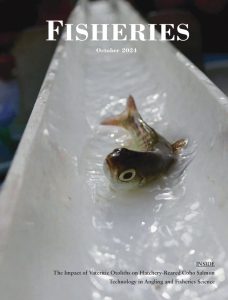
 Thank you for choosing to submit your paper to Fisheries magazine. The following guides will help you determine your type of submission. In 2025, AFS began publishing with Oxford University Press, and we have made changes to the style and adopted APA reference style. Please take the time to read and follow the Instructions to Authors and Reference Style Guide as closely as possible, as doing so will ensure your paper matches the magazine’s requirements.
Pre-submission consultations are welcomed and encouraged to evaluate content or determine how manuscripts can be structured to be consistent with Fisheries editorial goals. Please contact Steven Cooke (stevencooke@cunet.carleton.ca) for pre-submission inquiries.
This magazine uses ScholarOne Manuscripts to peer review manuscript submissions. Submit your manuscript online using our manuscript tracking website at http://mc.manuscriptcentral.com/fisheries. If you cannot submit your manuscript online, please e-mail the managing editor, Peter Turcik, for instructions: pturcik@fisheries.org.
Please note that Fisheries uses iThenticate software to screen papers for unoriginal material. By submitting your paper to Fisheries you are agreeing to any necessary originality checks your paper may have to undergo during the peer review and production processes.
Papers are accepted for publication on the condition that they are submitted solely to Fisheries and that they will not be reprinted or translated without the publisher’s permission. See “Dual Publication of Scientific Information”, Transactions of the American Fisheries Society 110:573-574 (1981). AFS requires an assignment of copyright from all authors, except for articles written on government time or for the government that cannot be copyrighted. Authors must obtain written permission to reprint any copyrighted material that has been published elsewhere, including tables and figures. Copies of the permission letter must be enclosed with the manuscript and credit given to the source.
MISSION STATEMENT
Fisheries is the monthly peer-reviewed membership publication of the American Fisheries Society (AFS). Its goal is to provide timely, useful, and accurate information on fisheries science, management, and the fisheries profession for AFS members. Some types of articles which are suitable for Fisheries include fishery case histories, review or synthesis articles covering a specific issue, policy articles, perspective or opinion pieces, essays, teaching case studies, and current events or news features. We strive to be a voice for AFS members who have ideas and stories to share that will advance fisheries science or AFS as a professional society.
Fisheries is the most widely read fisheries science publication in the world. Accordingly, content submitted for consideration should appeal broadly to fisheries professionals and speak to the interests of the AFS membership. Lengthy, highly technical, or narrowly focused research articles are better suited to the AFS technical publications, and we encourage authors to consider the other AFS journals as venues for these works. Most of the papers are synthetic or represent broadly-relevant case studies or analyses.
We particularly encourage the submission of short-form (under 5 typeset pages) “mini-review” articles. We will waive page charges for even shorter articles (under 2 typeset pages) on such articles as current events in fisheries science, interviews with fisheries scientists, history pieces, informative how-to articles, etc. We also encourage articles that will expose our members to new or different fields, and that recognize the varied interests of our readers. Research articles may be considered if the work has broad implications or applications and the subject matter can be readily understood by professionals of a variety of backgrounds.
PEER-REVIEWED ARTICLES
Fisheries manuscripts are typically less than 4,500 words (excluding references, photos, figures, tables, pull quotes, titles, translations, etc.); however, that limit is flexible. Longer papers are also considered provided they are of broad relevance to our community.
All peer-reviewed manuscripts will be reviewed by two or more outside and independent referees who are experts in the subject of the manuscript, and evaluated for publication by the Science Editors, Co-Chief Science Editors, and Editor-in-Chief. Papers are judged on scientific and professional merit, relevance, and interest to fisheries professionals. Authors may request anonymity during the review process and should structure their manuscripts accordingly.
Features
Feature are research articles reporting on original research on topics of broad interest that address contemporary issues and problems in all aspects of fisheries science, management, and policy. Articles on fisheries ecology and aquatic resource management; biology of fishes, including physiology, culture, genetics, disease, and others; economics and social issues; educational/administrative concepts, controversies, techniques, philosophies, and developments; and other general interest, fisheries-oriented subjects will be considered. Review articles, which are syntheses or summaries of information on a topic that is important to the field of fisheries also fall under this category. Features have a cover page, for which authors may submit an image, which should have a resolution of 300 dpi or higher. Please email images to the Managing Editor.
Features require page charges of $1,500. AFS members without institutional funding may apply for a page charge waiver.
Perspectives
Perspectives are similar manuscripts to Features but are more opinionated in nature. Perspectives offer new proposals for critical evaluations of contemporary concepts, paradigms, and ideas.
New for 2025, Perspectives require page charges of $1,500. AFS members without institutional funding may apply for a page charge waiver.
Essays—recommended maximum word count: 2,000
Essays are thought-provoking or opinion articles based upon sound science. Essays may cover a wide range of topics, including professional, conservation, research, AFS, political, management, and other issues. Essays may be submitted in conjunction with a feature article on the same topic. Essays can be up to 2,000 words, may include photographs or illustrations, and should not cite more than eight references. However, essays should provide scientific documentation, unlike unreviewed opinion pieces (below). Essays are peer-reviewed based on the following criteria: contribution to the ongoing debate, logical opinion based on good science, persuasiveness, and clarity of writing. Reviewer agreement with the opinion of the views expressed is not a criterion. Essays do not have page charges or abstracts.
Comment and Response to Comment—maximum word count: 400
Comments are critiques of peer reviewed papers published by this Magazine; the original authors will be invited to provide a Response to Comment. The Magazine welcomes Comments from readers offering relevant comments and providing objective and scholarly criticism of recently published articles in the Magazine. Contributions should be constructive, professional, and polite.
For a detailed outline of the process, please contact us to request the AFS Comment Procedures. Comments require page charges of $750.
Fisheries Education
Fisheries will consider publication of case studies and other articles specifically intended as teaching tools. These articles, including case studies or short topical summaries, should be formatted to be used for teaching aids for courses taught at the undergraduate level. Fisheries Education articles should be readily understood by undergraduate students with basic training in biological/ecological sciences, and include background information, discussion questions, teaching notes, and references. Peer review of teaching case studies and educational topics will be handled by a special committee of the AFS Education Section.
Authors are responsible for obtaining permission to use any copyrighted material contained in their journal article and supplementary materials. This requirement applies to any content that was not personally created by the author but instead is reproduced or adapted from other sources. Please see this helpful guide.
EDITORIAL BOARD-REVIEWED ARTICLES
These types of submissions are shorter than peer-reviewed articles and do not go through the full peer-review process, but are instead reviewed by the Editor-in-Chief, Co-Chief Science Editors, and/or Managing Editor.
Letters to Fisheries
Letters to Fisheries allow authors to bring up topics of interest to readers of Fisheries. The purpose is to provide readers a way to broach subjects and opinions that may be of interest to others and to promote discussion on fishery science, management, or the AFS, but do not meet the criteria of a full Essay or Perspective article.
Submission Criteria: Letters are limited to 400 words, not including references. Submissions must be succinct, appropriate, and signed by the submitter—anonymous submissions will not be accepted. Submissions should be on topics germane to fishery science, management, or AFS. The inclusion of references or links to information the end of the letter is encouraged as appropriate. Letters will be reviewed by the Fisheries Co-Chief Science Editors and Editor-in-Chief, in conjunction with appropriate AFS leadership or staff. Submissions should comply with the spirit of AFS standards of conduct as outlined in the AFS Standards of Professional Conduct and AFS Meetings Code of Conduct policies, available on the AFS website. Publication is at the discretion of the Editor-in-Chief or Co-Chief Science Editor. Note that submissions may be edited for clarity.
Submissions can sent to Managing Editor Peter Turcik at pturcik@fisheries.org.
Magazine Articles
These include but are not limited to: exceptional digital images of fish or aquatic habitats, current events, interviews, member profiles, AFS member milestones or memorials, and submissions to magazine.
Columns—recommended maximum word count: 800-1,600
- Fish Tails
- Cool Fish
- Landscapes
- Photo Diary
- Backpage
- Student Angle
- World Fisheries
- Guest Columns
- Community Advocacy Columns
Fish Tails are short, entertaining anecdotes from unusual circumstances or experiences in the fisheries profession. These columns should have a lesson that AFS members and other readers can learn from the story and apply in their own work and/or personal lives. These lessons should be clearly introduced early on and reiterated at the end. Columns may include a colorful illustration, image, or photo. Maximum word count: 900
The Cool Fish and Landscapes columns examine unusual or interesting fish or habitats.
The World Fisheries column acquaints readers with lesser-known fisheries, generally outside of North America.
The Photo Diary (8–10 photos) and Backpage (1 photo) columns tell fisheries stories through the use of exceptional photography. Please send to Managing Editor Peter Turcik at pturcik@fisheries.org
Student Angle. We welcome student perspectives through the Student Angle column. For information about submitting a column, please contact the Student and Early Career Subsection President at afsstudent@gmail.com.
Guest Columns. Authors are encouraged to submit most opinion pieces about fisheries science or management as essays for editorial review. Occasionally, editorials about professional or policy issues may be inherently unsuitable for a scientific review. Sometimes these pieces are submitted by a committee, agency, or organization. Editorials should be 750–1,500 words, may be edited for length or content, and referred for outside review or rebuttal if necessary. A disclaimer may accompany Fisheries Forum editorials stating that the opinion is that of the author and not the American Fisheries Society.
Community Advocacy Columns. For columns pertaining to building bridges to bring people together in to advance collective interest in sustainable fisheries, please contact Community Advocacy Editor, Kaylyn Zipp, at kaylyn.zipp@maine.edu.
Do NOT use the online manuscript tracking system to submit magazine items—the text and >300 dpi digital photos (TIF or JPG) for all items except the Calendar should be emailed to the Managing Editor at pturcik@fisheries.org.
In Memoriam
Friends, colleagues, and relatives can celebrate the lives of recently deceased AFS members with an In Memoriam. These shorter pieces can be up to 800 words, with one or two images of the person, usually a portrait and one of them doing something they loved or working in their field. Authors need to include the person’s date of birth and date of passing. In Memoriam manuscripts should be emailed to Managing Editor at pturcik@fisheries.org.
Unit News and Other Departments
AFS members are encouraged to submit items for the Unit News, Member Happenings, Obituaries, Letters to the Editor, and Calendar departments. Dated material (calls for papers, meeting announcements, and nominations for awards) should be submitted as early as possible, but at least 8 weeks before the requested month of publication. AFS Unit News and Letters should be kept under 400 words and may be edited for length or content.
Calendar
Calendar items should include the date, event title, location, and contact information (including a website, if there is one), and should be submitted online at https://fisheries.org/events-page/add-your-event/ or emailed to bbeard@fisheries.org.
Book Reviews
Please contact Book Review Editor Francis Juanes at 413-545-2758, juanes@uvic.ca, if you want to be added to the list of potential book reviewers.
New books (preferably two copies) submitted for review should be sent to:
Francis Juanes, Liber Ero Professor of Fisheries Department of Biology, University of Victoria, PO Box 3020, Station CSC, Victoria, BC, V8W 3N5. Canada. Tel: (250) 721-6227. E-mail: juanes@uvic.ca.
QUESTIONS?
Peter Turcik, Managing Editor
American Fisheries Society
425 Barlow Place
Bethesda, MD 20814-2199
301-897-8616, ext.201
pturcik@fisheries.org
(For fastest responses, please e-mail)
Detailed instructions for using the online manuscript tracking system are available at: http://mc.manuscriptcentral.com/fisheries
Also see the Fisheries “Guidelines for Reviewers” at fisheries.org.